- Plants
- ›Vascular Plants
- ›flowering plants
- ›Dicots
- ›Mints, Plantains, Olives, and Allies
- ›figwort family
- ›Buddlejeae
- ›Buddleja
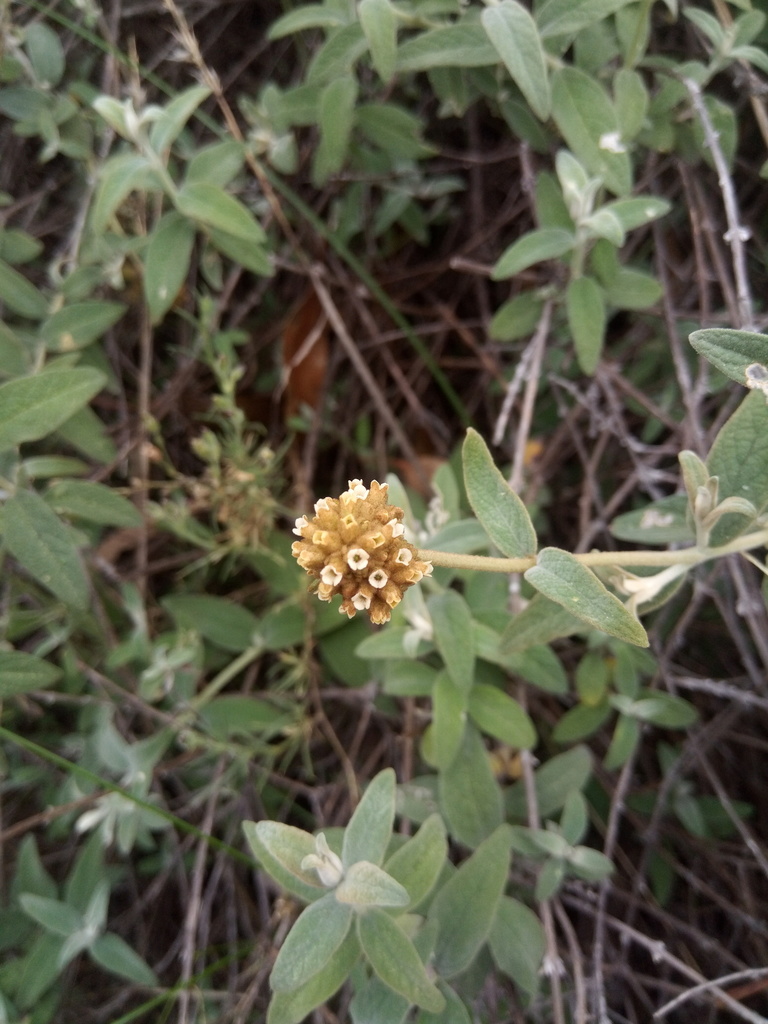
Buddleja aromatica
Buddleja aromatica is endemic to the Cordillera Oriental and Central of Bolivia, and northern Argentina, where it grows on rocky areas amid semi-arid scrub and thorn. The species was first described and named by Rémy in 1847.
From the article Buddleja aromatica on Wikipedia (CC BY-SA), quoted section by section
Description
Buddleja aromatica is a dioecious shrub, 0.5–2 m tall, with greyish fissured bark. The young branches are subquadrangular and tomentose, bearing sessile subcoriaceous oblong-lanceolate leaves, tomentose to glabrescent above and lanose below, 2–6 cm long by 0.5–1.8 cm wide. The white or creamy white inflorescence is variable, comprising one terminal head, or with up to four additional pairs of pedunculate heads below in the axils of small leaves, each head with 20–30 sessile flowers; the corollas are 3–4 mm long. The species is very similar to B. cordobensis and B. araucana, but differing in some vegetative and reproductive features. Ploidy: 2n = 38.
How it is grown
The shrub is not known to be in cultivation. A juvenile specimen at the Logan Botanic Garden, Scotland, perished circa 1995.
== References ==
Wikipedia: “Cultivation”
Where it lives
Recorded sightings
—
geo-referenced records in GBIF, from museums, herbaria and field observers.
Drag the globe to turn it. Dots are where records exist, not a range map; darker means more records.
In the stacks
Searching the stacks…
Every page naming Buddleja aromatica in the Biodiversity Heritage Library →
This page is assembled live from iNaturalist, GBIF, Wikipedia, the Source Library and the Internet Archive. It is not yet part of the hand-edited codex. iNaturalist taxon 446880.