- Plants
- ›Vascular Plants
- ›flowering plants
- ›Dicots
- ›Roses, Elms, Figs, and Allies
- ›elm family
- ›Ulmus
- ›Ulmus
- ›Ulmus
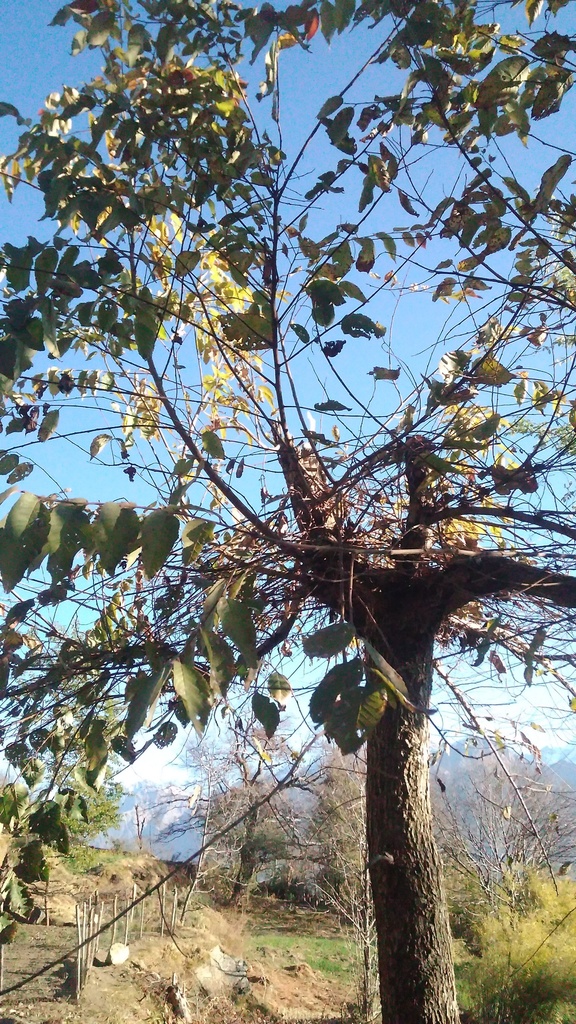
Himalayan elm
Ulmus wallichiana
Ulmus wallichiana Planch., the Himalayan elm, also known as the Kashmir elm and Bhutan elm, is a mountain tree ranging from central Nuristan in Afghanistan, through northern Pakistan and northern India to western Nepal at elevations of 800–3000 m. Its common name is occasionally used in error for the cherry bark elm Ulmus villosa, which is also endemic to the Kashmir, but inhabits the valleys, not the mountain slopes, and is dissimilar in appearance. The species is closely related to the wych elm U. glabra.
From the article Ulmus wallichiana on Wikipedia (CC BY-SA), quoted section by section
Description
The Himalayan elm grows to 30 m tall, with a broad crown featuring several ascending branches. The bark of the trunk is greyish brown and longitudinally furrowed. The leaves are elliptic-acuminate, < 13 cm long by 6 cm broad on petioles 5–10 mm long. The samarae are usually orbicular, < 13 mm in diameter, on 5mm pedicels.
At the table
Endemic to an impoverished region with no fossil fuel resources, U. wallichiana is heavily lopped for firewood, and also for fodder, leaving it in danger of extermination in some areas. Elsewhere however, it has been deliberately planted near villages and farmhouses. Recognizing its predicament, efforts have been made in India to conserve the tree by drying the seeds and placing them in refrigerated storage. A species of considerable commercial potential, research has also been undertaken into optimal propagation methods. The tree was first introduced to the West in the 1920s, with the arrival of a specimen at the Arnold Arboretum from Chamba, a hill station overlooking the north Indian plain. The tree soon proved eminently unsuited to the cold Boston winters and died, but not before a five-budded cutting could be sent to S. G. A. Doorenbos, Parks Director at The Hague, in 1929. Doorenbos was able to graft four of the buds, and the following year had a row of strongly growing plants. The trees were again badly damaged by frost, but in 1938 were used as a source of anti-fungal genes in the Dutch elm breeding programme and crossed with the English winter-hardy cultivar 'Exoniensis'. U. …
Wikipedia: “Cultivation and uses”
Where it lives
Recorded sightings
—
geo-referenced records in GBIF, from museums, herbaria and field observers.
Drag the globe to turn it. Dots are where records exist, not a range map; darker means more records.
In the stacks
Searching the stacks…
Every page naming Ulmus wallichiana in the Biodiversity Heritage Library →
This page is assembled live from iNaturalist, GBIF, Wikipedia, the Source Library and the Internet Archive. It is not yet part of the hand-edited codex. iNaturalist taxon 444538.