- Plants
- ›Vascular Plants
- ›flowering plants
- ›Dicots
- ›pinks, cactuses, and allies
- ›cacti
- ›globular cacti, moonlight cacti, torch cacti, and allies
- ›Trichocereeae
- ›Espostoa
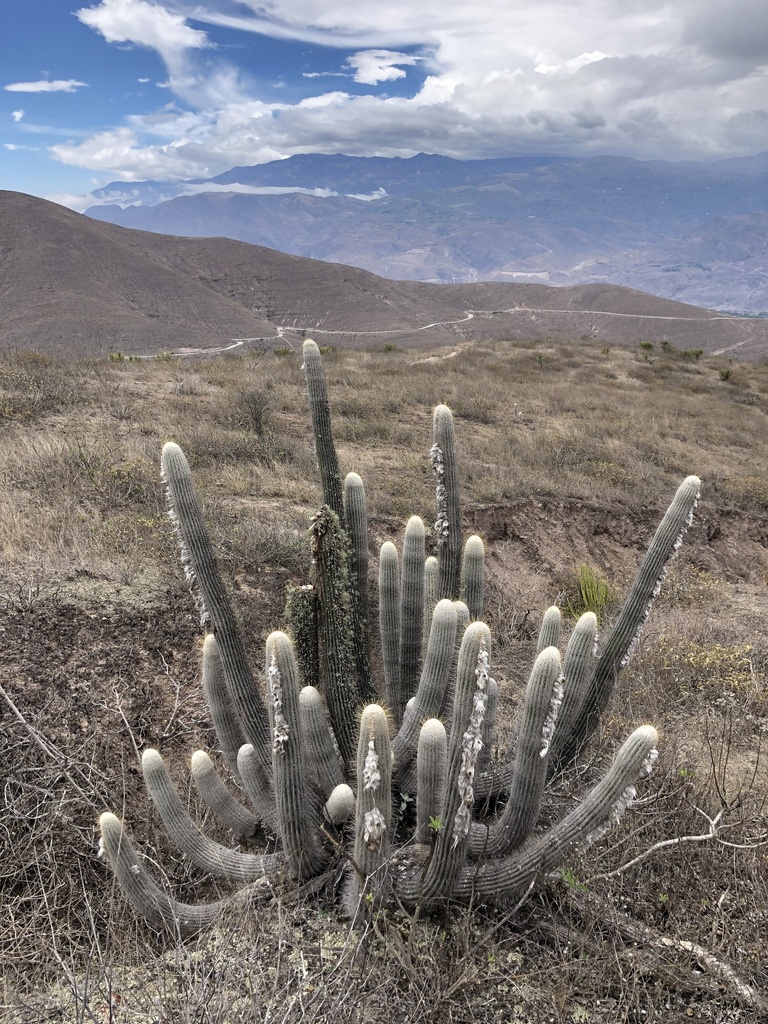
Espostoa frutescens
Espostoa frutescens is a species of flowering plant in the family Cactaceae.
From the article Espostoa frutescens on Wikipedia (CC BY-SA), quoted section by section
Description
Espostoa frutescens is a cactus that grows up to 2 meters tall, with branches emerging from its base. The upright shoots range from 0.5 to 2 meters in length and 6 to 10 centimeters in diameter. The plant has 22 to 28 low, rounded ribs with closely spaced, elliptical, light brown woolly areoles. It bears 40 or more light yellow, needle-like spines that are 4 to 8 millimeters long, sometimes with a single central spine 1 to 2.5 centimeters long. The cephalium, measuring 20 to 50 centimeters long, has five to seven ribs and is covered in light brown wool up to 3 centimeters long. The funnel-shaped, white flowers are 4 to 4.5 centimeters long and 3.5 to 4 centimeters in diameter. The circular green fruits measure 1.6 to 2 centimeters in length and 1.5 to 2.5 centimeters in diameter. The species relies on nectar bats (including Geoffroy's tailless bat) for pollination. To facilitate the bats' echolocation, the plant's flowers are surrounded with a sound-absorbent furry area resulting in stronger flower echoes.
Range & habitat
Espostoa frutescens is endemic to Ecuador and confined to Loja, El Oro and Azuay provinces. Its habitat is open areas in dry forests from 500 metres (1,600 ft) to 2,000 metres (6,600 ft) altitude.
Wikipedia: “Distribution and habitat”
Where it lives
Recorded sightings
—
geo-referenced records in GBIF, from museums, herbaria and field observers.
Drag the globe to turn it. Dots are where records exist, not a range map; darker means more records.
In the stacks
Searching the stacks…
Every page naming Espostoa frutescens in the Biodiversity Heritage Library →
This page is assembled live from iNaturalist, GBIF, Wikipedia, the Source Library and the Internet Archive. It is not yet part of the hand-edited codex. iNaturalist taxon 438733.