- Plants
- ›Vascular Plants
- ›flowering plants
- ›Dicots
- ›pinks, cactuses, and allies
- ›cacti
- ›globular cacti, moonlight cacti, torch cacti, and allies
- ›Notocacteae
- ›Eriosyce
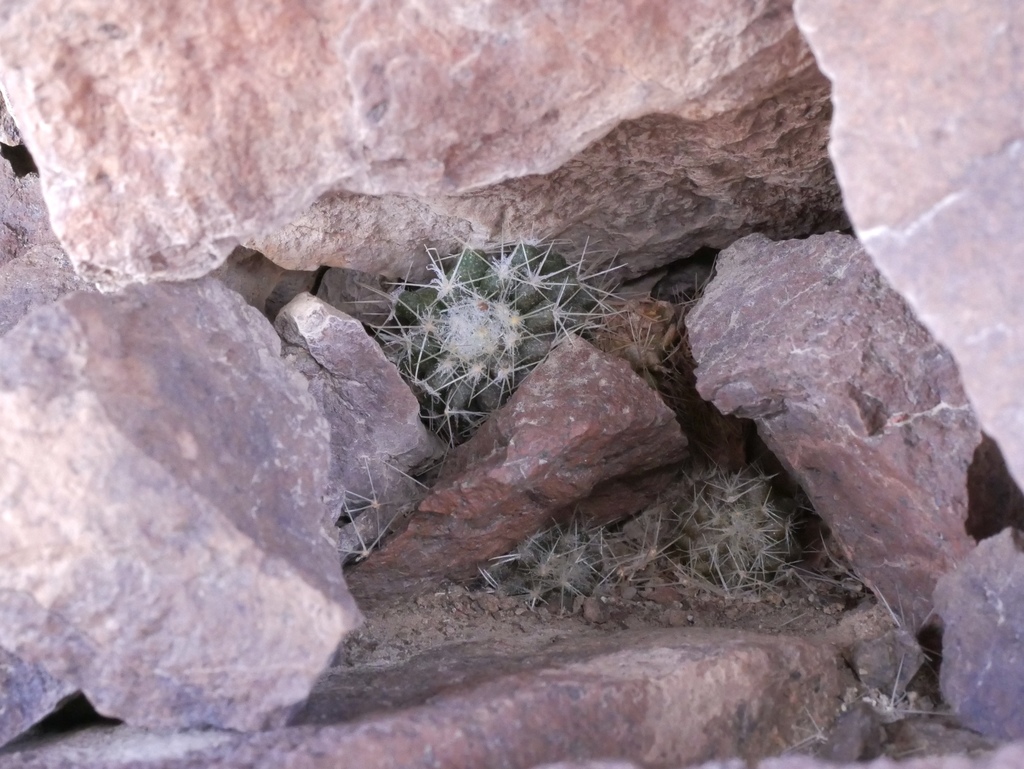
Eriosyce laui
Eriosyce laui is a species of cactus. It has been treated as a synonym of Islaya laui, and the species has also been placed in a separate genus, Rimacactus, as its sole species Rimacactus laui. The genus is recognized by other sources.
From the article Rimacactus on Wikipedia (CC BY-SA), quoted section by section
Description
Rimacactus laui is a cactus species characterized by its spherical to elongated shoots, measuring up to 3 cm in diameter. These shoots exhibit a whitish-green to reddish coloration and possess a carrot-shaped taproot. The plant's barely visible ribs are segmented into warty tubercles, each bearing a small leaf remnant. The radial spines, numbering nine to thirteen, are thin, needle-like, spreading, and translucent white. They are up to 9 mm long and brittle, with no distinction between central and radial spines. The flowers are narrowly funnel-shaped, approximately 2 cm long and 1.5 cm in diameter, and sulfur-yellow with a whitish-yellow base. They often appear in clusters of up to six. The pericarpel of the flower is smooth or nearly smooth. The fruits are red, elongated, balloon-shaped, and smooth, reaching up to 3.5 cm in length. They open via a basal pore.
Range & habitat
Rimacactus laui is native to the north of the Chilean Antofagasta region, specifically near Tocopilla, where it grows on dry slopes of the coastal mountain range with fog at elevations around 400 meters. Plants are found growing along Eriosyce iquiquensis and Eulychnia iquiquensis.
Wikipedia: “Distribution”
Where it lives
Recorded sightings
—
geo-referenced records in GBIF, from museums, herbaria and field observers.
Drag the globe to turn it. Dots are where records exist, not a range map; darker means more records.
In the stacks
Searching the stacks…
Every page naming Eriosyce laui in the Biodiversity Heritage Library →
This page is assembled live from iNaturalist, GBIF, Wikipedia, the Source Library and the Internet Archive. It is not yet part of the hand-edited codex. iNaturalist taxon 438696.