- Plants
- ›Vascular Plants
- ›flowering plants
- ›Dicots
- ›pinks, cactuses, and allies
- ›cacti
- ›globular cacti, moonlight cacti, torch cacti, and allies
- ›Pachycereae
- ›Echinocereus
- ›Triglochidiatus
- ›Scheeria
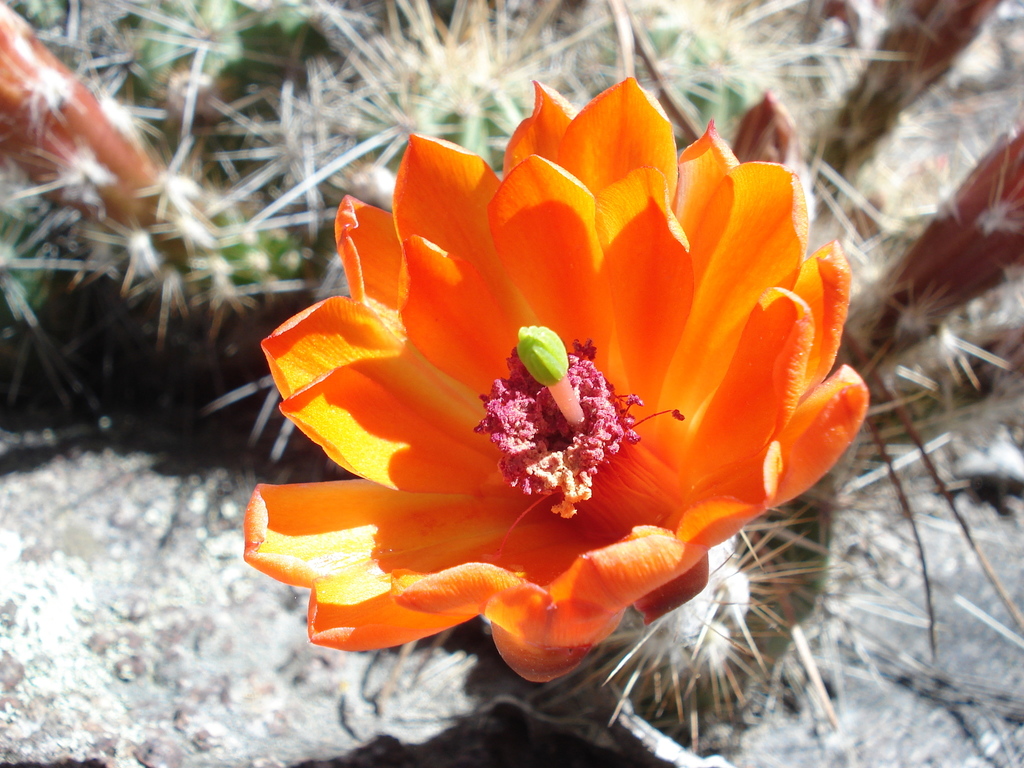
Echinocereus salm-dyckianus
Echinocereus salm-dyckianus is a species of plant found in Mexico.
From the article Echinocereus salm-dyckianus on Wikipedia (CC BY-SA), quoted section by section
Description
Echinocereus salm-dyckianus is a clumping columnar cactus with up to 97 shoots. The cylindrical stems are tapered towards their tip, 10 to 16.5 cm (3.9 to 6.5 in) long and have a diameter of 2.9 to 5.2 cm (1.1 to 2.0 in). There are seven to ten clearly blunt ribs, which are straight and slightly bumpy. There are 8 to 12 yellow to reddish brown radial spines. The two to four central spines, is terete longer and thicker than radial spines at 4 to 25 mm (0.16 to 0.98 in). The tubular-funnel-shaped flowers are pink to orange apricot with a magenta inside. They appear along the sides of the shoots from sharply pointed buds, are 8 to 10.3 cm (3.1 to 4.1 in) long and 4.4 to 6.5 cm (1.7 to 2.6 in) diameter with a hairy tube covered with white woolly hairs. This species is pollinated by hummingbirds and opens in the daytime and in the night. The fruit is round 20 to 24 mm (0.79 to 0.94 in) in length, greenish brown with white flesh and black seeds. Chromosome count is 4n=44.
Range & habitat
Echinocereus salm-dyckianus is found in Sierra Saguaribo in eastern Sonora and Sierra Charuco, Rio Haciendita, La Bateria, Nabogame, Sierra Obscura in western Chihuahua, Mexico, growing in Sierra Madre Occidental at elevation between 1699 and 2431 meters. Plants are found growing in canyons and rocky slopes in the shade growing along with Echinocereus rigidissimus subsp. rubispinus, Echinocereus stolonifer, Echinocereus stolonifer subsp. tayopensis, and Echinocereus polyacanthus.
Wikipedia: “Distribution”
Where it lives
Recorded sightings
—
geo-referenced records in GBIF, from museums, herbaria and field observers.
Drag the globe to turn it. Dots are where records exist, not a range map; darker means more records.
In the stacks
Searching the stacks…
Every page naming Echinocereus salm-dyckianus in the Biodiversity Heritage Library →
This page is assembled live from iNaturalist, GBIF, Wikipedia, the Source Library and the Internet Archive. It is not yet part of the hand-edited codex. iNaturalist taxon 438549.