- Plants
- ›Vascular Plants
- ›flowering plants
- ›Dicots
- ›pinks, cactuses, and allies
- ›cacti
- ›globular cacti, moonlight cacti, torch cacti, and allies
- ›Pachycereae
- ›Echinocereus
- ›Echinocereus
- ›Reichenbachia
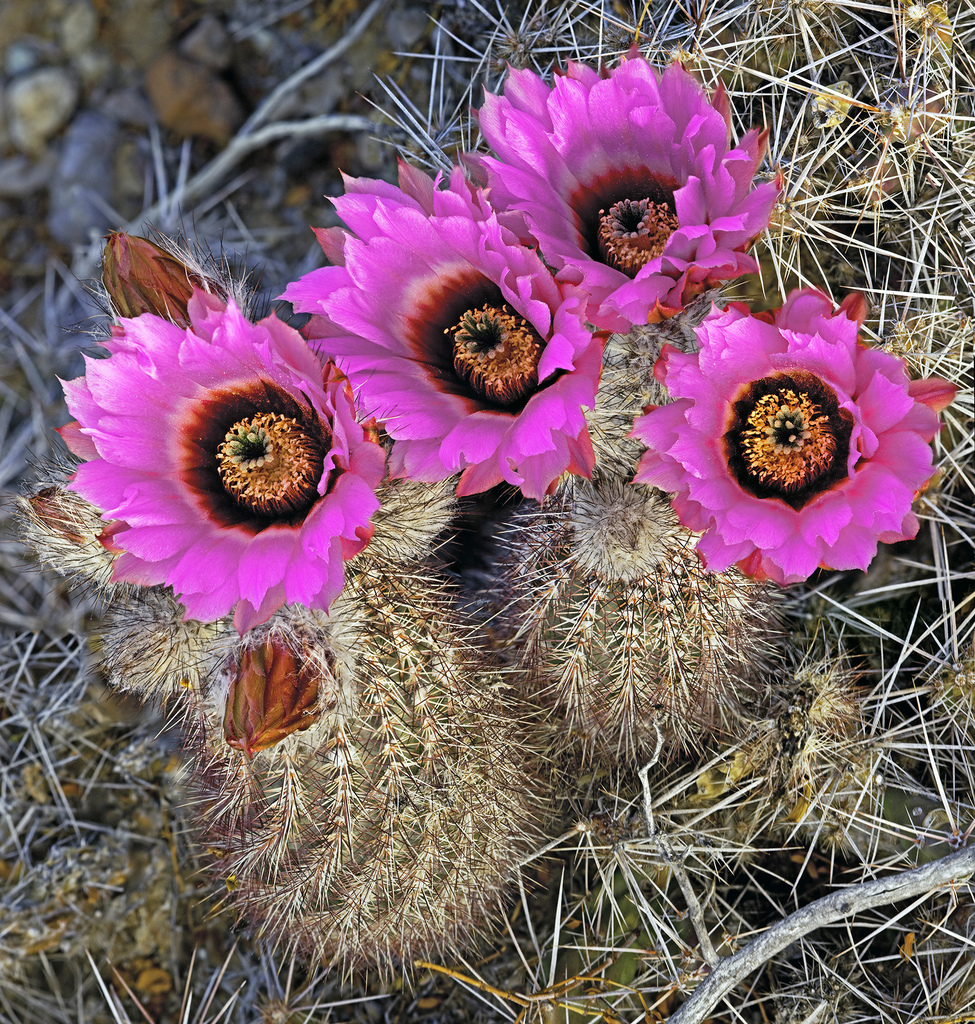
Chisos Mountain Hedgehog Cactus
Echinocereus chisosensis
Echinocereus chisoensis is a rare North American species of cactus known by the common name Chisos Mountain hedgehog cactus, native to the Chihuahuan Desert of northern Mexico and the south-central United States.
From the article Echinocereus chisoensis on Wikipedia (CC BY-SA), quoted section by section
Description
Echinocereus chisoensis is an inconspicuous plant, either solitary or forming small loose clumps. Stems are gray to blue-green cylindrical taper towards the tip, measuring 5 to 25 centimeters in length and 3 to 5 centimeters in diameter, sometimes erect but sometimes partially reclining on the ground. The spines do not conceal the shoots, and the roots are occasionally thickened. The plant has 10 to 16 ribs arranged in a somewhat spiral pattern, which are clearly tuberculated, with noticeably woolly areoles. The 1 to 6 slender, brownish central spines are up to 1.7 centimeters long, with the lowest being the longest. The 11 to 16 whitish to grayish radial spines are 1.2 to 2 centimeters long, with the top ones being very short and the bottom ones the longest. Flowers can be up to 6 to 9.5 centimeters long and 5 to 12 centimeters long, whitish along the throat, with red or purple spots near the base, and light pink-magenta near the tips. Anthers are yellow, fruit green. The club-shaped, reddish, woolly, and bristly fruits are up to 3.5 centimeters long and tear open when ripe.
Range & habitat
The plant is native to the Chihuahuan Desert of northern Mexico in the states of Coahuila, Chihuahua, and Durango and in Brewster County, Texas, United States below 1000 meters. Plants are found growing in desert grasslands or open xerophyllous shrublands in limestone flats and soil.
Wikipedia: “Distribution”
What it does
Because it is self-incompatible, flowers of one cactus require pollen from another individual of the species for fertilization; when plants are rare and spread apart, the likelihood that a pollinator will stop at the plant and deliver the correct pollen is lower. When fruits are successfully produced, they are often taken by jackrabbits and rodents for food. Dry conditions may increase this herbivory and decrease pollinator abundance.
Wikipedia: “Pollination”
Where it lives
Recorded sightings
—
geo-referenced records in GBIF, from museums, herbaria and field observers.
Drag the globe to turn it. Dots are where records exist, not a range map; darker means more records.
In the stacks
Searching the stacks…
Every page naming Echinocereus chisosensis in the Biodiversity Heritage Library →
This page is assembled live from iNaturalist, GBIF, Wikipedia, the Source Library and the Internet Archive. It is not yet part of the hand-edited codex. iNaturalist taxon 438545.