- Fungi Including Lichens
- ›Basidiomycete Fungi
- ›Higher Basidiomycetes
- ›Mushrooms, Bracket Fungi, Puffballs, and Allies
- ›Agaricomycetidae
- ›boletes and allies
- ›boletes
- ›Boletoideae
- ›Xerocomellus
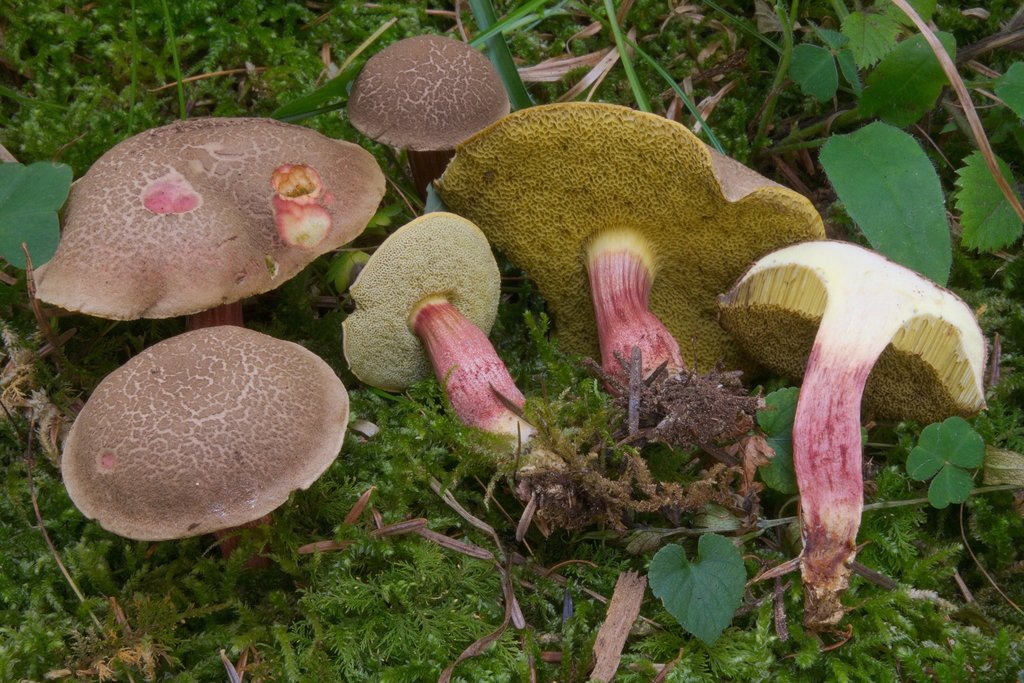
Red-cracking Bolete
Xerocomellus chrysenteron
Xerocomellus chrysenteron, formerly known as Boletus chrysenteron or Xerocomus chrysenteron and commonly known as the red cracking bolete, is a species of fungus in the family Boletaceae. The small mushroom has tubes and pores instead of gills beneath their caps. It is edible but not choice.
From the article Xerocomellus chrysenteron on Wikipedia (CC BY-SA), quoted section by section
Description
Young specimens often have a dark, dry surface, and tomentose caps. When fully expanded, the brownish cap ranges from 4 to 10 cm (1+1⁄2 to 4 in) in diameter with very little substance and thin flesh that turns a blue color when slightly cut or bruised. The caps mature to convex and plane in old age. Cracks in the mature cap reveal a thin layer of light red flesh below the skin. The 1 to 2 cm-diameter stems have no ring, are mostly bright yellow and the lower part is covered in coral-red fibrils and has a constant elliptical to fusiform diameter throughout its length of 4 to 13 cm. The cream-colored stem flesh turns blue when cut. The species has large, yellow, angular pores, and produces an olive brown spore print.
Similar species. Xerocomellus chrysenteron cannot be identified with certainty without the aid of a microscope, as many intermediate forms occur between it and other taxa, in particular, some forms of Xerocomellus pruinatus and Hortiboletus rubellus. X. porosporus is also similar to this species, but it is easily separated on account of the whitish under layer and truncate (chopped off) spores. This species is also easily confused with X. cisalpinus, Hortiboletus engelii, X. dryophilus, Aureoboletus mirabilis, and X. zelleri. The caps are similar to Imleria badia, the bay bolete.
Range & habitat
Xerocomellus chrysenteron grows singly or in small groups in hardwood/conifer woods from early summer to mid-winter. It is mycorrhizal with hardwood trees, often beech on well-drained soils. It is frequent in parts of the northern temperate zones. The species has been recorded in Taiwan. It has been introduced to New Zealand, where it grows in groups under introduced deciduous trees. This species may not be as common as once thought, having been often mistaken for the recently recognised X. cisalpinus.
Wikipedia: “Distribution and habitat”
What it does
The fruit bodies of X. chrysenteron are prone to infestation by the bolete eater (Hypomyces chrysospermus).
Wikipedia: “Ecology”
At the table
Xerocomellus chrysenteron is considered edible but not desirable due to bland flavor and soft texture. The pores are recommended to be removed immediately after mushrooms are picked as they rapidly decay. Young fungi are palatable and suitable for drying, but they become slimy when cooked; mature specimens are rather tasteless and decay quickly.
Wikipedia: “Edibility”
Where it lives
Recorded sightings
—
geo-referenced records in GBIF, from museums, herbaria and field observers.
Drag the globe to turn it. Dots are where records exist, not a range map; darker means more records.
In the old herbals & bestiaries

In the stacks
Searching the stacks…
Every page naming Xerocomellus chrysenteron in the Biodiversity Heritage Library →
This page is assembled live from iNaturalist, GBIF, Wikipedia, the Source Library and the Internet Archive. It is not yet part of the hand-edited codex. iNaturalist taxon 438013.