- Animals
- ›Chordates
- ›Vertebrates
- ›Mammals
- ›Therians
- ›Placental Mammals
- ›Primates, Rodents, and Allies
- ›Rodents
- ›Beavers, Pocket Gophers, and Allies
- ›Beavers
- ›Castor
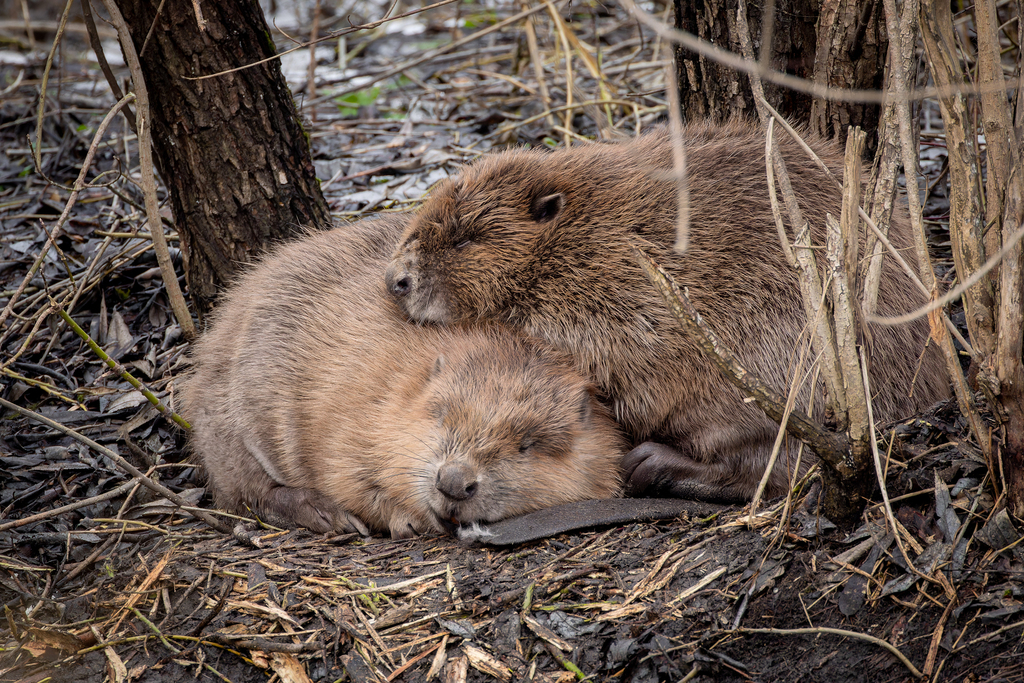
Eurasian Beaver
Castor fiber
The Eurasian beaver (Castor fiber) or European beaver is a species of beaver widespread across Eurasia, with a rapidly increasing population of 1.5 million in 2020. The Eurasian beaver was hunted to near-extinction for both its fur and castoreum, with only about 1,200 beavers in eight relict populations from France to Mongolia in the early 20th century. It has since been reintroduced into much of its former range and now lives from Western, Southern, Central and Eastern Europe, Scandinavia, Russia through China and Mongolia, with about half the population in Russia. It is listed as least concern on the IUCN Red List.
From the article Eurasian beaver on Wikipedia (CC BY-SA), quoted section by section
Description
The Eurasian beaver's fur colour varies between regions. Light, chestnut-rust is the dominant colour in Belarus. In Russia's Sozh River basin, it is predominantly blackish brown, while in the Voronezh Nature Reserve beavers are both brown and blackish-brown. The Eurasian beaver is one of the largest living rodent species and the largest rodent native to Eurasia. Its head-to-body length is 80–100 cm (31–39 in) with a 25–50 cm (9.8–19.7 in) long tail length. It weighs around 11–30 kg (24–66 lb). By the average weights known, it appears to be the world's second heaviest rodent after the capybara, and is slightly larger and heavier than the North American beaver. One exceptionally large recorded specimen weighed 31.7 kg (70 lb), but it is reportedly possible for the species to exceptionally exceed 40 kg (88 lb).
Differences from North American beaver. Although the Eurasian beaver appears superficially similar to the North American beaver, there are several important differences, chief among these being that the North American beaver has 40 chromosomes, while the Eurasian beaver has 48. The two species are not genetically compatible: the result of over 27 attempts in Russia to hybridise the two species was just one stillborn kit, bred from the pairing of a male North American beaver and a female Eurasian beaver. …
Range & habitat
The Eurasian beaver is recovering from near extinction, after depredation by humans for its fur and for castoreum, a secretion of its scent gland believed to have medicinal properties. The estimated population was only 1,200 by the early 20th century. In many European countries, the Eurasian beaver became extirpated, but reintroduction and protection programmes led to gradual recovery so that by 2020, the population was at least 1.5 million. It likely survived east of the Ural Mountains from a 19th-century population as low as 300 animals. Factors contributing to their survival include their ability to maintain sufficient genetic diversity to recover from a population as low as three individuals, and that beavers are monogamous and select mates that are genetically different from themselves. About 83% of Eurasian beavers live in the former Soviet Union due to reintroductions.
Continental Europe. The Eurasian beaver lives in almost all countries in continental Europe, from Spain and France in the west, to Russia and Moldova in the east, and Montenegro, Serbia and Bulgaria in the southeast. In 2022 and again in 2025 beaver signs were found and documented in Portugal, in regions near the border with Spain. The only significant areas where it has no known population are the southern Balkans: Albania, Kosovo, Northern Macedonia, Greece and European Turkey. …
Wikipedia: “Distribution and habitat”
What it does
The Eurasian beaver is a keystone species, as it helps to support the ecosystem which it inhabits. It creates wetlands, which provide habitat for European water vole, Eurasian otter and Eurasian water shrew. By coppicing waterside trees and shrubs it facilitates their regrowth as dense shrubs, thus providing cover for birds and other animals. Beavers build dams that trap sediment, improve water quality, recharge groundwater tables and increase cover and forage for trout and salmon. Also, abundance and diversity of vespertilionid bats increase, apparently because of gaps created in forests, making it easier for bats to navigate.
Reproduction. Eurasian beavers have one litter per year, coming into oestrus for only 12 to 24 hours, between late December and May, but peaking in January. Unlike most other rodents, beaver pairs are monogamous, staying together for multiple breeding seasons. Gestation averages 107 days and they average three kits per litter with a range of two to six kits. Most beavers do not reproduce until they are three years of age, but about 20% of two-year-old females reproduce.
Diet. European beavers are herbivorous, eating "water and river bank plants", including tubers, shoots, twigs, leaves, buds, "rootstocks of myrtles, cattails, water lilies", and also trees (such as willow, aspen, and birch), including softwood tree bark. …
Wikipedia: “Behaviour and ecology”
Listen
Looking for field recordings…
Where it lives
Recorded sightings
—
geo-referenced records in GBIF, from museums, herbaria and field observers.
Drag the globe to turn it. Dots are where records exist, not a range map; darker means more records.
In the old herbals & bestiaries


In the stacks
Searching the stacks…
Every page naming Castor fiber in the Biodiversity Heritage Library →
This page is assembled live from iNaturalist, GBIF, Wikipedia, the Source Library and the Internet Archive. It is not yet part of the hand-edited codex. iNaturalist taxon 43793.