- Animals
- ›Chordates
- ›Vertebrates
- ›Mammals
- ›Therians
- ›Placental Mammals
- ›Primates, Rodents, and Allies
- ›Rodents
- ›Beavers, Pocket Gophers, and Allies
- ›Beavers

Beavers
Castor
Beavers (genus Castor) are large semiaquatic rodents of the Northern Hemisphere. There are two extant species: the North American beaver (Castor canadensis) and the Eurasian beaver (C. fiber). Beavers are the second-largest living rodents, after capybaras, weighing up to 50 kg (110 lb). They have stout bodies with large heads, long chisel-like incisors, brown or gray fur, hand-like front feet, webbed back feet, and tails that are flat and scaly. The two species differ in skull and tail shape and fur color. Beavers can be found in a number of freshwater habitats, such as rivers, streams, lakes and ponds. They are herbivorous, consuming tree bark, aquatic plants, grasses and sedges.
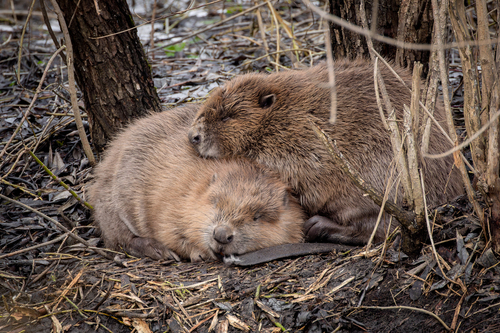
Beavers build dams and lodges using tree branches, vegetation, rocks and mud; they chew down trees for building material. Dams restrict water flow, forming ponds. Lodges, which are usually built in ponds, serve as shelters. Their infrastructure creates wetlands used by many other species, and because of their effect on other organisms in the ecosystem, beavers are considered a keystone species. Adult males and females live in monogamous pairs with their offspring. After their first year, the young help their parents repair dams and lodges; older siblings may also help raise newly born offspring. Beavers hold territories and mark them using scent mounds made of mud, debris, and castoreum—a liquid substance excreted through the beaver's urethra-based castor sacs. Beavers can also recognize their kin by their anal gland secretions and are more likely to tolerate them as neighbors.
2 branches of this genus, most-observed first · about 2 known species
See this branch on the Wheel of Life →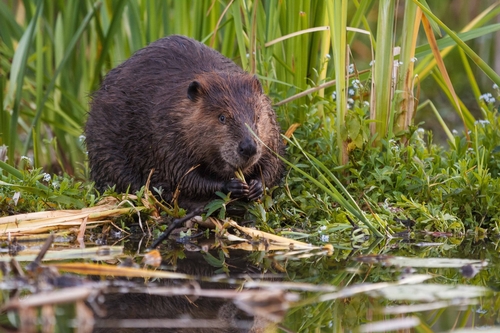
Where it lives
Recorded sightings
—
geo-referenced records in GBIF, from museums, herbaria and field observers.
Drag the globe to turn it. Dots are where records exist, not a range map; darker means more records.
In the old herbals & bestiaries

Books on Marine Fishes
Guillaume Rondelet · 1554 · p.877

The Ambonese Herbal, Vol. 3
Georg Eberhard Rumphius · 1743 · p.139

Metamorphosis Insectorum Surinamensium
Maria Sibylla Merian · 1705 · p.99

Ortus sanitatis
1491 · p.532

Introductory Book
Michael Scot · 1350 · p.113

Garden of Health (Hortus Sanitatis)
Jacob Meydenbach · 1491 · p.489

Garden of Health
1507 · p.431

History of Animals, Book II: On Oviparous Quadrupeds
Conrad Gessner · 1586 · p.721

Maria Sibylla Merian — Dissertatio de generatione et metamorphosibus insectorum Surinamensium (1719)
Maria Sibylla Merian · 1719 · p.107

The Great Herbary with all the figures of the herbs
1532 · p.118

The Great Herbary with all the figures of the herbs
1532 · p.249

Notable Commentaries on the History of Plants
Leonhart Fuchs · 1542 · p.374
In the stacks
Searching the stacks…
Every page naming Castor in the Biodiversity Heritage Library →
This page is assembled live from iNaturalist, GBIF, Wikipedia, the Source Library and the Internet Archive. It is not yet part of the hand-edited codex. iNaturalist taxon 43792.