- Plants
- ›Vascular Plants
- ›flowering plants
- ›Dicots
- ›Roses, Elms, Figs, and Allies
- ›elm family
- ›Ulmus
- ›Ulmus
- ›Ulmus
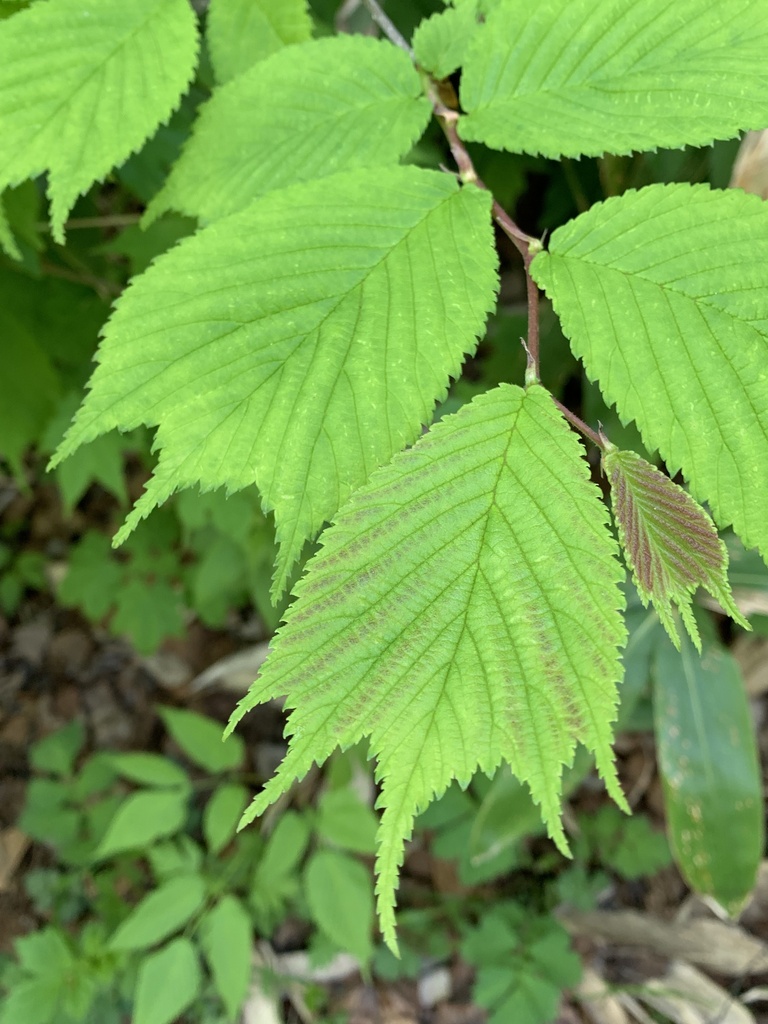
Ulmus laciniata
Ulmus laciniata (Trautv.) Mayr, known variously as the Manchurian, cut-leaf, or lobed elm, is a deciduous tree native to the humid ravine forests of Japan, Korea, northern China, eastern Siberia and Sakhalin, growing alongside Cercidiphyllum japonicum, Aesculus turbinata, and Pterocarya rhoifolia, at elevations of 700–2200 m, though sometimes lower in more northern latitudes, notably in Hokkaido.
From the article Ulmus laciniata on Wikipedia (CC BY-SA), quoted section by section
Description
Ulmus laciniata is chiefly distinguished by its leaves, often regularly incised to form between three and seven apical lobes, giving rise to its common name, the cut-leaf elm. The cusped leaves are normally a feature of adult trees, which can also bear leaves without this feature. The tree can reach a height of 27 m, although the trunk rarely exceeds 0.5 m d.b.h. The bark of young trees is dark, grey-brown, exfoliating in flakes, but becomes shallowly fissured with maturity. The unwinged branchlets bear laciniate leaves usually obtriangular, < 18 cm in length. The perfect wind-pollinated apetalous flowers are produced on second-year shoots in April (March in England), followed in May by elliptic < 20 × 14 mm samarae lightly-notched at the apex. Growth is moderate; the trunk of one specimen planted on permanently damp, fertile soil in south Hampshire, UK, increased in diameter at breast height (d.b.h.) by a modest average of 1.7 cm per annum.
At the table
The Ainu people traditionally use the bark of the tree for producing Ainu bark cloth. The species was introduced to the West in 1905, but remains uncommon in cultivation. A specimen, obtained from the Leon Chenault nursery in Orléans, stood in the Ryston Hall arboretum, Norfolk, in the early 20th century. The tree was comprehensively evaluated in the Netherlands in the 1950s as a potential source of anti-fungal genes for use in the Dutch elm hybridization programme, but was found intolerant of all but the most sheltered and humid conditions. Trees planted in England at the Sir Harold Hillier Gardens (sole accession died 2007) and as part of Butterfly Conservation's elm trials at Great Fontley have confirmed the Dutch assessment. Trees grown from seed commence flowering in their eighth year. The Dutch elm breeding programme revealed that the tree has a relatively high degree (39% seed viability) of self-fertility. The species is very difficult to propagate from hardwood cuttings, even under mist, often rooting but failing to leaf. However, the tree was propagated and marketed in the UK by the Hillier & Sons nursery, Winchester, Hampshire, from 1948, but sales were very low, with only three sold from 1962 to 1977. There are no known cultivars of U. laciniata, nor is it known to be in commerce.
Wikipedia: “Cultivation and uses”
Where it lives
Recorded sightings
—
geo-referenced records in GBIF, from museums, herbaria and field observers.
Drag the globe to turn it. Dots are where records exist, not a range map; darker means more records.
In the stacks
Searching the stacks…
Every page naming Ulmus laciniata in the Biodiversity Heritage Library →
This page is assembled live from iNaturalist, GBIF, Wikipedia, the Source Library and the Internet Archive. It is not yet part of the hand-edited codex. iNaturalist taxon 437559.