- Plants
- ›Vascular Plants
- ›flowering plants
- ›monocots
- ›Agaves, Orchids, Irises, and Allies
- ›Aloe family
- ›Aloes and allies
- ›Aloe
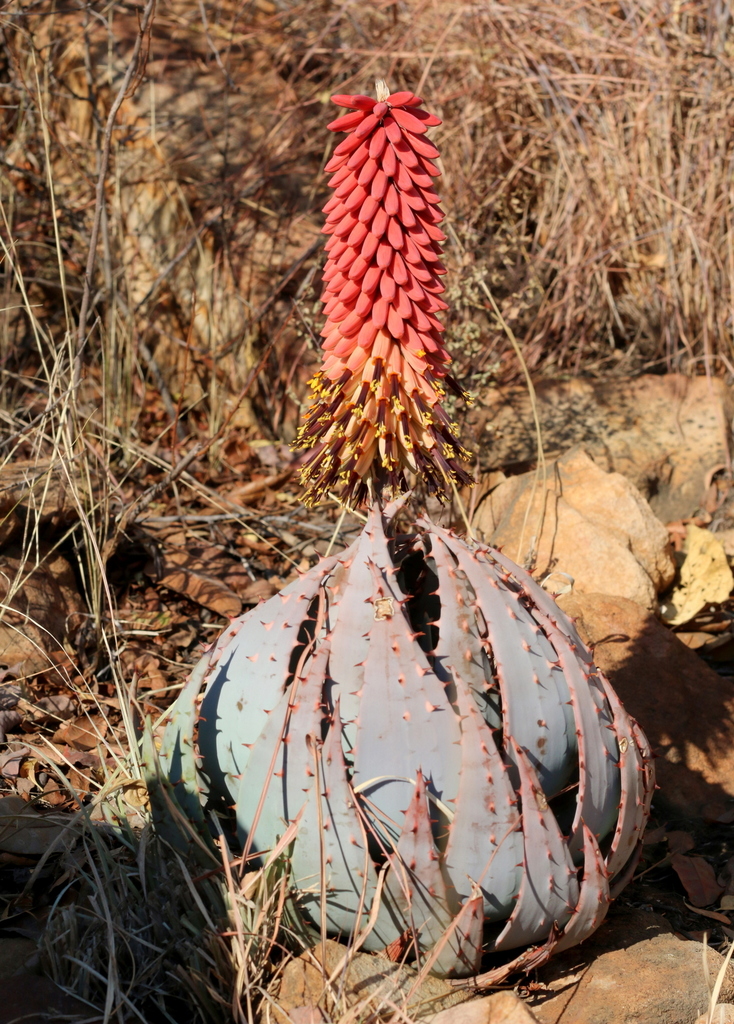
Turks Aloe
Aloe peglerae
Aloe peglerae (the Magaliesberg aloe or fez aloe) is a small, stemless South African aloe. This unique succulent plant is classed as an endangered species. The species was listed by CITES as an Appendix II species, requiring special trade protections to prevent the further endangerment of the current wild population due to the plant trade.
From the article Aloe peglerae on Wikipedia (CC BY-SA), quoted section by section
Description
The fez aloe is typically 30–40 cm (12–16 in) in diameter, and 30–40 cm in height. The glaucous leaves are strongly incurved to form a compact, spherical rosette. The inflorescence can be observed in July and August, and usually consists of a single cylindrical spike 30–40 cm tall, occasionally forked. The visible portions of filaments are deep purple in colour.
Range & habitat
This species is endemic to South Africa, where it only occurs in Gauteng and the North West Province. In this limited range, it is naturally found only along the northern dip slopes of the Magaliesberg and the Witwatersberg, the range just south and parallel to it.
Wikipedia: “Distribution”
Where it lives
Recorded sightings
—
geo-referenced records in GBIF, from museums, herbaria and field observers.
Drag the globe to turn it. Dots are where records exist, not a range map; darker means more records.
In the stacks
Searching the stacks…
Every page naming Aloe peglerae in the Biodiversity Heritage Library →
This page is assembled live from iNaturalist, GBIF, Wikipedia, the Source Library and the Internet Archive. It is not yet part of the hand-edited codex. iNaturalist taxon 435547.