- Animals
- ›Chordates
- ›Vertebrates
- ›Mammals
- ›Therians
- ›Placental Mammals
- ›Primates, Rodents, and Allies
- ›Primates
- ›Monkeys, Apes, and Tarsiers
- ›Monkeys and Apes
- ›Apes and Old World Monkeys
- ›Old World Monkeys
- ›Cercopithecines
- ›Baboons, Macaques, and Mangabeys
- ›Macaca
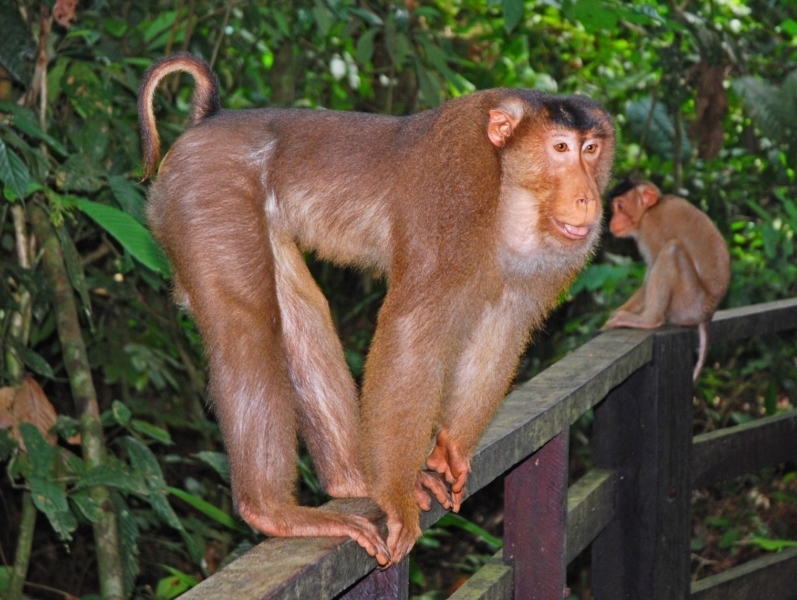
Southern Pig-tailed Macaque
Macaca nemestrina
The southern pig-tailed macaque (Macaca nemestrina), also known as the Sundaland pig-tailed macaque and the Sunda pig-tailed macaque, is a medium-sized macaque that lives in Sundaland, southern Thailand, Malaysia, and Indonesia. It is known locally as beruk.
From the article Southern pig-tailed macaque on Wikipedia (CC BY-SA), quoted section by section
Description
As with other Macaca species, males are larger than females; while males are measured at 50–58 cm (20–23 in) in length and 5–12 kg (11–26 lb) in weight, females are measured at 38–48 cm (15–19 in) in length and 4.5–6 kg (9.9–13.2 lb) in weight. This macaque has buff-brown fur, with a darker dorsal area and lighter ventral area. Its common name refers to the short tail held semi-erect, resembling the tail of a pig.
Range & habitat
This macaque is mostly found in rainforest up to 2,000 metres (6,600 ft), but will also enter plantations and gardens. It is found in the southern half of the Malay Peninsula (only just extending into southernmost Thailand), Borneo, Sumatra and Bangka Island. There are reports of the species having been present in Singapore before 1950, but these were likely escaped pets. The only pig-tailed macaques in Singapore today are introduced monkeys.
Wikipedia: “Habitat and distribution”
What it does
M. nemestrina is mainly terrestrial, but also a skilled climber. Unlike almost all primates, these macaques love water. They live in large groups that split into smaller groups during daytime when they are foraging. They are omnivorous, feeding mainly on fruits, seeds, berries, cereals, fungi, and invertebrates. A study in peninsular Malaysia found them to be the primary, and perhaps the only, seed dispersers of the rattan species Calamus calicarpus (syn. Daemonorops calicarpa) and Calamus castaneus. There is a hierarchy among males, based on strength, and among females, based on heredity. Thus, the daughter of the alpha female will immediately be placed above all other females in the group. The alpha female leads the group, while the male role is more to manage conflict within the group and to defend it. Female gestation lasts around 5.7 months. She will give birth to one infant every two years. Weaning occurs at 4–5 months. Sexual maturity is reached at 3–5 years. In Thailand, they have been trained for 400 years to harvest coconuts.
Wikipedia: “Behaviour and ecology”
In human culture
The species epithet, nemestrina, is an adjective (derived from Latin Nemestrinus, meaning "the god of groves") modified to agree in gender with the feminine generic name. M. nemestrina formerly included the northern pig-tailed, Pagai Island, and Siberut macaques as subspecies. All four are now considered separate species.
In the 19th century, bruh was the native name used by Malays in Sumatra for the macaque.
Wikipedia: “Etymology and taxonomy”
Listen
Looking for field recordings…
Where it lives
Recorded sightings
—
geo-referenced records in GBIF, from museums, herbaria and field observers.
Drag the globe to turn it. Dots are where records exist, not a range map; darker means more records.
In the old herbals & bestiaries

In the stacks
Searching the stacks…
Every page naming Macaca nemestrina in the Biodiversity Heritage Library →
This page is assembled live from iNaturalist, GBIF, Wikipedia, the Source Library and the Internet Archive. It is not yet part of the hand-edited codex. iNaturalist taxon 43455.