- Animals
- ›Chordates
- ›Vertebrates
- ›Mammals
- ›Therians
- ›Placental Mammals
- ›Primates, Rodents, and Allies
- ›Primates
- ›Monkeys, Apes, and Tarsiers
- ›Monkeys and Apes
- ›New World Monkeys
- ›Spider, Howler, and Woolly Monkeys
- ›Howler Monkeys
- ›Alouatta
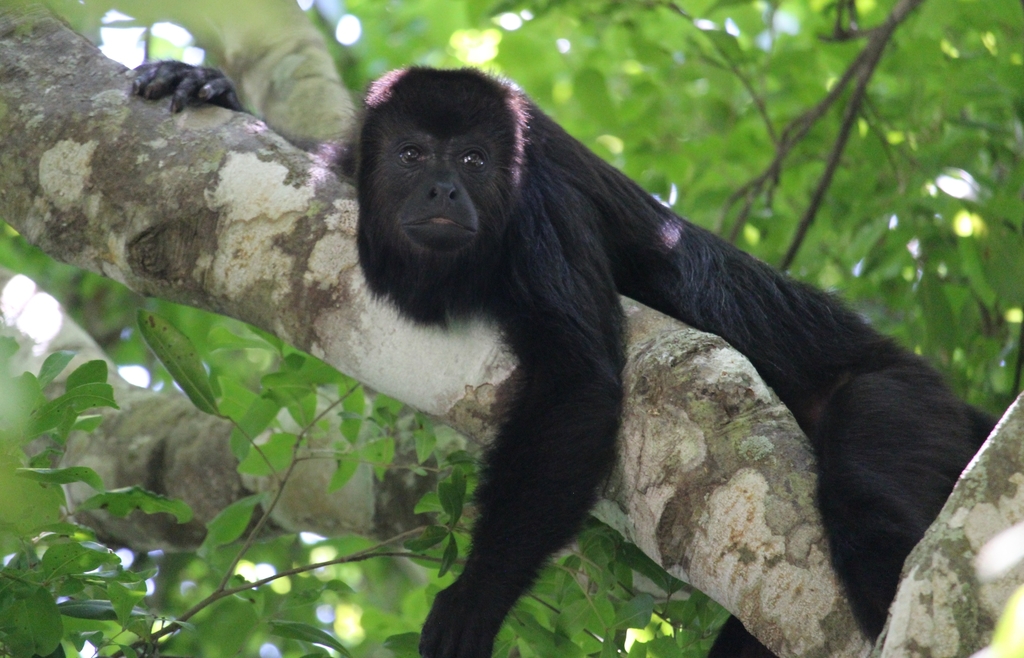
Yucatán Black Howler Monkey
Alouatta pigra
The Yucatán black howler, or Guatemalan black howler, (Alouatta pigra) is a species of howler monkey, a type of New World monkey, from Central America. It is found in Belize, Guatemala and Mexico, in and near the Yucatán Peninsula. It lives in evergreen, semideciduous and lowland rain forests. It is also known as the baboon in Belize, although it is not closely related to the baboons in Africa.
From the article Yucatán black howler on Wikipedia (CC BY-SA), quoted section by section
Description
The Yucatán black howler is the largest of the howler monkey species and one of the largest of the New World monkeys. Yucatán black howler males are larger than those of any other Central American monkey species. On average, males weigh 11.4 kg (25 lb) and females weigh 6.4 kg (14 lb). The body is between 521 and 639 mm (20.5 and 25.2 in) in length, excluding the tail. The tail is between 590 and 690 mm (23 and 27 in) long. Adults of both sexes have long, black hair and a prehensile tail, while infants have brown fur. Males over four months old have white scrotums. The Yucatán black howler shares several adaptations with other species of howler monkey that allow it to pursue a folivorous diet (mostly leaves). Its molars have high shearing crests, to help it eat the leaves. The male of the species has an enlarged hyoid bone near the vocal cords. This hyoid bone amplifies the male howler's calls, allowing it to locate other males without expending much energy, which is important, since leaves are a low-energy food. Howling occurs primarily at dawn and at dusk. The Yucatán black howler is diurnal and arboreal. It lives in groups of generally one or two adult males, with a ratio of about 1.3 females for every male. Groups generally have between two and 10 members, including juveniles, but groups as large as 16 members have been studied. …
Listen
Looking for field recordings…
Where it lives
Recorded sightings
—
geo-referenced records in GBIF, from museums, herbaria and field observers.
Drag the globe to turn it. Dots are where records exist, not a range map; darker means more records.
In the stacks
Searching the stacks…
Every page naming Alouatta pigra in the Biodiversity Heritage Library →
This page is assembled live from iNaturalist, GBIF, Wikipedia, the Source Library and the Internet Archive. It is not yet part of the hand-edited codex. iNaturalist taxon 43439.