- Animals
- ›Chordates
- ›Vertebrates
- ›Mammals
- ›Therians
- ›Placental Mammals
- ›Primates, Rodents, and Allies
- ›Primates
- ›Monkeys, Apes, and Tarsiers
- ›Monkeys and Apes
- ›New World Monkeys
- ›Marmosets and Tamarins
- ›Saguinus
- ›Oedipomidas
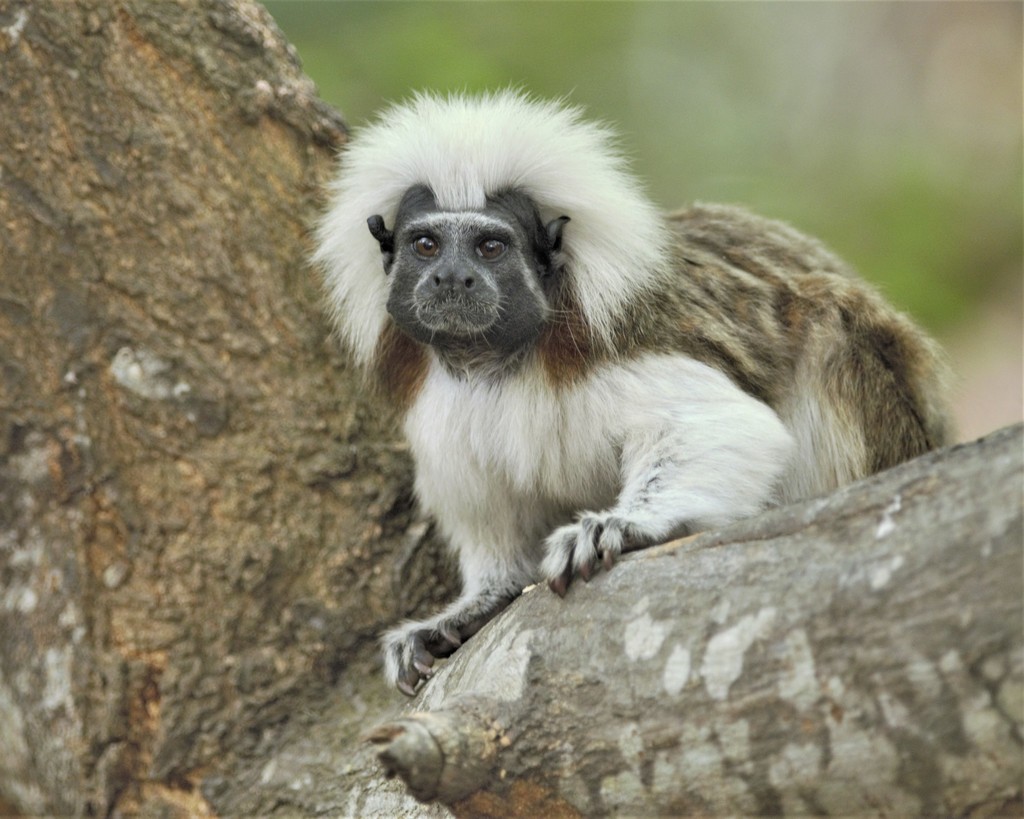
Cotton-headed Tamarin
Saguinus oedipus
The cotton-top tamarin (Saguinus oedipus) is a small New World monkey weighing less than 0.5 kg (1.1 lb). One of the smallest primates, the cotton-top tamarin is easily recognized by the long, white sagittal crest extending from its forehead to its shoulders. The species is found in tropical forest edges and secondary forests in northwestern Colombia, where it is arboreal and diurnal. Its diet includes insects and plant exudates, and it is an important seed disperser in the tropical ecosystem.
The cotton-top tamarin displays a wide variety of social behaviors. In particular, groups form a clear dominance hierarchy where only dominant pairs breed. The female normally gives birth to twins and uses pheromones to prevent other females in the group from breeding. These tamarins have been extensively studied for their high level of cooperative care, as well as altruistic and spiteful behaviors. Communication between cotton-top tamarins is sophisticated and shows evidence of simple grammatical structure.
From the article Cotton-top tamarin on Wikipedia (CC BY-SA), quoted section by section
Range & habitat
The cotton-top tamarin is restricted to a small area of northwest Colombia, between the Cauca and Magdalena Rivers to the south and east, the Atlantic coast to the north, and the Atrato River to the west. They are found exclusively in Colombia; 98% of their habitat has been destroyed. Historically, the entire area was suitable for the cotton-top tamarin, but due to habitat loss through deforestation, it survives in fragmented parks and reserves. One of the most important areas for the cotton-top is the Paramillo National Park, which consists of 460,000 hectares (1,800 mi2) of primary and secondary forests. The cotton-top tamarin is found in both primary and secondary forests, from humid tropical forests in the south of its range to tropical dry forests in the north. It is seldom found at altitudes above 400 m (1,300 ft), but has been encountered up to 1,500 m (4,900 ft). It prefers the lower levels of the tropical forests, but may also be found foraging on the ground and between the understory and the canopy. It can adapt to forest fragments and can survive in relatively disturbed habitats. In the dry forests are pronounced seasons. Between December and April, it is dry, while heavy rainfall occurs between August and November which can flood the forest floor. Across its range, annual rainfall varies between 500 and 1,300 mm (20 and 51 in).
Wikipedia: “Habitat and distribution”
What it does
The cotton-top tamarin has a diet of mainly fruit (40%) and animal material (40%). This includes insects, plant exudates such as gum and sap, nectar, and occasionally reptiles and amphibians. Due to its small body size and high food passage rate, its diet must be high-quality and high-energy. Insectivory is common in the cotton-top and the species hunts for insects using a variety of methods: stealth, pouncing, chasing, exploring holes, and turning over leaves. Tamarins act as seed dispersers in tropical ecosystems. While larger primates eat larger seeds, tamarins eat the smaller ones. The expelled seeds have a higher germination rate than others and ingesting larger seeds may help to dislodge and expel intestinal parasites. The cotton-top tamarin is diurnal and sleeps with its social group in trees with foliage cover. The group leaves the sleeping tree together an hour after dawn and spends the day foraging, resting, travelling, and grooming. The species is thought to rise late and increases the speed of its foraging and travelling before dusk to avoid crepuscular and nocturnal predators. Its main predators include raptors, mustelids, felids, and snakes. The cotton-top tamarin is extremely vigilant, always looking for potential predators. …
Wikipedia: “Ecology”
At the table
The cotton-top tamarin makes selective, specialized vocalizations in the presence of food. These include the C-call, produced when a cotton-top approaches and sorts through food, and the D-call, which is associated with food retrieval and is exhibited while eating. C-call chirping is believed to be an honest signal for communicating food preference, and a cotton-top tamarin more often and more rapidly vocalizes with these chirps when approaching a highly favored food source. Functionally, this behavior may inform other tamarins of the actions the caller will take in a feeding context and whether a preferable food source is available. Despite this research indicating that food calls may be informative to fellow group mates, other observations of cotton-tops show that quantity and distribution of food and audience do not significantly alter a caller's food-centered vocalizations. The cotton-top tamarin is seen to produce food calls both in the presence and absence of group members. Additionally, response to food calls are directed back to an original caller independent of visual confirmation of a food source. While this may appear to be a result of a very primitive form of communication, Roush and Snowdon (2005) maintain that the food-calling behavior confers some mentally representable information about food to recipient tamarins.
Wikipedia: “Food calls”
Listen
Looking for field recordings…
Where it lives
Recorded sightings
—
geo-referenced records in GBIF, from museums, herbaria and field observers.
Drag the globe to turn it. Dots are where records exist, not a range map; darker means more records.
In the stacks
Searching the stacks…
Every page naming Saguinus oedipus in the Biodiversity Heritage Library →
This page is assembled live from iNaturalist, GBIF, Wikipedia, the Source Library and the Internet Archive. It is not yet part of the hand-edited codex. iNaturalist taxon 43391.