- Animals
- ›Chordates
- ›Vertebrates
- ›Mammals
- ›Therians
- ›Placental Mammals
- ›Primates, Rodents, and Allies
- ›Primates
- ›Monkeys, Apes, and Tarsiers
- ›Monkeys and Apes
- ›New World Monkeys
- ›Marmosets and Tamarins
- ›Saguinus
- ›Leontocebus
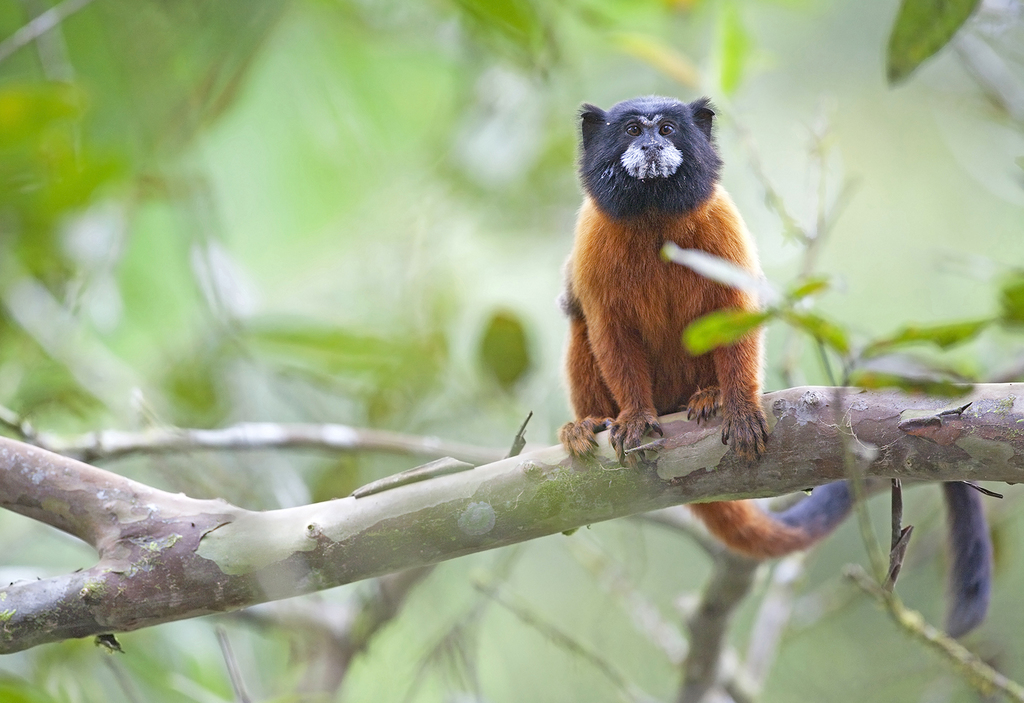
Golden-mantle Saddleback Tamarin
Saguinus tripartitus
The golden-mantled tamarin (Leontocebus tripartitus) is a tamarin species from South America. It is found in Ecuador and Peru, specifically in the upper Amazon (lowland), east of the Andes in Ecuador, and Northeast Peru; between the Rio Curaray and Rio Napo in Peru.
From the article Golden-mantled tamarin on Wikipedia (CC BY-SA), quoted section by section
Description
This tamarin measures 218–240 mm from the tip of the nose to the beginning of the tail and has a tail length of 316–341 mm. Its ear length is 31–32 mm. The head is black, with a black collar of hair continuous under the throat. The muzzle and sometimes face are pure white, and the neck has a ruff of bright golden to creamy fur dorsally, sharply contrasting with the black crown. Its underparts are orange. The long tail is not prehensile, as in all tamarins, and the large eyes face forward. The species is monomorphic. It has large canines and claw-like nails on all digits except the opposable.
What it does
The golden-mantled tamarin is an arboreal, diurnal species ranging through the understory, moving by quadrupedal walk and leap, mainly on small horizontal supports. Leaping is the main gap-crossing mode of locomotion, though it decreases in proportion with a higher use of the upper forest layers. It forages most actively between 4–10 meters off the forest floor, and eats mainly fruit, nectar and insects but also consumes gum from either natural holes or holes created by the pygmy marmoset. Due to its small body size, limited gut volume, and rapid rate of food passage, tamarins require a diet high in nutrient quality and available energy. Water accumulated on leaves, in flower cups, or in hollows is lapped; dew and moisture from a hand previously dipped in water are licked. Callitrichids do not suck up liquids or hold vessels to the mouth as do most cebids and catarrhines. The faculty of suckling, a specialization of the young, disappears soon after weaning. During the dry season they are known to be less active and more social due to low food sources.
Chemosignalling. Marmosets and tamarins possess a rich repertoire of chemosignalling behaviors. These are associated closely with investigatory behaviors. …
Wikipedia: “Behavior”
Listen
Looking for field recordings…
Where it lives
Recorded sightings
—
geo-referenced records in GBIF, from museums, herbaria and field observers.
Drag the globe to turn it. Dots are where records exist, not a range map; darker means more records.
In the stacks
Searching the stacks…
Every page naming Saguinus tripartitus in the Biodiversity Heritage Library →
This page is assembled live from iNaturalist, GBIF, Wikipedia, the Source Library and the Internet Archive. It is not yet part of the hand-edited codex. iNaturalist taxon 43381.