- Animals
- ›Chordates
- ›Vertebrates
- ›Mammals
- ›Therians
- ›Placental Mammals
- ›Primates, Rodents, and Allies
- ›Primates
- ›Monkeys, Apes, and Tarsiers
- ›Monkeys and Apes
- ›New World Monkeys
- ›Marmosets and Tamarins
- ›Saguinus
- ›Tamarinus
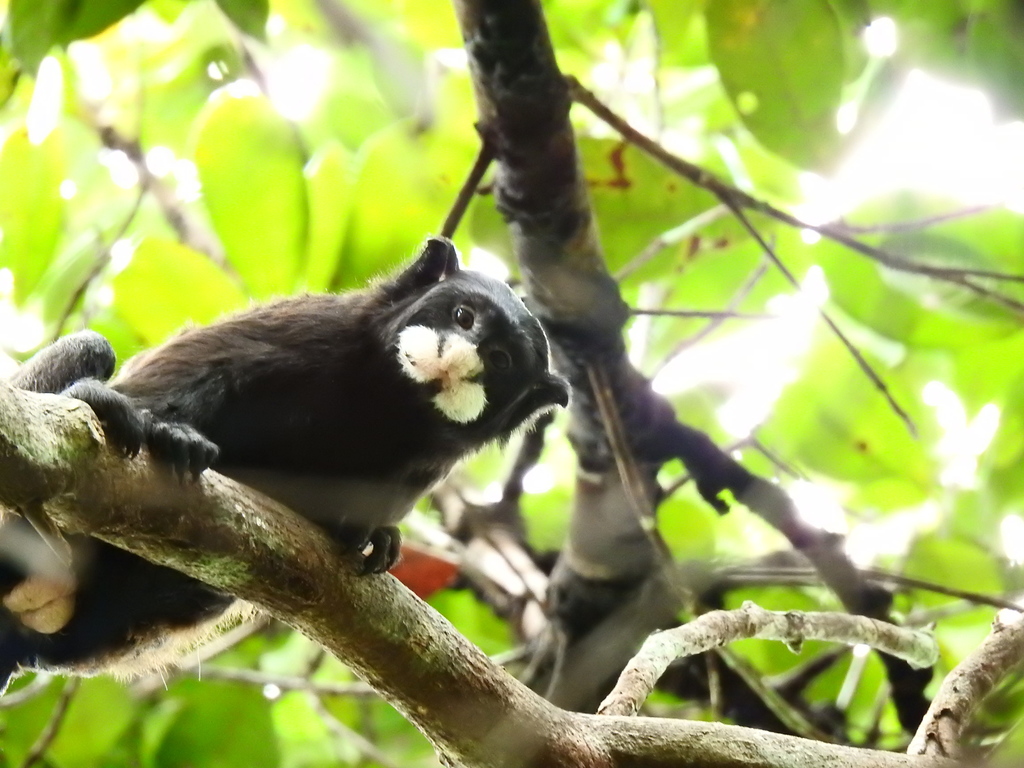
Spix's Mustached Tamarin
Saguinus mystax
The moustached tamarin (Saguinus mystax) is a New World monkey and a species of tamarin. The moustached tamarin is named for the lack of coloring in the facial hair surrounding their mouth, appearing similar to a moustache. As with most New World monkeys, the moustached tamarin is found only in areas of South America.
From the article Moustached tamarin on Wikipedia (CC BY-SA), quoted section by section
Description
Moustached tamarins have a lifespan of about 20 years in captivity, likely lower in the wild. They are small, weighing 500 to 600 grams, and range in length from 30 to 92 centimeters, with adult females larger than males. Moustached tamarin monkeys are characterized by white, curly hair around their mouth, similar to a moustache. Their face is flat with almond-like shaped eyes. Their ears are furry and large, and they have long, silky, body hair. They have a brownish-black body with a white moustache and white nose. They have tegula, which are claw-like nails, on each digit except their big toe. These claws allow them to easily cling to trees while they feed. They have conical or spatulate incisors, which are used for cutting food, and are smaller than their canines. The lingual and labial sides of their incisors have a thick layer of enamel. Unlike most New World Monkeys, the moustached tamarin monkey has non-opposable thumbs and lacks a prehensile tail.
Vision. Heterozygous females, which make up about 60% of the female tamarin population, have trichromatic vision, while the remaining moustached tamarin population have dichromatic vision. Trichromatic vision is the capacity to see a broader range of color due to the presence of three color receptors in the retina, at the back of the eye, allowing them to distinguish between greens, blues and reds. …
Range & habitat
Moustached tamarins are inhabitants of tropical rainforests in Brazil, Bolivia and Peru. They live in arid, upland forests in the Amazonian lowland, mostly occupying higher tree branches. The home range of moustached tamarins is between 25 and 50 hectares.
Wikipedia: “Habitat and distribution”
What it does
Moustached tamarins are omnivorous, frugivorous and insectivorous. Their diet mainly consists of fruits, nectar, gum exudates, invertebrates and small vertebrates. Invertebrates include katydids, stick grasshoppers, and spiders. Vertebrates include lizards and frogs. Gum feeding is seasonal, however it is a dietary staple during dry and early wet seasons when other resources are scarce. Exudates supplement nutrients and balance mineral intake; which prevent the species from experiencing a range of detrimental effects from a low-calcium and high-phosphorus insectivorous diet. They display a highly opportunistic foraging pattern, and the ratio and variety of their comestibles depend on the availability in their geographical location. Moustached tamarins select trees by the amount of nectar they yield, rather than proximity to their home range. This higher volume of nectar makes the chosen trees more reliable because it allows them to feed for longer periods. Their remarkable spatial memory allows them to quickly recall the location of fruiting trees. Spatial memory is vital because it aids in the exploitation of a widely scattered set of feeding sites and minimizes effort in foraging. The moustached tamarin monkey is a crucial seed disperser for many plant species as a result of their diverse diet. …
Wikipedia: “Ecology”
Listen
Looking for field recordings…
Where it lives
Recorded sightings
—
geo-referenced records in GBIF, from museums, herbaria and field observers.
Drag the globe to turn it. Dots are where records exist, not a range map; darker means more records.
In the old herbals & bestiaries

In the stacks
Searching the stacks…
Every page naming Saguinus mystax in the Biodiversity Heritage Library →
This page is assembled live from iNaturalist, GBIF, Wikipedia, the Source Library and the Internet Archive. It is not yet part of the hand-edited codex. iNaturalist taxon 43380.