- Animals
- ›Chordates
- ›Vertebrates
- ›Mammals
- ›Therians
- ›Marsupials
- ›Kangaroos, Possums, Wombats, and Allies
- ›Wombats and Koalas
- ›Wombats
- ›Lasiorhinus
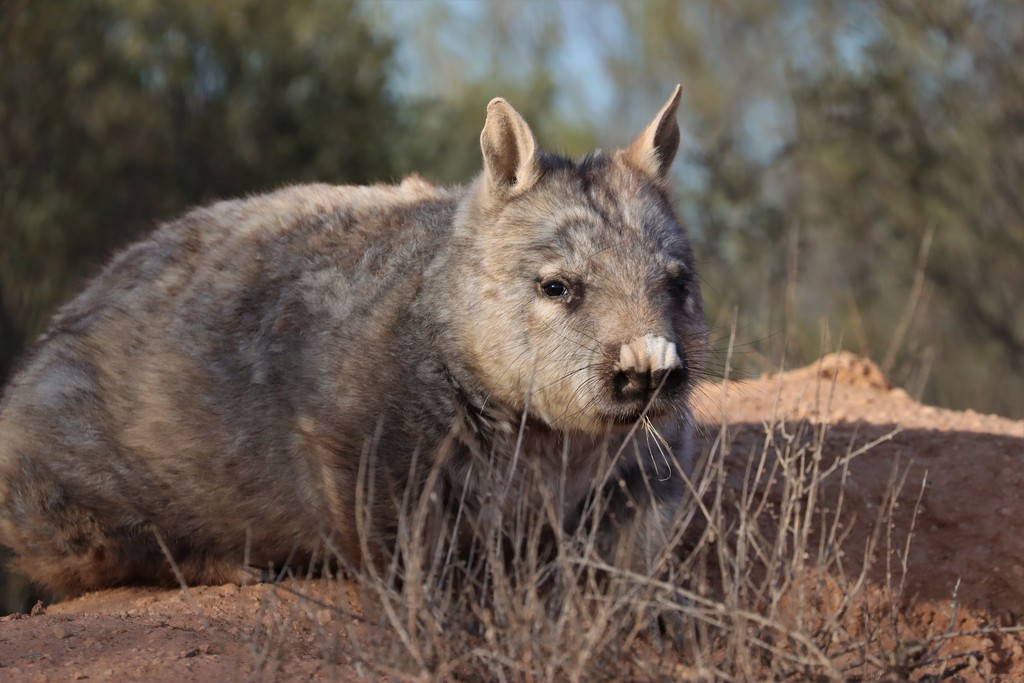
Southern Hairy-nosed Wombat
Lasiorhinus latifrons
The southern hairy-nosed wombat (Lasiorhinus latifrons) is one of three extant species of wombats. It is found in scattered areas of semiarid scrub and mallee from the eastern Nullarbor Plain to the New South Wales border area. It is the smallest of all three wombat species. The young often do not survive dry seasons. It is the state animal of South Australia.
Among the oldest southern hairy-nosed wombats ever documented were a male and a female from Brookfield Zoo just outside Chicago. Their names were Carver, who lived to be 34, and his mother, Vicky, who lived to be 24. In South Australia in 2010, a tame wombat named Wally was also reported as having reached the age of 34. Hamlet, a wombat at the Toronto Zoo, similarly died at age 34.
From the article Southern hairy-nosed wombat on Wikipedia (CC BY-SA), quoted section by section
Description
The southern hairy-nosed wombat is adapted to digging; it has a stocky and robust build, flattened claws, and five digits. It is also plantigrade. The body length ranges from 772 to 934 mm (30.4 to 36.8 in) with a body mass ranging from 19 to 32 kg (42 to 71 lb). Its short tail is hidden by its fur. The pelage is silky and is typically greyish or tan in colour. The wombat grooms itself with its second and third toes, which are fused together, except at the tips. The head is robust and flattened and the ears are pointed. The snout resembles that of a pig. The animal gets its name from the hairs that cover its rhinarium. The wombat's incisors resemble those of rodents, and its molars are widely spaced by the palate. The teeth keep growing for the entirety of the animal's life, which is likely an adaptation to its harsh diet. Compared to the common wombat, the southern hairy-nosed wombat has a larger temporalis muscle and a smaller masseter muscle. Also, unlike the northern hairy-nosed wombat, the southern hairy-nosed wombat's nasal bone is longer than the frontal bone.
Range & habitat
Southern hairy-nosed wombats range though Western Australia, southern South Australia, and south-western New South Wales. They live in semiarid to arid grasslands and woodlands.
Wikipedia: “Distribution and habitat”
What it does
Southern hairy-nosed wombats, along with other wombat species, select native perennial grasses and sedges, but do consume introduced pasture species, forbs, and the leaves of woody shrubs if their favoured food is not available. Much of the southern hairy-nosed wombat's diet is Austrostipa nitida, which grows around its warren complex and is trimmed as it grazes. This creates an area with a higher density of new green shoots, a sign of delayed growth of individual grass. The teeth of the wombat are more effective in grinding food into small particles than the western grey kangaroo. Its digestive tract has a tiny caecum and a colon divided into parts. The anterior part is relatively small and serves as the site for fermentation, while the posterior part is larger and is where water is reabsorbed. The wombat conserves water by recycling more urea to the colon rather than releasing it as urine. Wombats release less than other herbivorous mammals. As such, the southern hairy-nosed wombat produces very dry faeces, with water contents as low as 40%. Wombats are also host to a diverse gut microbiome, which is thought to help them derive energy and essential nutrients from their relatively poor diets, as well as assist with nitrogen recycling. It has been estimated that the microbial fermentation of fibre in the wombat gut accounts for >60% of the host's daily energy requirements. …
Wikipedia: “Feeding and energy”
Listen
Looking for field recordings…
Where it lives
Recorded sightings
—
geo-referenced records in GBIF, from museums, herbaria and field observers.
Drag the globe to turn it. Dots are where records exist, not a range map; darker means more records.
In the stacks
Searching the stacks…
Every page naming Lasiorhinus latifrons in the Biodiversity Heritage Library →
This page is assembled live from iNaturalist, GBIF, Wikipedia, the Source Library and the Internet Archive. It is not yet part of the hand-edited codex. iNaturalist taxon 43007.