- Animals
- ›Chordates
- ›Vertebrates
- ›Mammals
- ›Therians
- ›Marsupials
- ›Kangaroos, Possums, Wombats, and Allies
- ›Macropods
- ›Potoroos and Bettongs
- ›Potoroos
- ›Potorous
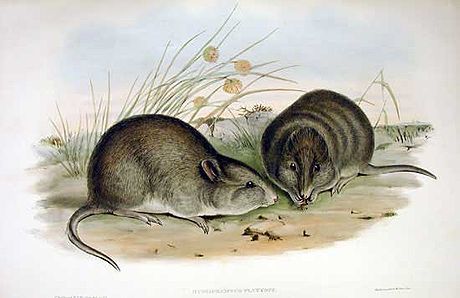
Broad-faced Potoroo
Potorous platyops
The broad-faced potoroo (Potorous platyops) is an extinct potoroid marsupial that was found in southwestern Australia. The first specimen was collected in 1839, and described by John Gould in 1844. Only a small number of specimens have been collected since. The last live capture was in 1875. Subfossil remains indicate that it had an extensive distribution around the semiarid coastal districts of Southwest Australia.
The habitat of the broad-faced potoroo is almost entirely unknown, but unlike its relatives, such as the long-nosed potoroo Potorous tridactylus and long-footed Potorous longipes, they do not seem to have lived in dense understories in forests. Preserved specimens indicate that it was smaller than other potoroos at around 300 mm (1 ft) long with a 180-mm tail. Their weight is estimated at 800 g. Their coat was grizzled with yellowish hairs above and greyish white below. Their body was similar in shape to that of other potoroids. Their ears were small and rounded, muzzle fairly short, and cheeks notably puffy.
From the article Broad-faced potoroo on Wikipedia (CC BY-SA), quoted section by section
Description
The broad-faced potoroo is a member of the genus Potorous. It is described as having a relatively broad skull and shorter muzzle. The species is presumed to have become extinct sometime after the last recorded capture of the animal in 1875, and sometime before 1905. The colour of the pelage is greyish brown at the upper-side. Straw-yellow hairs are interspersed through the fur to give a streaked effect. The underside and the flanks are pale grey. The head and body are about 305 millimetres in length, while the tail is about 178 mm long. Their hind feet are about 54 mm in length and their weight is approximately 800 grams. Their noses are short and blunt, which is an unusual characteristic among potorines and is usually associated with species such as the rufous bettong (Aepyprymnus rufescens) and the desert rat-kangaroo (Caloprymnus campestris).
Range & habitat
The few records of live specimens are restricted to Southwest Australia. The species could have already been near-extinct when Gilbert obtained his specimen, and no specific localities are known with any certainty. Sub-fossil remains indicate a wide distribution range, extending from the southern to the western regions of Australia, including Nullarbor Plain, and perhaps as far north as the Northwest Cape region. Remains have also been found on Kangaroo Island. Some evidence indicates that P. platyops, like the desert-dwelling rat-kangaroo (Caloprymnus campestris), was already in decline when the invasive European rabbit became established in the species' former range.
Wikipedia: “Distribution”
What it does
The behaviour of the species has not been recorded, and nothing is known of its diet. The scant record of its habitat includes those provided by John Gilbert's informants, one of whom said, "All I could glean of its habits was that it was killed in a thicket surrounding one of the salt lagoons in the interior". An assessment of documents prior to the 20th century concluded the only ecological change to affect the population were anecdotal reports of a "disease", similar to one that had resulted in the sudden absence of similar species. A synthesis combining other historical evidence proposes what may have been an epizootic during the 1890s that precipitated their extinction. No historical evidence could be found to link the conclusion of South African collector Guy C. Shortridge, writing in 1910, that ecological changes such as bushfire and the introduction of cats were directly linked to the species' decline. Guy Shortridge searched extensively for this species on his collecting expedition near Bremer Bay, finding Potorous gilbertii skulls at caves near Margaret River, but could only provide the historical details of this species provided to him in his 1910 report. …
Wikipedia: “Ecology”
Listen
Looking for field recordings…
Where it lives
Recorded sightings
—
geo-referenced records in GBIF, from museums, herbaria and field observers.
Drag the globe to turn it. Dots are where records exist, not a range map; darker means more records.
In the stacks
Searching the stacks…
Every page naming Potorous platyops in the Biodiversity Heritage Library →
This page is assembled live from iNaturalist, GBIF, Wikipedia, the Source Library and the Internet Archive. It is not yet part of the hand-edited codex. iNaturalist taxon 42992.