- Plants
- ›Vascular Plants
- ›flowering plants
- ›monocots
- ›Agaves, Orchids, Irises, and Allies
- ›Orchids
- ›Lower Epidendroid Orchids
- ›Gastrodieae
- ›Gastrodiinae
- ›Gastrodia
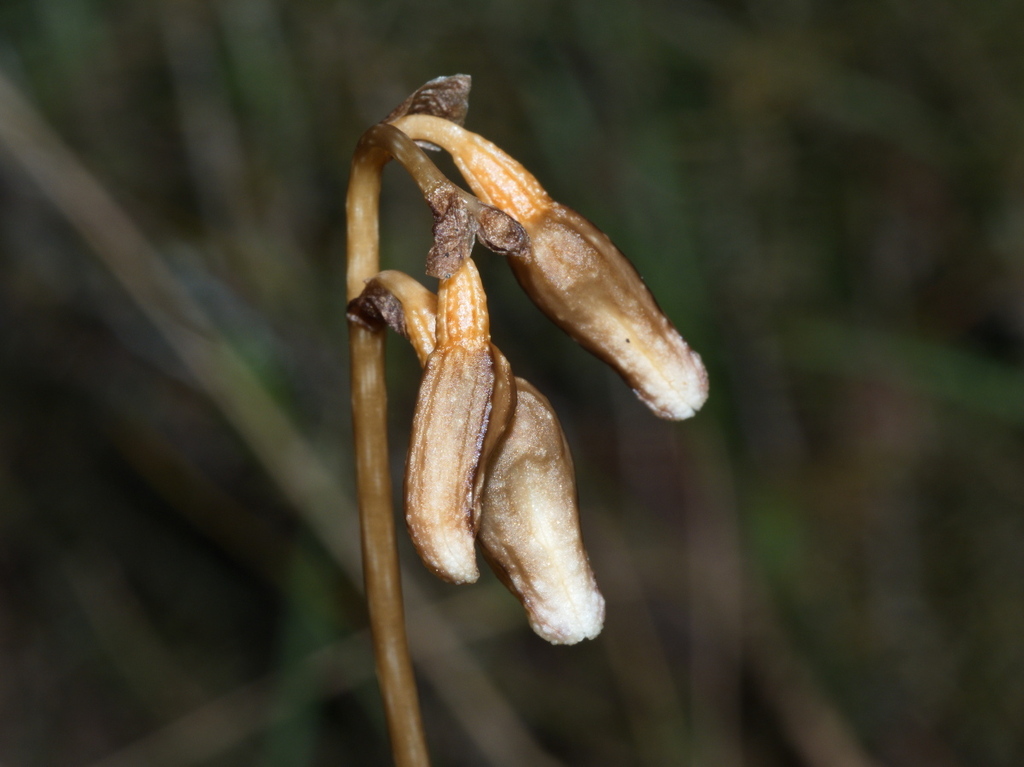
Gastrodia vescula
Gastrodia vescula, commonly known as small potato orchid, is a leafless terrestrial mycotrophic orchid in the family Orchidaceae. It has a very thin, brittle, light brown flowering stem with up to three pale brown flowers that are white on the inside. It is only known from a small area near the border between South Australia and Victoria.
From the article Gastrodia vescula on Wikipedia (CC BY-SA), quoted section by section
Description
Gastrodia vescula is a leafless terrestrial, mycotrophic herb that has a very thin, brittle pale brown flowering stem 50–200 cm (20–80 in) tall with up to three, mostly drooping, smooth light brown flowers. The sepals and petals are joined, forming a tube about 10–12 mm (0.4–0.5 in) long and white inside with the lobes about 2 mm (0.08 in) long. The labellum is about 9–11 mm (0.35–0.43 in) long, about 3 mm (0.12 in) wide with three lobes and completely enclosed in the tube. Flowering occurs from November to December.
Range & habitat
The small potato orchid is only known from small area in the far southeast of South Australia and far western Victoria where it grows in dense, heathy forest.
== References ==
Wikipedia: “Distribution and habitat”
Where it lives
Recorded sightings
—
geo-referenced records in GBIF, from museums, herbaria and field observers.
Drag the globe to turn it. Dots are where records exist, not a range map; darker means more records.
In the stacks
Searching the stacks…
Every page naming Gastrodia vescula in the Biodiversity Heritage Library →
This page is assembled live from iNaturalist, GBIF, Wikipedia, the Source Library and the Internet Archive. It is not yet part of the hand-edited codex. iNaturalist taxon 429631.