- Plants
- ›Vascular Plants
- ›flowering plants
- ›monocots
- ›Agaves, Orchids, Irises, and Allies
- ›Orchids
- ›Lower Epidendroid Orchids
- ›Gastrodieae
- ›Gastrodiinae
- ›Gastrodia
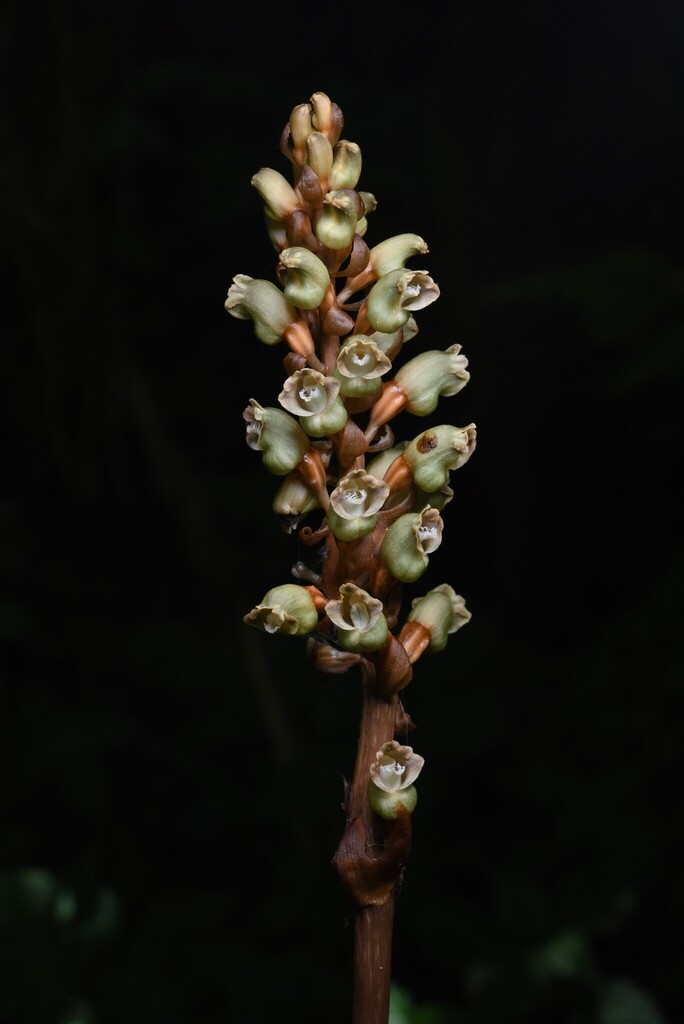
Tianma
Gastrodia elata
Gastrodia elata is a saprophytic perennial herb in the Orchidaceae family. It is found in Nepal, Bhutan, India, Japan (Hokkaido, Honshu, Shikoku, Kyuushu ), North Korea, Siberia, Taiwan as well as China (in the provinces of Jilin, Liaoning, Inner Mongolia, Hebei, Shanxi, Shanxi, Gansu, Jiangsu, Anhui, Zhejiang, Jiangxi, Henan, Hunan, Hubei, Sichuan, Guizhou, Yunnan, and Tibet) grow at elevations of 400–3200 meters at the edge of forest.
From the article Gastrodia elata on Wikipedia (CC BY-SA), quoted section by section
Description
The orchid has an 8–12 centimeters long elliptical underground rhizome with a diameter of 3–5 centimeters but may grow up to 7 centimeters. The stem is erect with a height of 0.3–1 meter up to 2 meters, the orange yellow, tan, cylinder, and leafless. The flowered pale olivine or the orange red, the scape is length 5–30 centimeters, longest may be 50 centimeters. Floral Bracts are long lanceolate, length 1-1.5 centimeters; Pedicel and ovary of branch 0.7–1.2 centimeter, slightly short in colored bract; The sepal and the petal produce a slanting pot shape perianth tube, the perianth tube long the approximately 1 centimeter, the diameter 5–7 millimeters. The labellum is white, circular, with a length of 6–7 millimeters and width of 3–4 millimeters, the tip 3 cracks, the base pastes the tight pistil column full terminal, has a pair of pulp callus, in the callus connection perianth tube. The pistil column length 5–7 millimeters, have the short pistil column foot. Capsule each approximately 30, oval or but actually oval, length 1.2–1.8 centimeters, width 8–9 millimeters. The seed are most, 2 – 40,000 grains of each fruit, minimum, powdery. Flowering season June to July, fruit time July to August.
Range & habitat
It is found in Nepal, Bhutan, India, Japan (Hokkaido, Honshu, Shikoku, Kyuushu), Korea, Siberia, Taiwan, and China (in the provinces of Jilin, Liaoning, Inner Mongolia, Hebei, Shanxi, Shanxi, Gansu, Jiangsu, Anhui, Zhejiang, Jiangxi, Henan, Hunan, Hubei, Sichuan, Guizhou, Yunnan, and Tibet). It grows at elevations of 400–3,200 m (1,300–10,500 ft), at the edge of forests.
Wikipedia: “Distribution and habitat”
In medicine
The herb, specifically the rhizome, is used in traditional Chinese medicine and Sichuan cuisine as tian-ma. It is one of the three orchids listed in the earliest known Chinese Materia Medica (Shennong Bencaojing) (c. 100 AD). Medicinally, it is used for 'calming the liver' and for treating headaches, dizziness, tetanus, and epilepsy. According to "Nutrition Review," "Gastrodia root has been shown to exert novel pain relief and inflammatory-mediating activities, as well as in vivo and in vitro inhibitory activity on nitric oxide (NO) production." Gastrodin and gastrodigenin are thought to be the two signature compounds of this herb. The Chinese Pharmacopoeia requires medicinal rhizomes to contain, at minimum, 0.25% gastrodin + gastrodigenin by dry weight.
Wikipedia: “Traditional use”
Where it lives
Recorded sightings
—
geo-referenced records in GBIF, from museums, herbaria and field observers.
Drag the globe to turn it. Dots are where records exist, not a range map; darker means more records.
In the old herbals & bestiaries

Bencao Gangmu, Volume Upper-Middle
李時珍 · 1596 · p.18

Collected Illustrations of the Three Realms: Plants
王圻, 王思義 · 1607 · p.58

Sancai Tuhui (Vol. 97)
王圻, 王思義 · 1607 · p.34

Sancai Tuhui (Vol. 92)
王圻, 王思義 · 1609 · p.59

Sancai Tuhui (Vol. 101)
王圻, 王思義 · 1609 · p.22

Illustrated Herbal Primer
Chen Jiamo (陳嘉謨) · 1628 · p.80

Illustrated Investigation of the Names and Realities of Plants, Volume 7
吳其濬 · 1848 · p.18

Illustrated Investigation of the Names and Realities of Plants, Volume 7
吳其濬 · 1848 · p.18

Illustrated Compendium of Materia Medica (Vol. 14)
吳其濬 · 1848 · p.161
In the stacks
Searching the stacks…
Every page naming Gastrodia elata in the Biodiversity Heritage Library →
This page is assembled live from iNaturalist, GBIF, Wikipedia, the Source Library and the Internet Archive. It is not yet part of the hand-edited codex. iNaturalist taxon 429605.