- Animals
- ›Chordates
- ›Vertebrates
- ›Mammals
- ›Therians
- ›Marsupials
- ›Kangaroos, Possums, Wombats, and Allies
- ›Macropods
- ›Kangaroos, Wallabies and Allies
- ›Kangaroos, Wallabies, Pademelons, and Dorcopsises
- ›Tree Kangaroos and Allies
- ›Petrogale
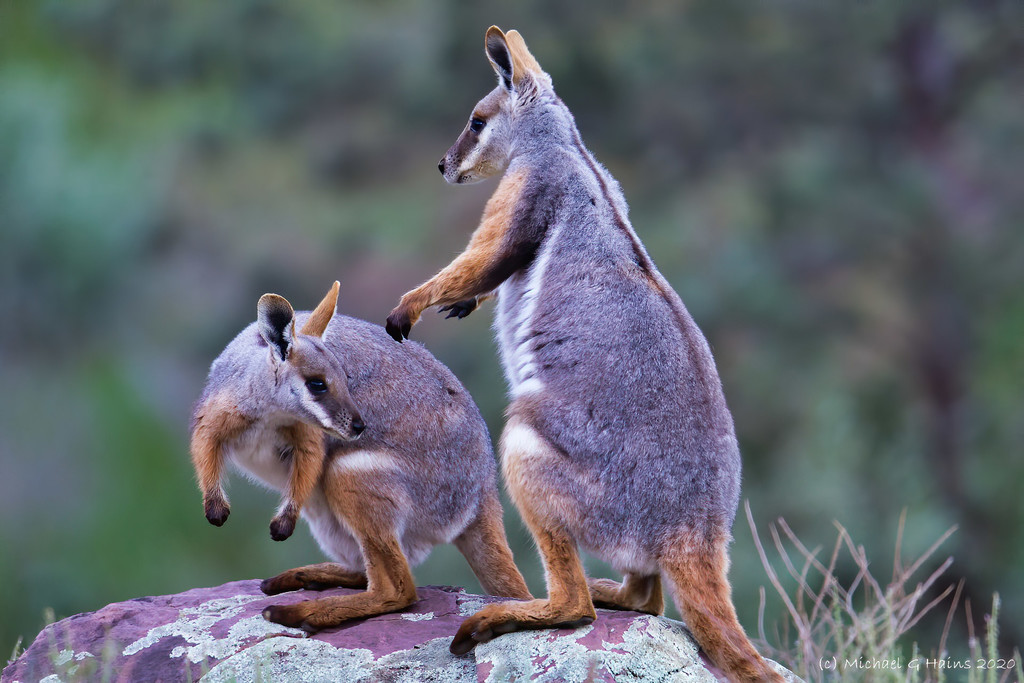
Yellow-footed Rock Wallaby
Petrogale xanthopus
The yellow-footed rock-wallaby (Petrogale xanthopus), formerly known as the ring-tailed rock-wallaby, is a member of the macropod family (the marsupial family that includes the kangaroos, wallabies, tree-kangaroos, and wallaroos).
From the article Yellow-footed rock-wallaby on Wikipedia (CC BY-SA), quoted section by section
Description
The yellow-footed rock-wallaby is grey to fawn-grey above and light-coloured below with a black mid-dorsal stripe from the crown of the head to the centre of the back. There is a distinct white cheek stripe, with ears ranging in colour from orange to grey-brown. The forearms and hind legs are bright yellow to rich orange to a light orange-brown. The tail is orange-brown irregularly ringed with dark brown and golden-brown, with the colour of the tip variable from dark brown to white. The head and body length is 480–650 mm (usually 600 mm), with tail length 570–700 mm (usually 690 mm), and weight 6–11 kg.
Range & habitat
This species of rock-wallaby is found in western New South Wales, eastern South Australia and isolated portions of Queensland. It is not typically found near human habitation, instead preferring rough terrain and rock outcroppings.
Wikipedia: “Distribution and habitat”
Listen
Looking for field recordings…
Where it lives
Recorded sightings
—
geo-referenced records in GBIF, from museums, herbaria and field observers.
Drag the globe to turn it. Dots are where records exist, not a range map; darker means more records.
In the stacks
Searching the stacks…
Every page naming Petrogale xanthopus in the Biodiversity Heritage Library →
This page is assembled live from iNaturalist, GBIF, Wikipedia, the Source Library and the Internet Archive. It is not yet part of the hand-edited codex. iNaturalist taxon 42931.