- Animals
- ›Chordates
- ›Vertebrates
- ›Mammals
- ›Therians
- ›Marsupials
- ›Kangaroos, Possums, Wombats, and Allies
- ›Macropods
- ›Kangaroos, Wallabies and Allies
- ›Kangaroos, Wallabies, Pademelons, and Dorcopsises
- ›Tree Kangaroos and Allies
- ›Petrogale
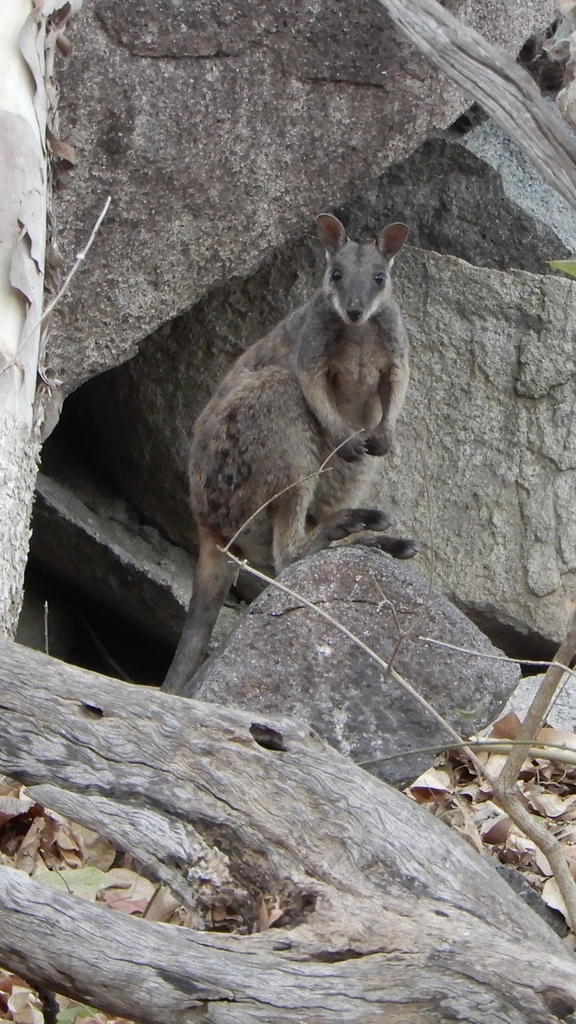
Cape York Rock Wallaby
Petrogale coenensis
The Cape York rock-wallaby (Petrogale coenensis) is a species of rock-wallaby restricted to Cape York Peninsula in northeastern Queensland, Australia. It is a member of a group of seven very closely related rock-wallabies, all found in northeastern Queensland, also including the Mount Claro rock-wallaby (P. sharmani), the Mareeba rock-wallaby (P. mareeba) and Godman's rock-wallaby (P. godmani).
The Cape York rock-wallaby is found only in central Cape York, from the Musgrave to the Pascoe River. It is also the only member of the group of seven species to be completely separated geographically from its relatives; it is separated from Godman's rock-wallaby by the Hann River Catchment (around 70 km).
From the article Cape York rock-wallaby on Wikipedia (CC BY-SA), quoted section by section
Description
This wallaby is a relatively small macropod with its physical characteristics suited for their rocky terrains. An adult wallaby has a head to body length of 15-20in and a tail length of 16-22in. Their tails are typically as long as or longer than their bodies. An adult Cape York Rock-Wallaby has a body mass of about 6.6-13.2lb. These wallabies can be identified distinctly by their greyish to brown fur, with a darker back and a pale underside. Their ears are short and rounded. Like other wallabies, the Cape York Rock-Wallaby has powerful hindlimbs for jumping, short forelimbs for balance and climbing, and a long tail to counterbalance navigating cliffsides. Their feet are rough and have padded soles modified for grip on rocky surfaces. Endemic to the Cape York Peninsula in northeastern, Australia, the Cape York Rock-Wallaby occupies multiple habitats such as granite boulder piles, areas with crevices and caves, rocky cliffs, and sandstone outcrops. The environments, mostly rocky, protect this species from predators and weather. The Cape York Rock-Wallaby usually stays within the caves and crevices during daytime and emerges at night for foraging.
Wikipedia: “Description and habitat”
What it does
Since Cape York Rock-Wallabies are herbivores, they play a crucial role within the ecosystem. They aid in dispersing plant seeds and maintaining their habitat's health. Wallabies promote biodiversity by feeding on multiple types of vegetation, eliminating invasives. By grazing, they maintain an even balance of plant species not allowing a specific plant to dominate regions. The Cape York-Rock Wallaby are an isolated species and spend most of their lives alone or in small groups. Though, their social behavior derives from pressures in the environment and the amount of food available. When it is time to find a mate, males can be observed competing by revealing their agility in strength to female companions.
Wikipedia: “Ecological Significance and Social Behavior”
Listen
Looking for field recordings…
Where it lives
Recorded sightings
—
geo-referenced records in GBIF, from museums, herbaria and field observers.
Drag the globe to turn it. Dots are where records exist, not a range map; darker means more records.
In the stacks
Searching the stacks…
Every page naming Petrogale coenensis in the Biodiversity Heritage Library →
This page is assembled live from iNaturalist, GBIF, Wikipedia, the Source Library and the Internet Archive. It is not yet part of the hand-edited codex. iNaturalist taxon 42926.