- Animals
- ›Chordates
- ›Vertebrates
- ›Mammals
- ›Therians
- ›Marsupials
- ›Kangaroos, Possums, Wombats, and Allies
- ›Macropods
- ›Kangaroos, Wallabies and Allies
- ›Kangaroos, Wallabies, Pademelons, and Dorcopsises
- ›Tree Kangaroos and Allies
- ›Dendrolagus
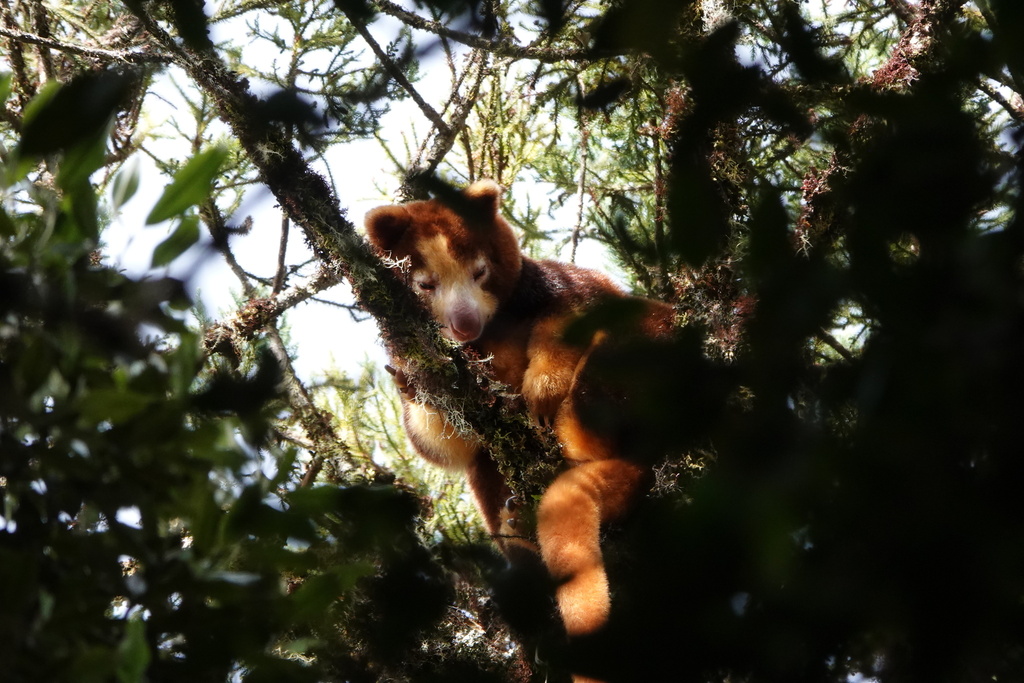
Huon Tree Kangaroo
Dendrolagus matschiei
Matschie's tree-kangaroo (Dendrolagus matschiei), also known as the Huon tree-kangaroo, is a tree-kangaroo native to the Huon Peninsula of northeastern New Guinea island, within the nation of Papua New Guinea. Under the IUCN classification, Matschie's tree-kangaroo is an endangered species. The scientific name honours German biologist Paul Matschie. The indigenous population refers to it as a Boongarry.
From the article Matschie's tree-kangaroo on Wikipedia (CC BY-SA), quoted section by section
Description
With a body and head length of 20 to 32 inches (51–81 cm), Matschie's tree-kangaroos are much smaller than Australia's well-known red kangaroo. An adult male weighs between 20 and 25 lb (9–11 kg). An adult female weighs between 15 and 20 lb (7–9 kg). There is no particular season in which they breed. Gestation lasts 44 days and joeys of captive bred individuals leave the pouch after 11 months. The average life span of the Matschie's tree-kangaroo in the wild is unknown, but is at least 14 years. The life span of the kangaroo in a zoo is about 20 years. A distinctive trait of all tree-kangaroos is the dorsal hair whorl they possess. The whorl is a region of hair that radiates outward in many directions and its location ranges from up near the shoulders and down to the tail. The Matschie's tree-kangaroo is golden ventrally, and on the lower parts of its limbs, its ear edges, belly, and tail. The rest of its body is a chestnut brown colour, with a darker stripe down its back. Their faces show a variable array of yellow and white hairs. The Matschie’s is similar in colour and size to Dendrolagus dorianus, the Doria's tree-kangaroo. It is also very closely related to Dendrolagus goodfellowi, the Goodfellow's tree-kangaroo, which was once considered a subspecies of the Matschie's. The Matschie's tree-kangaroo has limited hearing because of their small and bear-like ears. …
Range & habitat
Matschie's tree-kangaroos are restricted to the Huon peninsula of Papua New Guinea, a subdivision of Tumbanan faunal province, and are the only tree-kangaroos found there. They are also residents on the island of Umboi, which is just off the coast of Papua New Guinea. However, most scientists believe the tree-kangaroos were introduced onto this island and were not originally found there. The Matschie’s tree-kangaroo prefer to live in deciduous forests and tropical rainforests due to their largely arboreal nature. Their home range consists of about 25 hectares of the area.
Wikipedia: “Range”
What it does
Matschie's tree-kangaroo lives in the mountainous rainforests at elevations of between 1,000 and 3,000 metres (3,300 and 9,800 ft). As arboreal animals, they spend most of their time in the trees and come down occasionally to feed. They are very adept at hopping and can leap up to 30 feet (9 m). In the wild, researchers have found most Matschie’s live alone or in small assemblies, containing maybe a mother and her offspring and one male. Most of the time, the groups have a sex ratio of 1:1. Matschie’s tree-kangaroos appear to be scared of humans as they appear agitated in the presence of people and are very difficult to find in the field. They spend about 14 to 15 hours of their days sleeping and resting. The Matschie's tree-kangaroos are known for defending their home territory and marking their boundaries. Instead of sweating, Matschie's tree-kangaroo licks its forearms and allows the evaporation to help cool its body. When the temperature of the environment drastically changes at different times of the year, they are able to maintain a moderate body temperature because of their metabolic rate. Matschies' have been found to be very susceptible to mycobacterial infections; however, the infections do not seem to be contagious because some individuals that are around infected kangaroos do not appear to get the infection. …
Wikipedia: “Ecology and behavior”
Listen
Looking for field recordings…
Where it lives
Recorded sightings
—
geo-referenced records in GBIF, from museums, herbaria and field observers.
Drag the globe to turn it. Dots are where records exist, not a range map; darker means more records.
In the stacks
Searching the stacks…
Every page naming Dendrolagus matschiei in the Biodiversity Heritage Library →
This page is assembled live from iNaturalist, GBIF, Wikipedia, the Source Library and the Internet Archive. It is not yet part of the hand-edited codex. iNaturalist taxon 42901.