- Animals
- ›Chordates
- ›Vertebrates
- ›Mammals
- ›Therians
- ›Marsupials
- ›Kangaroos, Possums, Wombats, and Allies
- ›Cuscuses, Brush-tailed Possums, and Pygmy Possums
- ›Cuscuses and Brush-tailed Possums
- ›Grey and Spotted Cuscuses
- ›Spilocuscus
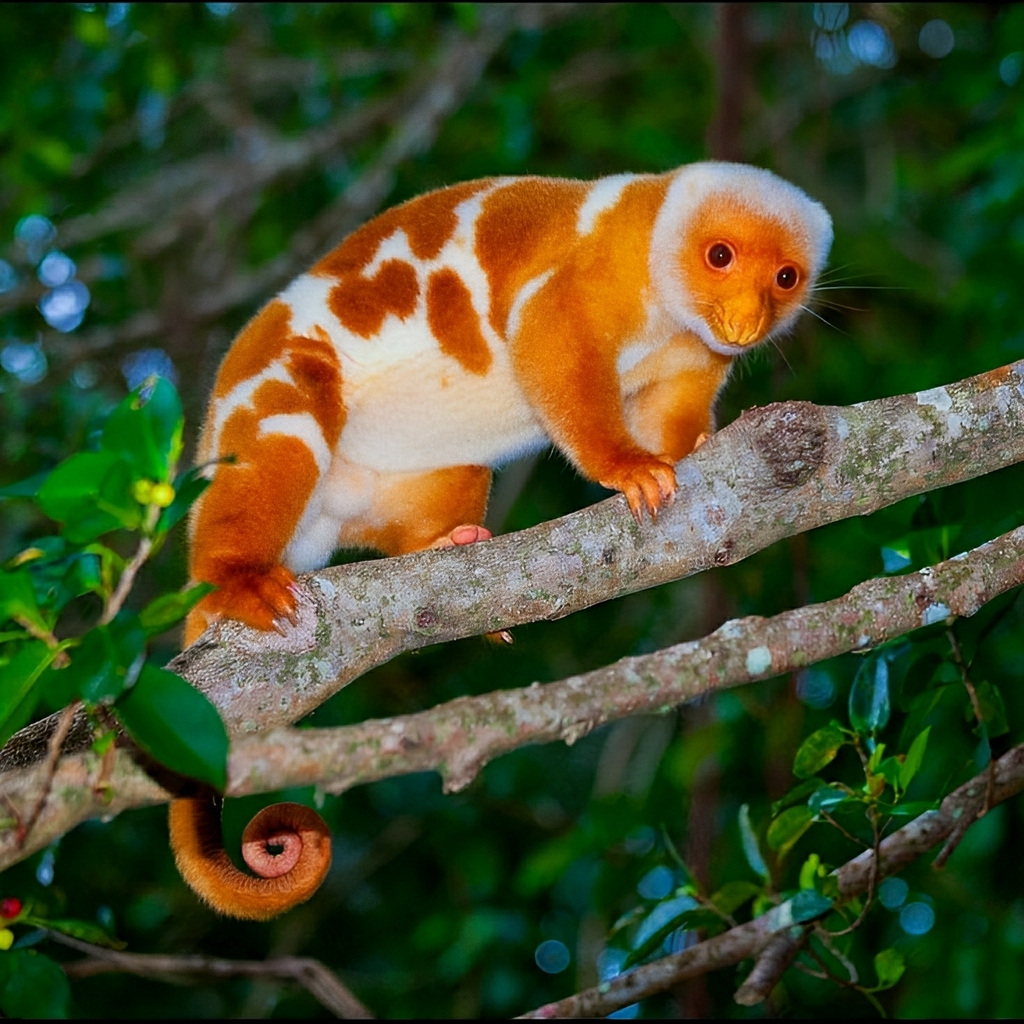
Common Spotted Cuscus
Spilocuscus maculatus
The common spotted cuscus (Spilocuscus maculatus), also known as the white cuscus, is a cuscus, a marsupial that lives in the Cape York region of Australia, New Guinea, and nearby smaller islands.
From the article Common spotted cuscus on Wikipedia (CC BY-SA), quoted section by section
Description
The common spotted cuscus is about the size of a common house cat, weighing 1.5 to 6 kilograms (3.3 to 13.2 lb), body size about 35 to 65 centimetres (14 to 26 in) long, and a tail 32 to 60 centimetres (13 to 24 in) long. It has a round head, small hidden ears, thick fur, and a prehensile tail to aid in climbing. Its eyes range in colour from yellows and oranges to reds, and are slit much like a snake's. All four of its limbs have five digits and strong, curved claws, except the first digit on each foot. The second and third digits of the hind foot are partly syndactylous: they are united by skin at the top joint, but divide at the claws. These smaller claws can serve as hair combs when cleaning. The first and second digits of the fore foot are opposable to the other three, helping it grip branches while climbing. The undersides of its paws are bare and striated, which also help it grasp trees and food. The first digit on the hind foot is clawless and opposable. It has thick, woolly fur of varying colours depending on age, sex, and location. Males are typically grey/white or brown/white with splotchy patterns on their back and a white underbelly. Only males have spots. Females are usually white or grey and unspotted. Some completely white individuals are known in both males and females. …
Range & habitat
The common spotted cuscus lives in rainforests, mangroves, hardwood and eucalyptus forests below 1,200 metres (3,900 ft); unlike most of its relatives, it is not restricted to rainforest environments. Because it lives in dense wooded habitats, it is not easily seen, especially in Australia. It is debated whether cuscuses originated in Australia and then migrated to New Guinea, or vice versa. It is believed that over the past million years there have been waves of migration during periods of low sea levels that exposed seabed across the Torres Strait. Currently the common spotted cuscus resides in Cape York, Queensland, in northeastern Australia, as well as New Guinea and nearby smaller islands. It inhabits areas as far west as Sulawesi and as far east as the Solomon Islands.
Wikipedia: “Habitat and environment”
What it does
The common spotted cuscus is typically very shy, so it is rarely seen, especially in northern Australia. It is nocturnal, hunting and feeding at night and sleeping during the day on self-made platforms in tree branches. It also has been found resting in tree hollows, under tree roots, or among rocks. It is slow-moving and somewhat sluggish, sometimes mistaken for sloths, other possums, or even monkeys. Unlike its close relatives, the common spotted cuscus has been observed feeding during the day on rare occasions. The common spotted cuscus is typically a solitary creature, feeding and nesting alone. Interactions with others, especially between competing males, can be aggressive and confrontational. Male cuscuses scent mark their territory to warn off other males, emitting a penetrating musk odor both from their bodies and scent gland excretions. They distribute saliva on branches and twigs of trees to inform others of their territory and mediate social interactions. If they encounter another male in their area, they make barking, snarling, and hissing noises, and stand upright to defend their territories. They are aggressive, and can scratch, bite, and kick potential predators.
Wikipedia: “Behaviour”
Listen
Looking for field recordings…
Where it lives
Recorded sightings
—
geo-referenced records in GBIF, from museums, herbaria and field observers.
Drag the globe to turn it. Dots are where records exist, not a range map; darker means more records.
In the stacks
Searching the stacks…
Every page naming Spilocuscus maculatus in the Biodiversity Heritage Library →
This page is assembled live from iNaturalist, GBIF, Wikipedia, the Source Library and the Internet Archive. It is not yet part of the hand-edited codex. iNaturalist taxon 42852.