- Animals
- ›Chordates
- ›Vertebrates
- ›Mammals
- ›Therians
- ›Marsupials
- ›Kangaroos, Possums, Wombats, and Allies
- ›Cuscuses, Brush-tailed Possums, and Pygmy Possums
- ›Cuscuses and Brush-tailed Possums
- ›Grey and Spotted Cuscuses
- ›Spilocuscus
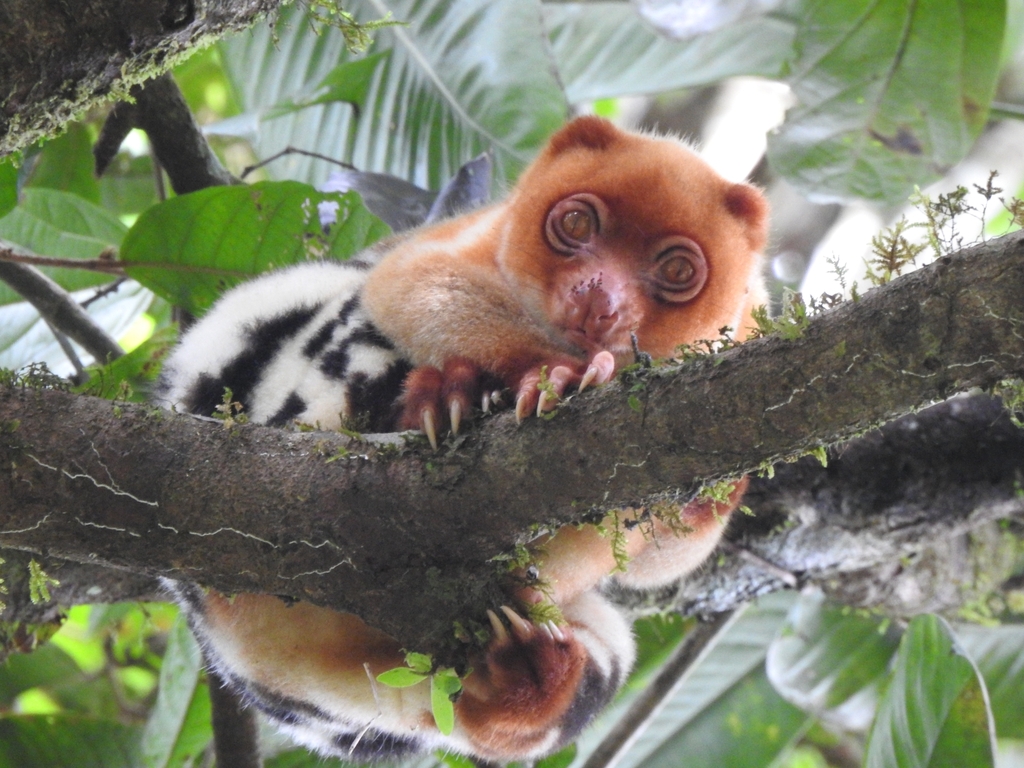
Black-spotted Cuscus
Spilocuscus rufoniger
The black-spotted cuscus (Spilocuscus rufoniger) is a species of marsupial in the family Phalangeridae. It is among the largest members of the family, only being surpassed by the bear cuscus. It is a relatively colourful species found in forests of northern New Guinea. It is threatened by hunting and habitat loss, and has already disappeared from large parts of its range. Consequently, it is rated as Critically Endangered by IUCN.
From the article Black-spotted cuscus on Wikipedia (CC BY-SA), quoted section by section
Description
Black-spotted cuscuses comprise one of the largest species of the family Phalangeridae; only surpassed in size by the bear cuscus. Adult black-spotted cuscuses weigh approximately 6 to 7 kg (13 to 15 lb) on average. Typically, they are 120 cm in length, with the head and body measuring approximately 70 cm, and the tail measuring 50 cm. Both adult males and females exhibit red and black fur that is dense and woolly. However, females are bigger and have a uniformly dark, saddle-like coloration, while males have spotty colorations. The pelages of the young transform through a series of colors during maturation. The undersides of black-spotted cuscuses have areas of yellow and white. Females possess four mammae and modified pouches for neonates that open anteriorly. Black-spotted cuscuses have round heads with a short, pointed snout. The frontal skull bones are convex, which gives them their bulging forehead, and they have a large sinus that is closed off from the nasal cavity. In black-spotted cuscuses, the basioccipital and alisphenoid bones in the skull create a well-developed structure earlier than in other Phalangeridae. Their eyes are characterized by large, vertically split pupils that are useful for their nocturnal lifestyle. There is fur lining the inner ears, which are almost invisible. Black-spotted cuscuses can be distinguished from other cuscuses by their teeth. …
Range & habitat
The black-spotted cuscus is indigenous to the island of New Guinea. Although the species is spread throughout northern New Guinea, it has been commonly seen in Sattelberg, a village in the Morobe Province of Papua New Guinea. It dwells in undisturbed lower-montane, tropical, primary forests and lowland areas of thick brushwood below 1200 meters in elevation. Black-spotted cuscuses have been located in secondary forests as well.
Wikipedia: “Geographic range and habitat”
What it does
Spilocuscus rufoniger are endotherms. The black-spotted cuscuses are primarily arboreal; they only descend to the ground periodically. Being nocturnal creatures, they rest in a curled position on high branches throughout the day. Naturally, they are sluggish creatures with predominantly solitary lifestyles. Feeding and nesting is performed individually. Interactions and encounters between individuals of this species typically involve aggression. There have been no reports of arboreal predators in the habitats of the black-spotted cuscus.
Reproduction. Little is known regarding the mating behavior of black-spotted cuscuses. Courting is typically performed on tree limbs. Black-spotted cuscuses produce offspring via sexual reproduction. They are viviparous, with the mother birthing live young.
Parental care. The mother possesses a pouch that functions in nursing and protecting her altricial neonates. Little else is noted in regards to the parental investment and care of the black-spotted cuscus.
Diet. Little is known about the dietary habits of this species. They are believed to be omnivores that consume small animals. In addition, they feed upon fruits, leaves, nuts.
Wikipedia: “Behavior”
In human culture
The family Phalangeridae originated from the Australian rainforests by the early Miocene epoch. Since then, cuscuses have successfully diversified from the Phalangerids. Current research has indicated that the Trichosurini (possums) separated from the cuscuses that comprised the extant Phalangerids approximately 23 to 29 million years ago. This split supports the surfacing of Sulawesi and New Guinea. The emergence of these land masses implies that the ancestors of the cuscuses traveled to the New Guinea region that appeared while the Trichosurini stayed in Australia. Shortly after this event, around 19 to 24 million years ago, the cuscuses divided into two groups. The first group consists of Ailurops and Strigocuscus celebensis, and the second consists of Phalanger and Spilocuscus, which currently has five species remaining. Out of these five, three are endangered, with Spilocuscus rufoniger being one of them. There is a masseteric process present in Spilocuscus rufoniger, which is unique to marsupials. There are also inflated frontal sinuses present in the species, which is thought to be a derived characteristic within the family Phalangeridae. Thus, certain distinct features of the black-spotted cuscuses allow them to be classified them as marsupials in the family Phalangeridae.
Wikipedia: “Evolution and history”
Listen
Looking for field recordings…
Where it lives
Recorded sightings
—
geo-referenced records in GBIF, from museums, herbaria and field observers.
Drag the globe to turn it. Dots are where records exist, not a range map; darker means more records.
In the stacks
Searching the stacks…
Every page naming Spilocuscus rufoniger in the Biodiversity Heritage Library →
This page is assembled live from iNaturalist, GBIF, Wikipedia, the Source Library and the Internet Archive. It is not yet part of the hand-edited codex. iNaturalist taxon 42851.