- Animals
- ›Arthropods
- ›Hexapods
- ›Insects
- ›Winged and Once-winged Insects
- ›Ants, Bees, Wasps, and Sawflies
- ›Narrow-waisted Wasps, Ants, and Bees
- ›Ants, Bees, and Stinging Wasps
- ›Bees and Apoid Wasps
- ›Bees
- ›Honey Bees, Bumble Bees, and Allies
- ›Apine Bees
- ›Bombini
- ›Bombus
- ›Bombus
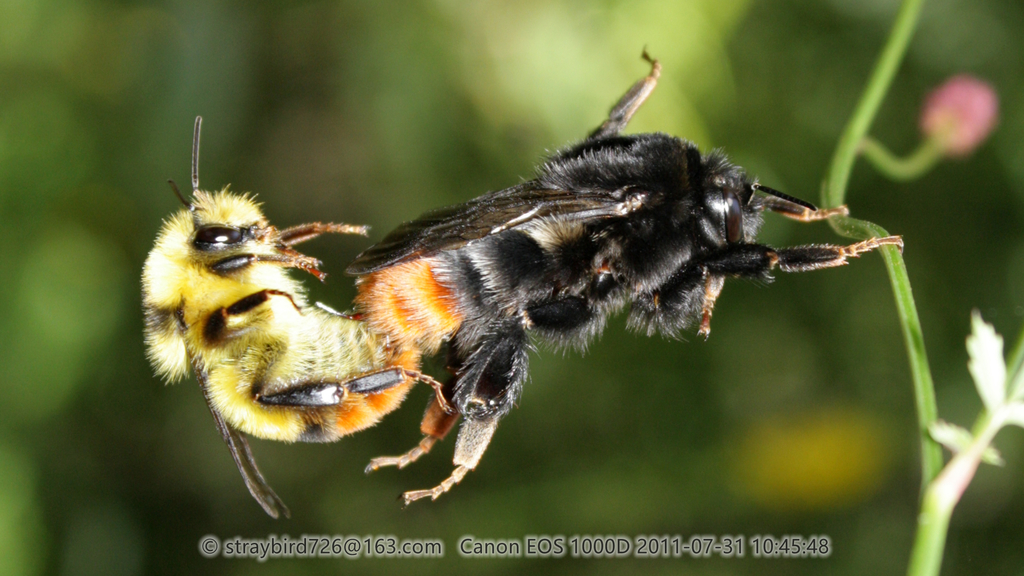
Fiery-tailed Bumble Bee
Bombus ignitus
Bombus ignitus is a species of bumblebee in the family Apidae. It is mainly distributed in Eastern Asia, commonly found in China, Japan and Korea. It is used in China and Japan commercially as a pollinator. B. ignitus is a eusocial insect with a queen that is monandrous: mating with only one male in the late summer before hibernating until the following spring. It builds its nest out of a mass of pollen and lays its eggs after completion. Due to numerous conflicts between queens and fertile workers, some surviving queens are badly injured, described by some as living corpses.
From the article Bombus ignitus on Wikipedia (CC BY-SA), quoted section by section
Description
Bombus ignitus is a large bee characterized by a medium length tongue. Females have black bristles that cover the back of the thorax and the mid-legs. The abdomen is separated into five tergum. Starting from the thorax, the first three terga are black in color, whereas the fourth and fifth terga are orange-red in color. Males are characterized by golden yellow bristles that form two bands on the anterior and posterior thorax. Like the female, the male has an abdomen separated into five tergum. Starting from the thorax, the first two terga are golden yellow in color, differentiating males from females. The third tergum is black in color. The fourth and fifth terga, like the female, is orange-red in color. Compared to the female, the male compound eye is small. The antenna of males are shorter than the antenna of females, reaching only to the base of the wings. Compared to the males of other bumblebee species, the males of B. ignitus have greatly broadened penis valves that flare outwards to form a funnel shape. The queen has a body length of 19 mm (0.75 in). Workers have a body length of 15–17 mm (0.59–0.67 in). Males have a body length of 17 mm (0.67 in).
Range & habitat
Bombus ignitus is found in the Palearctic realm, primarily in East Asia. This includes the more humid and temperate areas China, Japan, and Korea. Populations of B. ignitus can be found at a mean altitude of 1425 m at the western, southern, and eastern foothills of the Sichuan Basin. Though uncommon, populations have been found at lower altitudes.
Wikipedia: “Distribution and habitat”
What it does
Bombus ignitus is monandrous; the queen mates with only a single drone to form a colony. All workers and new queens, as a result, are descendants of the queen and a single drone. This monandrous behavior decreases the amount of genetic variation present in a single colony relative to that of a polygynous or polyandrous species.
Wikipedia: “Mating behavior”
In medicine
The protein BiVSPI, Found in the venom of B. ignitus, has been identified as a serine protease inhibitor. BiVSPI exhibits antimicrobial functions, and has been found to inhibit the growth of Gram-positive bacteria and fungi. The cDNA of four antibacterial peptide genes - apidaecin, hymenoptaecin, abaecin, and defensin - were isolated and cloned from B. ignitus. Synthesized abaecin has been shown to inhibit the growth of Gram- negative bacteria, but had little inhibitory effect towards the growth of Gram-positive bacteria.
== References ==
Wikipedia: “Medical”
How it is grown
Bombus ignitus is currently used for agricultural pollination in China and Japan. The species has been chosen as a reliable species for commercial mass-production in Korea, though issues of diapause management must still be addressed. B. ignitus was chosen over the already established bumblebee, Bombus terrestris, for fear of competition or genetic contamination by mating with native bumblebee species.
Wikipedia: “Agricultural”
Listen
Looking for field recordings…
Where it lives
Recorded sightings
—
geo-referenced records in GBIF, from museums, herbaria and field observers.
Drag the globe to turn it. Dots are where records exist, not a range map; darker means more records.
In the stacks
Searching the stacks…
Every page naming Bombus ignitus in the Biodiversity Heritage Library →
This page is assembled live from iNaturalist, GBIF, Wikipedia, the Source Library and the Internet Archive. It is not yet part of the hand-edited codex. iNaturalist taxon 428357.