- Animals
- ›Chordates
- ›Vertebrates
- ›Mammals
- ›Therians
- ›Marsupials
- ›Kangaroos, Possums, Wombats, and Allies
- ›Cuscuses, Brush-tailed Possums, and Pygmy Possums
- ›Cuscuses and Brush-tailed Possums
- ›Grey and Spotted Cuscuses
- ›Phalanger
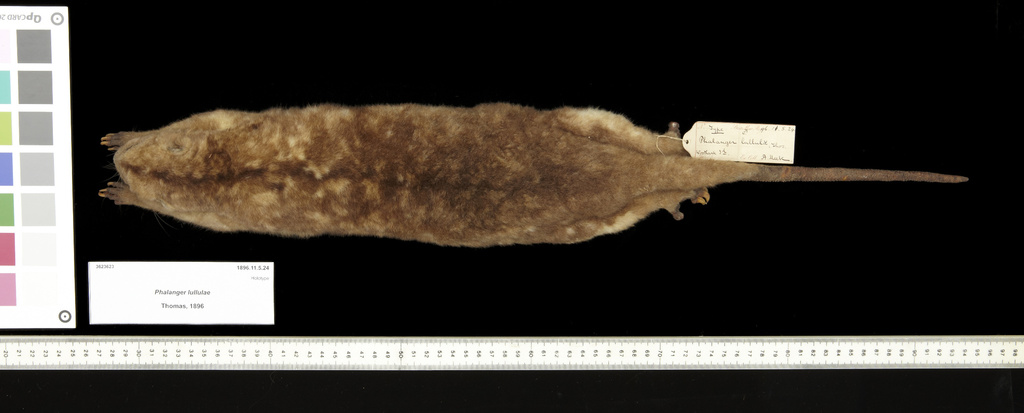
Woodlark Cuscus
Phalanger lullulae
The Woodlark cuscus (Phalanger lullulae) is a species of marsupial in the family Phalangeridae endemic to Papua New Guinea, specifically on Madau and Woodlark Island, a part of the Milne Bay Province of Papua New Guinea. It happens to be the largest mammal living on Woodlark Island but it is also found on the neighboring island of Alcester, 70 kilometers south of Woodlark Island.
From the article Woodlark cuscus on Wikipedia (CC BY-SA), quoted section by section
Range & habitat
This possum lives its arboreal life in primary and secondary tropical forests with a preference for the dry lowland forest. The hunters on Woodlark Island claim that the Phalanger lullalae finds shelter under the epiphytes and inside tree hollows during the day. Since the dry lowland forest makes up the Eastern half of Woodlark Island, there is a higher prominence of these possums here compared to the dense rain forests of the Western half of the Island.
Wikipedia: “Habitat”
What it does
The behaviors that occur among male and female Woodlark cuscus before, during, and after mating have not yet been observed. However, the capture of five female Woodlark cuscuses in August 1987 led to the following interesting observations: one of the females were parous but did not have any young while another was clearly lactating. Two others had its naked young in their pouches while one of them had its older young on its back. This transition from the pouch of the mother to the back of the mother as the young age is typical in the Phalanger lullulae because they are metatherians and this transition is typical metatherian behavior. The various states of the young and female cuscuses were in demonstrate that the breeding season most likely happens over a long period of time. It has also been noted that they give birth to single young. Another aspect of the Woodlark cuscus' metatherian identity can be seen the composition of the mother's milk. As the young grow, the carbohydrate, lipid, and protein compositions in the mother's milk fluctuates in accordance to the stage the young P. lullulae is in as it grows. The tiny young will feed on milk that is very dilute and composed of simple sugars while the older ones feed on more concentrated milk.
Wikipedia: “Reproduction and development”
In human culture
The generic name, Phalanger, is of Greek origin and means "spider's web." This name is given in reference to their syndactyly that exists on their hind feet. Its specific name, lullulae, is Latin in origin and is the Latin translation of "Woodlark."
Wikipedia: “Etymology”
Listen
Looking for field recordings…
Where it lives
Recorded sightings
—
geo-referenced records in GBIF, from museums, herbaria and field observers.
Drag the globe to turn it. Dots are where records exist, not a range map; darker means more records.
In the stacks
Searching the stacks…
Every page naming Phalanger lullulae in the Biodiversity Heritage Library →
This page is assembled live from iNaturalist, GBIF, Wikipedia, the Source Library and the Internet Archive. It is not yet part of the hand-edited codex. iNaturalist taxon 42824.