- Animals
- ›Chordates
- ›Vertebrates
- ›Mammals
- ›Therians
- ›Marsupials
- ›Kangaroos, Possums, Wombats, and Allies
- ›Gliders, Ring-tailed Possums, and allies
- ›Ring-tailed Possums and Greater Gliders
- ›Typical Ring-tailed Possums
- ›Pseudocheirus
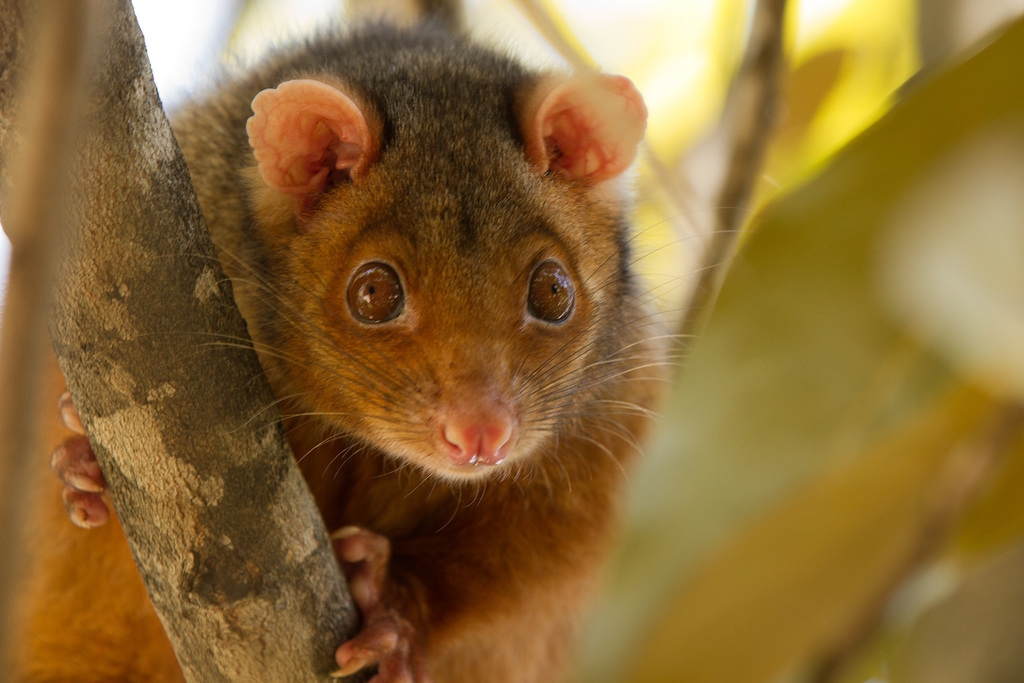
Eastern Ring-tailed Possum
Pseudocheirus peregrinus
The common ringtail possum (Pseudocheirus peregrinus, Greek for "false hand" and Latin for "pilgrim" or "alien") is an Australian marsupial.
The possum lives in a variety of habitats and eats a variety of leaves of both native and introduced plants, as well as flowers, fruits and sap. It also consumes caecotropes, which are material fermented in the caecum and expelled during the daytime when it is resting in a nest. This behaviour is called caecotrophy and is similar to that seen in rabbits.
From the article Common ringtail possum on Wikipedia (CC BY-SA), quoted section by section
Description
The common ringtail possum weighs between 550 and 1,100 g (19 and 39 oz) and is approximately 30–35 cm (12–14 in) long when grown (excluding the tail, which is roughly the same length again). It has grey or black fur with white patches behind the eyes and usually a cream-coloured belly. It has a long prehensile tail which normally displays a distinctive white tip over 25% of its length. The back feet are syndactyl, which helps it to climb. The ringtail possum's molars have sharp and pointed cusps.
Range & habitat
The common ringtail possum ranges on the east coast of Australia, as well as Tasmania and a part of southwestern Australia. They generally live in temperate and tropical environments and are rare in drier environments. Ringtail possums prefer forests of dense brush, particularly eucalyptus forests. The common ringtail possum and its relatives occupy a range of niches similar to those of lemurs, monkeys, squirrels, and bushbabies in similar forests on other continents. It is less prolific and less widespread than the common brushtail possum.
Wikipedia: “Distribution and habitat”
What it does
The common ringtail possum is nocturnal and well adapted to arboreal life. It relies on its prehensile tail and sometimes will descend to the ground. They communicate with soft, high-pitched, and twittering calls.
Diet and foraging. The common ringtail possum feeds on a wide variety of plants in the family Myrtaceae including the foliage, flowers and fruits from shrubs and lower canopy. Some populations are also known to feed on the leaves of cypress pine (Callitris), wattles (Acacia spp.) and plant gum or resins. When foraging, ringtail possums prefer young leaves over old ones. One study found the emergence of young possums from their pouches corresponds to the flowering and fruiting of the tea-tree, Leptospermum and the peak of fresh plant growth. Young eucalypt leaves are richer in nitrogen and have less dense cell walls than older leaves; however, the protein gained from them is less available due to higher amounts of tannins. When feeding, the possum's molars slice through the leaves, slitting them into pieces. The possum's gastrointestinal tract sends the fine particles to the caecum and the coarse ones to the colon. …
Wikipedia: “Behaviour”
Listen
Looking for field recordings…
Where it lives
Recorded sightings
—
geo-referenced records in GBIF, from museums, herbaria and field observers.
Drag the globe to turn it. Dots are where records exist, not a range map; darker means more records.
In the stacks
Searching the stacks…
Every page naming Pseudocheirus peregrinus in the Biodiversity Heritage Library →
This page is assembled live from iNaturalist, GBIF, Wikipedia, the Source Library and the Internet Archive. It is not yet part of the hand-edited codex. iNaturalist taxon 42775.