- Animals
- ›Chordates
- ›Vertebrates
- ›Mammals
- ›Therians
- ›Marsupials
- ›Kangaroos, Possums, Wombats, and Allies
- ›Gliders, Ring-tailed Possums, and allies
- ›Feather-tailed Gliders and Possums
- ›Acrobates
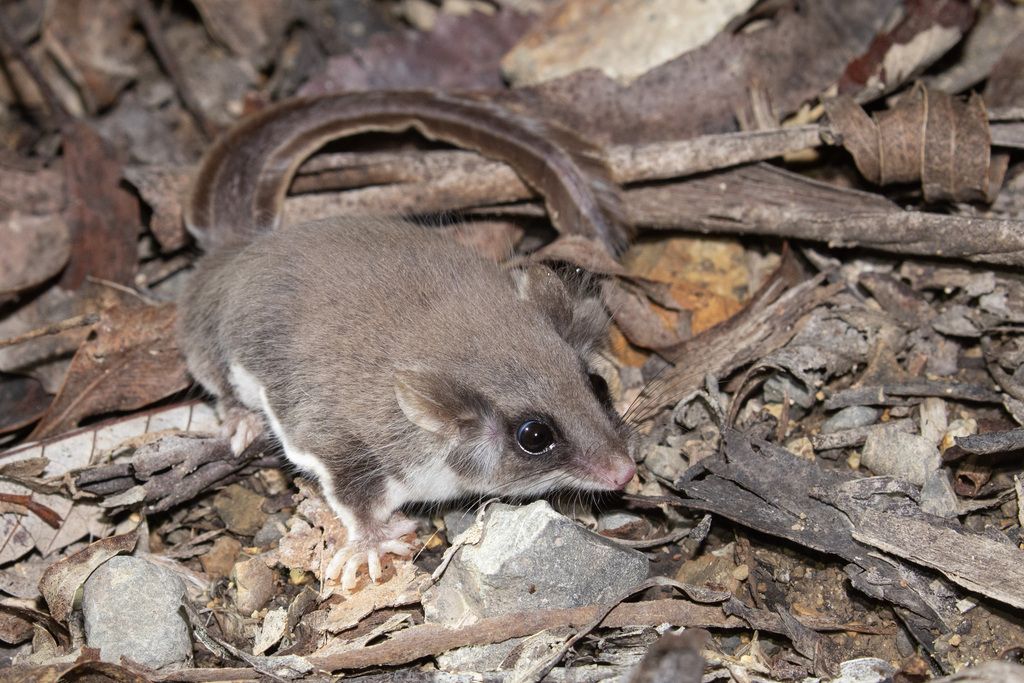
Narrow-toed Feather-tailed Glider
Acrobates pygmaeus
The feathertail glider (Acrobates pygmaeus), also known as the pygmy gliding possum, pygmy glider, pygmy phalanger, flying phalanger and flying mouse, is a species of marsupial native to eastern Australia. It is the world's smallest gliding mammal and is named for its long feather-shaped tail.
A second species, the broad-toed feathertail glider (Acrobates (Dromicia) frontalis, De Vis 1887) is recognised by some authors based on unpublished genetic studies and cryptic morphological differences in toe and tail characteristics. With this recognition, it is suggested that Acrobates pygmaeus takes the common name narrow-toed feathertail glider.
From the article Feathertail glider on Wikipedia (CC BY-SA), quoted section by section
Description
At just 6.5–8 cm (2.6–3.1 in) in head-and-body length and weighing about 12 g (3⁄8 oz), the feathertail glider is only around the size of a small mouse, and is the world's smallest gliding mammal. The fur is soft and silky, and is a uniform greyish brown on the upper body, and white on the underside. There are rings of dark fur around the eyes, the rhinarium is hairless and deeply cleft, and the ears are moderately large and rounded. The glider also has an unusually large number of whiskers, sprouting from the snout and cheeks, and from the base of each ear. Like other gliding mammals, the feathertail glider has a patagium stretching between the fore and hind legs. Only reaching the elbows and knees, this is smaller than that of the petaurid gliding possums, although the presence of a fringe of long hairs increases its effective area. The tail is about the same length as the head and body combined, oval in cross-section, only slightly prehensile, and has very short fur except for two distinctive rows of long, stiff hairs on either side. This gives the tail the appearance of a feather or a double-sided comb. The hindfeet possess enlarged, opposable first digits, which unlike all the other toes on both fore and hind feet, lack claws. The tongue is long and thin, reaching as much as 11 mm (0.43 in), and has numerous long papillae that give it a brush-like appearance. …
Range & habitat
Feathertail gliders are found across the eastern seaboard of continental Australia, from northern Queensland to Victoria and extreme south-eastern South Australia. There are no recognised subspecies. They inhabit a wide range of forest types across the region, from sea level to at least 1,200 m (3,900 ft). Fossils belonging to the genus Acrobates have been identified from deposits in Queensland dating back to 0.5 million years ago, during the late Pleistocene.
Wikipedia: “Distribution and habitat”
What it does
Feathertail gliders are omnivorous, feeding on nectar, pollen, and arthropods such as moths, ants, and termites. They are arboreal, and although they do occasionally descend to the ground to forage, they spend as much as 87% of their time over 15 m (50 ft) above the ground, particularly in eucalyptus trees. They are nocturnal, spending the day resting in nests in tree hollows, lined with leaves or shredded bark. They are social animals, and up to five may share a single nest, especially during the breeding season. They are highly adept climbers, able to cling to the smooth trunks of eucalyptus trees. In experiments, they have even proved able to climb vertical panes of glass, a feat that is due to a combination of fine skin ridges and sweat that allow their feet to function as suction cups. Movement through the trees is aided by their gliding ability; they are able to glide as far as 28 m (92 ft), and typically do so three to five times every hour through the night. Feathertail gliders do not hibernate as such, but are capable of entering torpor during cold weather at any time of the year. Torpor can last for several days, during which time the animal's body temperature can drop to as low as 2 °C (36 °F) and oxygen consumption to just 1% of normal. …
Wikipedia: “Behaviour and biology”
In human culture
A feathertail glider was featured on the reverse of the Australian 1-cent coin until 1991 when the 1-cent denomination was discontinued.
Wikipedia: “In culture”
Listen
Looking for field recordings…
Where it lives
Recorded sightings
—
geo-referenced records in GBIF, from museums, herbaria and field observers.
Drag the globe to turn it. Dots are where records exist, not a range map; darker means more records.
In the stacks
Searching the stacks…
Every page naming Acrobates pygmaeus in the Biodiversity Heritage Library →
This page is assembled live from iNaturalist, GBIF, Wikipedia, the Source Library and the Internet Archive. It is not yet part of the hand-edited codex. iNaturalist taxon 42715.