- Animals
- ›Chordates
- ›Vertebrates
- ›Mammals
- ›Therians
- ›Marsupials
- ›Opossums
- ›Opossums
- ›Large American Opossums, Mouse Opossums, and Allies
- ›Large New World Opossums
- ›Didelphis
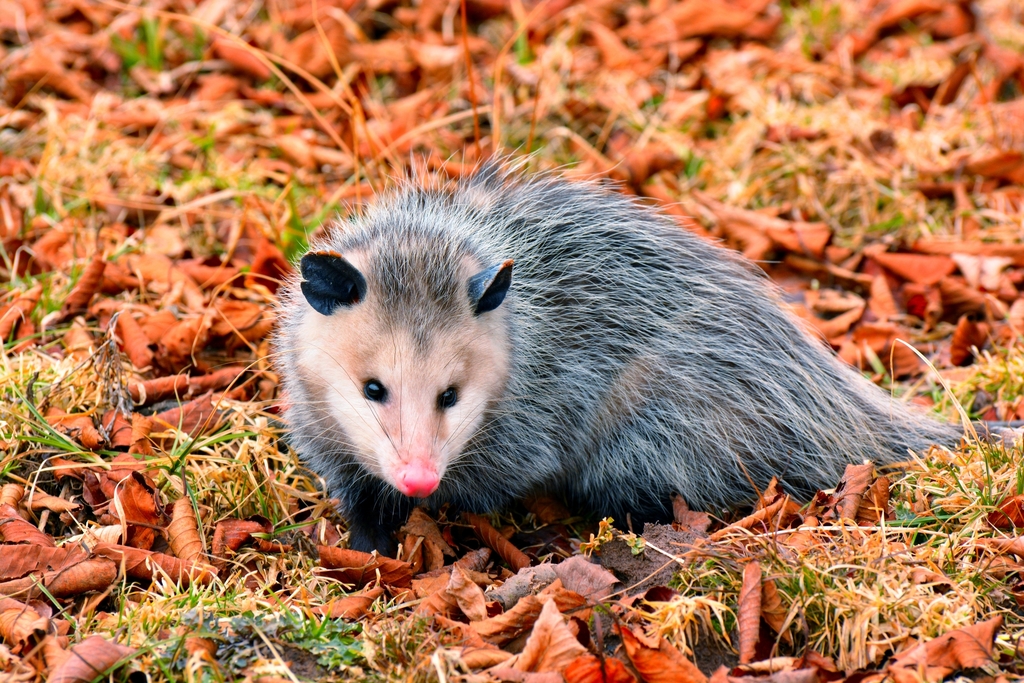
Virginia Opossum
Didelphis virginiana
The Virginia opossum (Didelphis virginiana), also known as the North American opossum, is a member of the opossum family found from southern Canada to northern Costa Rica, making it the northernmost marsupial in the world. Commonly referred to simply as the possum, it is a solitary nocturnal animal about the size of a domestic cat, and a successful opportunist.
Opossums are familiar to many North Americans as they frequently inhabit settled areas near food sources like trash cans, pet food, compost piles, gardens or housemice. Their slow, nocturnal nature and their attraction to roadside carrion make opossums more likely to become roadkill than other animals in their range.
From the article Virginia opossum on Wikipedia (CC BY-SA), quoted section by section
Description
Virginia opossums can vary considerably in size, with larger specimens found to the north of the opossum's range and smaller specimens in the tropics. They measure 33–55 cm (13–22 in) long from their snout to the base of the tail, with the tail adding another 25–54 cm (9.8–21.3 in). Males are slightly larger, with an average body length of 40.8 cm (16.1 in) with an average tail length of 29.4 cm (11.6 in), while females are 40.6 cm (16.0 in) long with a 28.1 cm (11.1 in) tail. Weight for males ranges from 2.1–2.8 kg (4.6–6.2 lb) and for females from 1.9–2.1 kg (4.2–4.6 lb). Their coats are a dull grayish brown, other than on their faces, which are white. Opossums have long, hairless, prehensile tails, which can be used to grab branches and carry small objects. They also have hairless ears and a long, flat nose. Opossums have 50 teeth, more than any other North American land mammal, and opposable, clawless thumbs on their rear limbs. Opossums have 13 nipples, arranged in a circle of 12 with one in the middle. The dental formula of an opossum is 5.1.3.44.1.3.4. No other mammal in North America has more than 6 upper incisors, while the Virginia opossum has 10. Despite being such a widespread and successful species, the Virginia opossum has one of the lowest encephalization quotients of any marsupial. Its brain is one-fifth the size of a raccoon's.
Tracks. …
Range & habitat
The Virginia opossum's ancestors evolved in South America, but spread into North America as part of the Great American Interchange, which occurred mainly after the formation of the Isthmus of Panama about 3 million years ago. Didelphis was apparently one of the later migrants, entering North America about 0.8 million years ago. It is now found throughout Central America and North America from Costa Rica to southern Ontario and is expanding its range northward, northwesterly and northeasterly at a significant pace. Its pre-European settlement range was generally as far north as Maryland; southern Ohio, Indiana and Illinois; Missouri and Kansas. The clearing of dense forests in these areas and further north by settlers allowed the opossum to move northward. Elimination of the opossum's main predators in these areas also contributed to their expansion. Since 1900, it has expanded its range to include most of New England (including Maine); New York, extreme southwestern Quebec; most of southern and eastern Ontario; most of Michigan and Wisconsin; most of Minnesota, southeastern South Dakota and most of Nebraska. Areas such as Rhode Island and Waterloo Region and Simcoe County in southern Ontario rarely had sightings of opossums in the 1960s, but now have them regularly; some speculate that this is likely due to global warming causing winters to be warmer. …
Wikipedia: “Range”
What it does
Opossums are omnivorous and eat a wide range of plant-based food, as well as animal-based food like small invertebrates, carrion, eggs, fish, amphibians, reptiles, birds, small mammals, and other small animals. Insects such as grasshoppers, crickets, and beetles make up the bulk of the animal foods eaten by opossums. It is a common misconception that opossums eat up to 95% of the ticks they encounter and it is claimed they may eat up to 5,000 ticks per season, preventing the spread of tick-born illnesses, including Lyme disease and Rocky Mountain spotted fever. A widely publicized 2009 study by the Cary Institute theorized that Virginia opossums in a laboratory setting could eat thousands of ticks per week by grooming. However, a 2021 study of the stomach contents of wild Virginia opossums in Illinois did not find any ticks in their diet. No scientific paper as of 2023 has reported ticks in the stomach contents of Virginia opossums. Small animals include young rabbits, meadow voles, mice, rats, birds, snakes, lizards, frogs, fish, crayfish, gastropods, and earthworms. The Virginia opossum has been found to be very resistant to snake venom,, due to unique blood proteins such as lethal toxin neutralizing factor. …
Wikipedia: “Diet”
Listen
Looking for field recordings…
Where it lives
Recorded sightings
—
geo-referenced records in GBIF, from museums, herbaria and field observers.
Drag the globe to turn it. Dots are where records exist, not a range map; darker means more records.
In the stacks
Searching the stacks…
Every page naming Didelphis virginiana in the Biodiversity Heritage Library →
This page is assembled live from iNaturalist, GBIF, Wikipedia, the Source Library and the Internet Archive. It is not yet part of the hand-edited codex. iNaturalist taxon 42652.