- Plants
- ›Vascular Plants
- ›flowering plants
- ›Dicots
- ›Sunflowers, Bellflowers, Fanflowers, and Allies
- ›Sunflowers, Daisies, Asters, and Allies
- ›Vernonioideae
- ›Arctotideae
- ›Arctotidinae
- ›Arctotheca
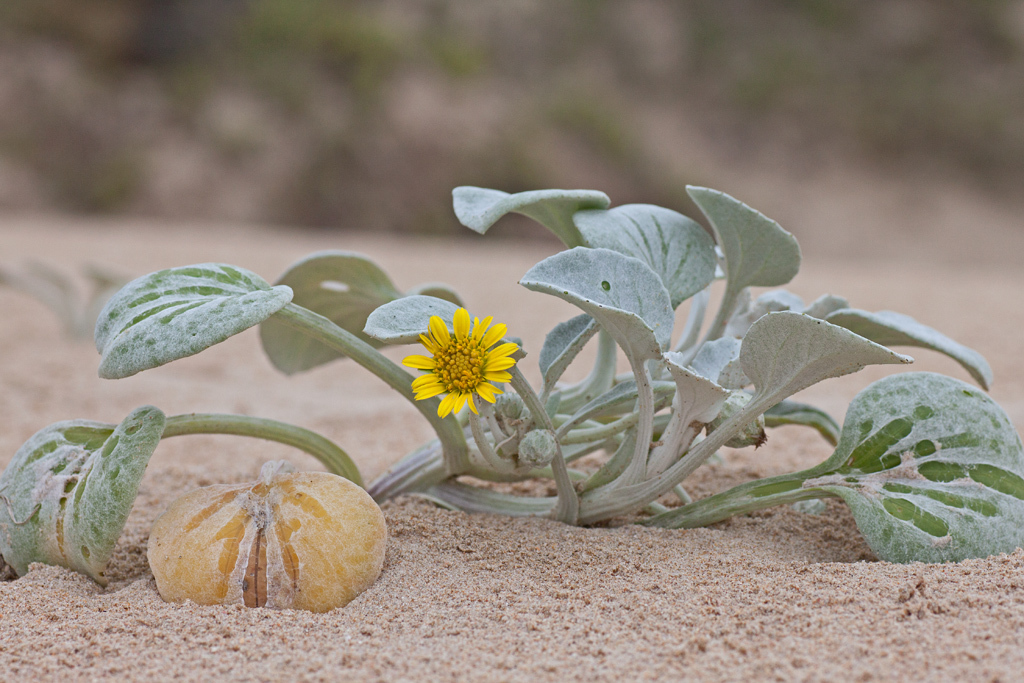
Cape Beach Daisy
Arctotheca populifolia
Arctotheca populifolia is a species of flowering plant in the family Asteraceae known by the common names beach daisy, Cape beach daisy, South African beach daisy, coast capeweed, dune arctotheca, beach pumpkin, sea pumpkin, dune cabbage, and in South Africa, seepampoen, tonteldoek, and strandgousblom. This species is native to coastal areas of the Cape Provinces and KwaZulu-Natal in South Africa, and of Mozambique. It was introduced to Australia and is now a common weed of coastal areas in New South Wales, South Australia, Tasmania, Victoria, and Western Australia.
From the article Arctotheca populifolia on Wikipedia (CC BY-SA), quoted section by section
Description
This plant is a perennial herb with thick, ribbed, decumbent stems growing in clumps up to 30 centimeters tall. The herbage is woolly, gray, and fleshy. The white-haired leaves have oval blades up to 6 centimeters long by 5 wide, with smooth or toothed edges. The inflorescence is borne on a woolly, erect peduncle up to 11 centimeters tall. The flower head is about 2 centimeters wide with yellow ray florets 5 to 7 millimeters long and yellow disc florets in the center. The fruit is a white-woolly cypsela about half a centimeter long.
What it does
This plant is a pioneer species of sandy coastal habitat types, such as dunes. It is a main factor in the formation of dune hummocks, a dune type formed in its native South Africa when wind deposits sand around it and other newly established beach plants. One small form of dune hummock is a nabkha. This plant and its associate Gazania rigens form nabkhas that are inhabited by a variety of small animals such as nematodes and the sand flea Talorchestia capensis. The ability of the plant to colonize bare sand has helped it take hold on the Australian coastline. It was planted for beach stabilization in Western Australia until it became apparent that it was invasive. Native Spinifex grasses are now used for this purpose. The beach daisy is now a coastal weed of much of temperate Australia. It can also grow on basaltic soils, allowing it to move inland from beaches to grasslands. The seeds of the plant are wind-dispersed, but because they remain viable in fresh and salt water, they are also commonly dispersed on the water. As a coastal species, they are carried on ocean currents. The seeds can also be transported in soil and plant waste. As an invasive species, it competes with native plants such as hairy spinifex (Spinifex sericeus). It binds sand more efficiently, holding more of it and thus changing the topography of the dune systems. …
Wikipedia: “Ecology”
Where it lives
Recorded sightings
—
geo-referenced records in GBIF, from museums, herbaria and field observers.
Drag the globe to turn it. Dots are where records exist, not a range map; darker means more records.
In the stacks
Searching the stacks…
Every page naming Arctotheca populifolia in the Biodiversity Heritage Library →
This page is assembled live from iNaturalist, GBIF, Wikipedia, the Source Library and the Internet Archive. It is not yet part of the hand-edited codex. iNaturalist taxon 424293.