- Animals
- ›Chordates
- ›Vertebrates
- ›Mammals
- ›Therians
- ›Placental Mammals
- ›Ungulates, Carnivorans, and Allies
- ›Carnivorans
- ›Mongooses
- ›Solitary Mongooses
- ›Ichneumia
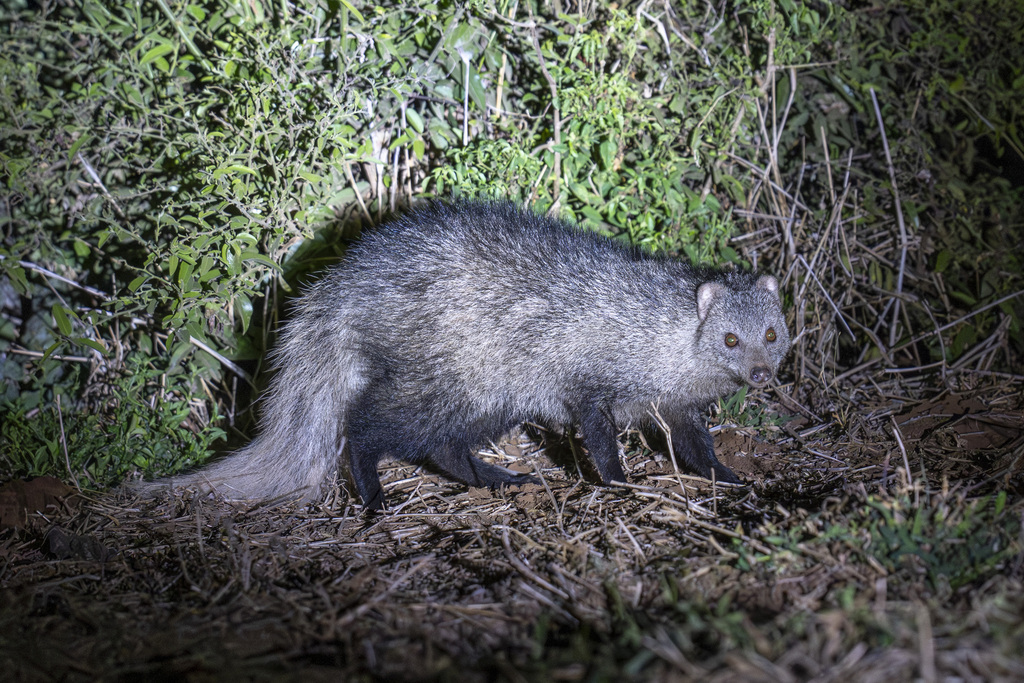
White-tailed Mongoose
Ichneumia albicauda
The white-tailed mongoose (Ichneumia albicauda) is on average the largest species in the mongoose family (Herpestidae). It is the only member of the genus Ichneumia.
From the article White-tailed mongoose on Wikipedia (CC BY-SA), quoted section by section
Description
The white-tailed mongoose attains a weight range of 1.8 to 5.2 kg (4.0 to 11.5 lb), with an average of approximately 3.38 kg (7.5 lb), has a head-and-body length of 53 to 71 cm (21 to 28 in) and a tail length of 40 to 47 cm (16 to 19 in). On average it appears to be the longest and heaviest extant species of mongoose, although its linear and body mass parameters broadly overlap with other larger mongoose species, in particular, the marsh mongoose seems to most closely rival (and possibly match) in range of body masses reported if not average weight. Its legs are relatively long for a mongoose. The head is long and narrow. Its large, rounded ears are set low on the sides of the head. It has a yellow to tan coloration on its body, with long black guard hairs, giving it an overall grizzled grey appearance. Distal from the tibiofemoral joint, the legs are black. The base of the large, bushy tail is brownish yellow, and on its distal half, and the tail is white as its name suggests. This appendage may comprise up to 40% of the creature's body length. This species lacks hair on its upper lip and on the forepaws. Females have four teats.
Wikipedia: “Characteristics”
Range & habitat
The white-tailed mongoose lives in most of Africa south of the Sahara, and the southern portion of the Arabian Peninsula. It lives in a wide range of habitats, from semi-desert to savanna woodland, but avoid moist areas like the Congo River basin or extremely arid areas. It prefers areas of thick cover, such as the edges of forests and brushy streams. In the East Sudanian Savanna, it was recorded in the transboundary Dinder–Alatash protected area complex during surveys between 2015 and 2018. Further northeast, it is also frequent in the Degua Tembien massif.
Wikipedia: “Distribution and habitat”
What it does
The white-tailed mongoose is primarily nocturnal and terrestrial. By day they will rest in an abandoned burrow, termite mound, or in cavities under tree roots. The average home range is 0.97 km2 (0.37 sq mi) for males and 0.64 km2 (0.25 sq mi) for females. Ranges of males do not overlap, but ranges of opposite sexes overlap significantly. Females either live alone with their own offspring or in a small group with other females and their offspring, although they do not associate with each other. Though they may share a range, they forage separately. They are, for the most part, solitary creatures, with the male and female only coming together to mate. Reports of groups are either a breeding pair or a mother and her offspring. These mongooses do not migrate except to establish their own territory away from their mother's range. These mongooses are very vocal, and make an unusual barking sound that is associated with sexual behavior. To ward off predators (such as humans and possibly large snakes and large birds of prey), they will secrete a noxious substance from their anal glands. They do not stand on their hind feet for any length of time like other mongooses.
Wikipedia: “Behaviour and ecology”
In human culture
The genus name, Ichneumia, is derived from the Greek ichneumon, which means 'tracker'. This name also happens to be the species and common name for the Egyptian mongoose (Herpestes ichneumon). The species name, albicauda, is derived from the Latin words albus, meaning 'white', and cauda, which means 'tail'.
Wikipedia: “Etymology”
Listen
Looking for field recordings…
Where it lives
Recorded sightings
—
geo-referenced records in GBIF, from museums, herbaria and field observers.
Drag the globe to turn it. Dots are where records exist, not a range map; darker means more records.
In the stacks
Searching the stacks…
Every page naming Ichneumia albicauda in the Biodiversity Heritage Library →
This page is assembled live from iNaturalist, GBIF, Wikipedia, the Source Library and the Internet Archive. It is not yet part of the hand-edited codex. iNaturalist taxon 41939.