- Animals
- ›Chordates
- ›Vertebrates
- ›Mammals
- ›Therians
- ›Placental Mammals
- ›Ungulates, Carnivorans, and Allies
- ›Carnivorans
- ›Mongooses
- ›Solitary Mongooses
- ›Herpestes
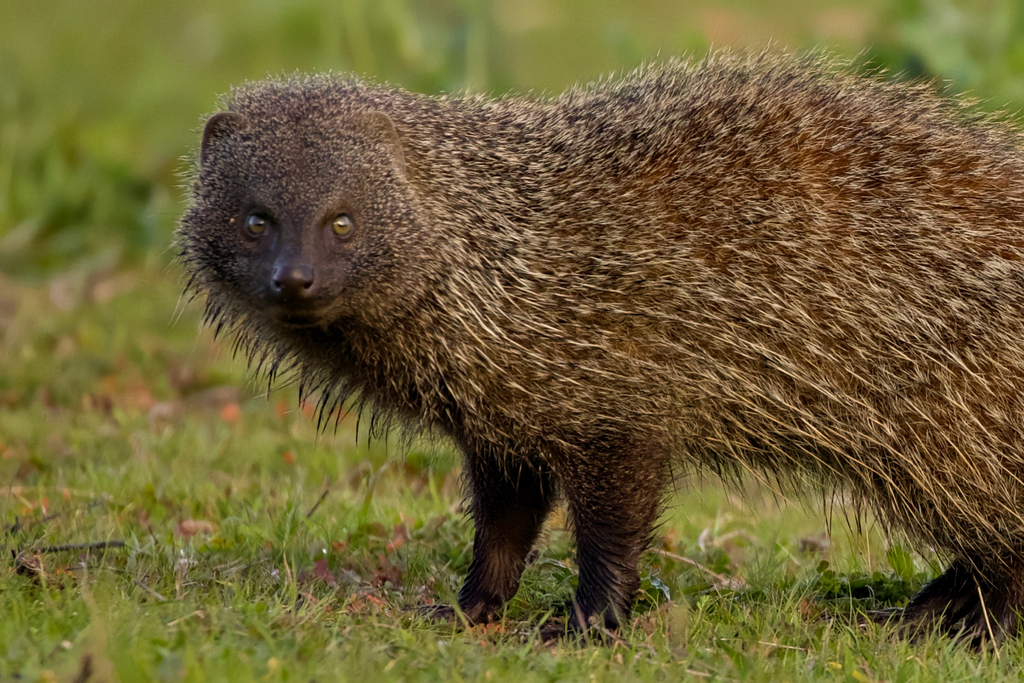
Egyptian Mongoose
Herpestes ichneumon
The Egyptian mongoose (Herpestes ichneumon), also known as ichneumon (), is a mongoose species native to the tropical and subtropical grasslands, savannas, and shrublands of Africa and around the Mediterranean Basin in North Africa, the Middle East and the Iberian Peninsula. Whether it is introduced or native to the Iberian Peninsula is in some doubt. Because of its widespread occurrence, it is listed as Least Concern on the IUCN Red List.
From the article Egyptian mongoose on Wikipedia (CC BY-SA), quoted section by section
Description
The Egyptian mongoose's long, coarse fur is grey to reddish brown and ticked with brown and yellow flecks. Its snout is pointed, its ears are small. Its slender body is 48–60 cm (1 ft 7 in – 2 ft 0 in) long with a 33–54 cm (1 ft 1 in – 1 ft 9 in) long black tipped tail. Its hind feet and a small area around the eyes are furless. It has 35–40 teeth, with highly developed carnassials, used for shearing meat. It weighs 1.7–4 kg (3.7–8.8 lb). Sexually dimorphic Egyptian mongooses were observed in Portugal, where some females are smaller than males. Female Egyptian mongooses have 44 chromosomes, and males 43, as one Y chromosome is translocated to an autosome.
Wikipedia: “Characteristics”
Range & habitat
The Egyptian mongoose lives in swampy and marshy habitats near streams, rivers, lakes and in coastal areas. Where it inhabits maquis shrubland in the Iberian Peninsula, it prefers areas close to rivers with dense vegetation. It does not occur in deserts. It has been recorded in Portugal from north of the Douro River to the south, and in Spain from the central plateau, Andalucía to the Strait of Gibraltar. In North Africa, it occurs along the coast of the Mediterranean Sea and the Atlas Mountains from Western Sahara, Morocco, Algeria and Tunisia into Libya, and from northern Egypt across the Sinai Peninsula. In Egypt, one individual was observed in Faiyum Oasis in 1993. In the same year, its tracks were recorded in sand dunes close to the coast near Sidi Barrani. An individual was observed on an island in Lake Burullus in the Nile Delta during an ecological survey in the late 1990s. In the Palestinian territories, it was recorded in the Gaza Strip and Jericho Governorate in the West Bank during surveys carried out between 2012 and 2016. In western Syria, it was observed in the Latakia Governorate between 1989 and 1995; taxidermied specimens were offered in local shops. In southern Turkey, it was recorded in the Hatay and Adana Provinces. In Sudan, it is present in the vicinity of human settlements along the Rahad River and in Dinder National Park. …
Wikipedia: “Distribution and habitat”
What it does
The Egyptian mongoose is diurnal. In Doñana National Park, single Egyptian mongooses, pairs and groups of up to five individuals were observed. Adult males showed territorial behaviour, and shared their home ranges with one or several females. The home ranges of adult females overlapped to some degree, except in core areas where they raised their offspring. It preys on rodents, fish, birds, reptiles, amphibians, and insects. It also feeds on fruit and eggs. To crack eggs open, it throws them between its legs against a rock or wall. In Doñana National Park, 30 Egyptian mongooses were radio-tracked in 1985 and their faeces collected. These samples contained remains of European rabbit (Oryctolagus cuniculus), sand lizards (Psammodromus), Iberian spadefoot toad (Pelobates cultripes), greater white-toothed shrew (Crocidura russula), three-toed skink (Chalcides chalcides), dabbling ducks (Anas), western cattle egret (Bubulcus ibis), wild boar (Sus scrofa) meat, Algerian mouse (Mus spretus) and rat species (Rattus). Research in southeastern Nigeria revealed that it also feeds on giant pouched rats (Cricetomys), Temminck's mouse (Mus musculoides), Tullberg's soft-furred mouse (Praomys tulbergi), Nigerian shrew (Crocidura nigeriae), Hallowell's toad (Amietophrynus maculatus), African brown water snake (Afronatrix anoscopus), and Mabuya skinks. It attacks and feeds on venomous snakes, an …
Wikipedia: “Behaviour and ecology”
In human culture
Mummified remains of four Egyptian mongooses were excavated in the catacombs of Anubis at Saqqara during works started in 2009. At the cemetery of Beni Hasan, an Egyptian mongoose on a leash is depicted in the tomb of Baqet I dating to the Eleventh Dynasty of Egypt. The Egyptian goddess Mafdet, who protected humans from snake and scorpion venom, was associated with the mongoose. The American poet John Greenleaf Whittier wrote a poem as an elegy for an ichneumon, which had been brought to Haverhill Academy in Haverhill, Massachusetts, in 1830. The long lost poem was published in the November 1902 issue of "The Independent" magazine. The Sherlock Holmes canon also features an ichneumon in the short story The Adventure of the Crooked Man, though due to Watson's description of its appearance and its owner's history in India it is likely to actually be an Indian grey mongoose.
Wikipedia: “In culture”
Listen
Looking for field recordings…
Where it lives
Recorded sightings
—
geo-referenced records in GBIF, from museums, herbaria and field observers.
Drag the globe to turn it. Dots are where records exist, not a range map; darker means more records.
In the stacks
Searching the stacks…
Every page naming Herpestes ichneumon in the Biodiversity Heritage Library →
This page is assembled live from iNaturalist, GBIF, Wikipedia, the Source Library and the Internet Archive. It is not yet part of the hand-edited codex. iNaturalist taxon 41900.