- Plants
- ›Vascular Plants
- ›flowering plants
- ›monocots
- ›grasses, sedges, cattails, and allies
- ›grasses
- ›Panicums, Bluestems, Paspalums, and Allies
- ›bristle, rosette, and barnyard grasses, and allies
- ›Anthephorinae
- ›Digitaria
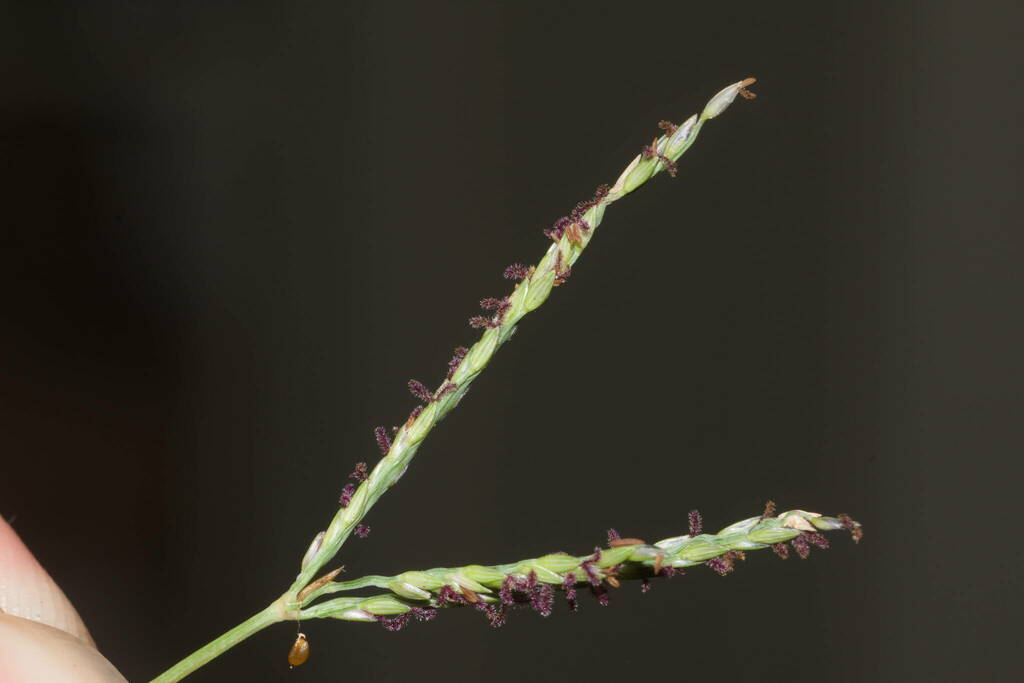
Blue Couch
Digitaria didactyla
Digitaria didactyla is a species of grass known by the common names blue couch, Queensland blue couch, blue serangoon grass, green serangoon grass, blue stargrass, and petit gazon (in Mauritius). It is native to Mauritius, Réunion, parts of mainland Africa, and Madagascar. It has been introduced widely outside its native range, mainly for use as a pasture and turf grass. It has naturalized in some regions.
From the article Digitaria didactyla on Wikipedia (CC BY-SA), quoted section by section
Description
This species is a mat-forming perennial grass with rhizomes and stolons. The stems can reach up to 63 centimeters long, but are generally 15 to 30 centimeters, with a creeping form, extending along the ground and rooting at the stem nodes. The narrow leaf blades are up to 7 centimeters long, usually hairless, and green to blue-green in color. The inflorescence has 2 to 4 thin, finger-like branches each up to 7 to 10 centimeters long. They are lined with pairs of small spikelets each under 3 millimeters long. The grass can grow into a dense, leafy stand up to 20 centimeters tall unless it is kept down, for example, with grazing. This species is similar to southern crabgrass (Digitaria ciliaris), but with fewer, narrower inflorescence branches. It is also similar to bermudagrass (Cynodon dactylon), but with shorter, wider leaves which are more blue in color.
At the table
This species has long been used as a pasture grass for grazing livestock. Animals find it palatable. It is also planted as a lawn and used as golf course turf. It is thought to be "one of the most popular lawn grasses in Queensland." It may be used as other forms of groundcover. It is very good for erosion control. Cultivars include 'Aussiblue' and 'Tropika', grey-green grass breeds recommended for turf use.
Wikipedia: “Uses”
Where it lives
Recorded sightings
—
geo-referenced records in GBIF, from museums, herbaria and field observers.
Drag the globe to turn it. Dots are where records exist, not a range map; darker means more records.
In the stacks
Searching the stacks…
Every page naming Digitaria didactyla in the Biodiversity Heritage Library →
This page is assembled live from iNaturalist, GBIF, Wikipedia, the Source Library and the Internet Archive. It is not yet part of the hand-edited codex. iNaturalist taxon 418635.