- Plants
- ›Vascular Plants
- ›flowering plants
- ›Dicots
- ›Roses, Elms, Figs, and Allies
- ›rose family
- ›brambles, roses, strawberries, and allies
- ›Brambles
- ›Rubus
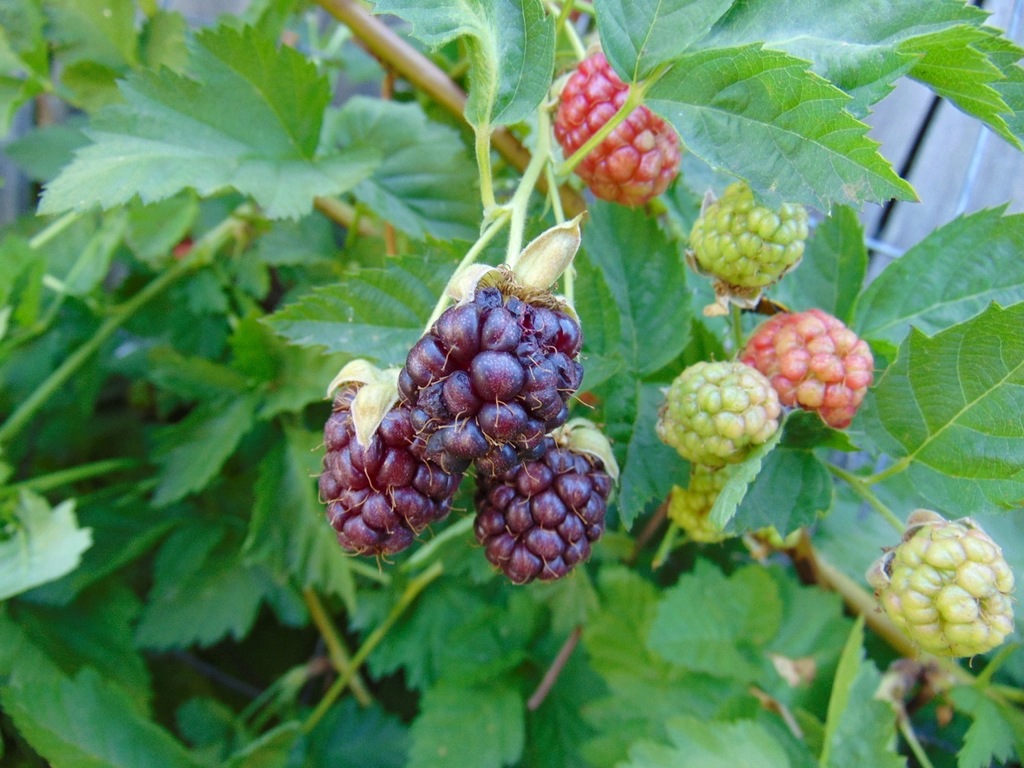
loganberry
Rubus × loganobaccus
The loganberry (Rubus × loganobaccus) is a hybrid of the North American blackberry (Rubus ursinus) and the European raspberry (Rubus idaeus), accidentally bred in 1881 by James Harvey Logan, for whom they are named. It is cultivated for its edible fruit.
From the article Loganberry on Wikipedia (CC BY-SA), quoted section by section
Description
The plant and the fruit resemble the blackberry more than the raspberry, but the fruit color is dark red rather than black.
At the table
Loganberries are consumed fresh or used for juice or in jams, pies, crumbles, fruit syrups, and country wines. In the UK, fresh or canned (tinned) loganberries are often paired with English sherry trifle, or their juice (or syrup) paired with the sherry. Loganberry is a popular beverage flavoring in Western New York and parts of Southern Ontario, beginning there as a drink sold at Crystal Beach Park in Crystal Beach, Ontario. Though the park has long been closed down, several companies still sell varieties of loganberry drinks through stores throughout the area, which are sold at several local fast-food franchises such as Mighty Taco in Buffalo, Sport of Kings Restaurant in Batavia, New York, as well as at supermarkets. Also, milkshakes are flavored with loganberry syrup.
Wikipedia: “Uses”
How it is grown
Loganberry plants are sturdy and more disease- and frost-resistant than many other berries. They are not very popular with commercial growers, though, due to several problems that increase labor costs: The plants tend to be thorny; the berries are often hidden by the leaves; and berries of varying maturity may grow on a single plant, making harvesting more complicated and less efficient, so loganberries are more commonly grown in household gardens. A loganberry bush usually produces about 10 canes (vines). The canes are not as upright as its raspberry parent, and tend instead to vine more like its blackberry parent. Growth can be undisciplined, with the canes growing five or more feet in a year. Some gardeners train the canes fanwise along a wall or a wire frame. Old canes die after their second year and should be cut away; they can become diseased, and they also hinder harvesting from newer growth. The loganberry fruits earlier than its blackberry parent. Fruit is produced for about two months, generally from midsummer until midautumn, with a plant at a given time mid-season bearing fruit in different stages, from blossom to maturity. The berries are generally harvested when they are a deep purple color, rather than red. Each bush can produce 7 to 8 kg (15 to 18 lb) of fruit a year. …
Wikipedia: “Cultivation”
In human culture
The 1896 book Santa Cruz County describes the loganberry thusly:The Loganberry originated with Judge J. H. Logan, of Santa Cruz, Cal., from whom it derives its name. Several years ago, growing in his garden, were plants of the 'Aughinbaugh' blackberry and 'Red Antwerp' raspberry. The plants, being near each other, had intermixed or grown together. The judge, having noticed that they bloomed and ripened their fruit together, conceived the idea of planting the seeds, from which planting resulted the production of the loganberry. He is entitled to all credit for the origination of this noble fruit, which will be a perpetual monument, placing his name beside those of Longworth, Hovey, Wilson, and other originators of new varieties of fruit. He has even done more than they. He has produced a fruit or berry entirely unlike any in previous existence, a hybrid or mixture of two fruits, partaking of the characteristics of both of its parents. The 'Aughinbaugh' blackberry, from the seed of which the Logan is supposed to have originated, has pistillate or imperfect flowers, which must have been fertilized by the pollen of the raspberry, producing this most singular and valuable fruit. The vines or canes of the loganberry grow entirely unlike either the blackberry or raspberry. They trail or grow upon the ground more like the dewberry. …
Wikipedia: “In culture”
Where it lives
Recorded sightings
—
geo-referenced records in GBIF, from museums, herbaria and field observers.
Drag the globe to turn it. Dots are where records exist, not a range map; darker means more records.
In the stacks
Searching the stacks…
Every page naming Rubus × loganobaccus in the Biodiversity Heritage Library →
This page is assembled live from iNaturalist, GBIF, Wikipedia, the Source Library and the Internet Archive. It is not yet part of the hand-edited codex. iNaturalist taxon 417619.