- Fungi Including Lichens
- ›Basidiomycete Fungi
- ›Higher Basidiomycetes
- ›Mushrooms, Bracket Fungi, Puffballs, and Allies
- ›Agaricomycetidae
- ›boletes and allies
- ›boletes
- ›Suillelloideae
- ›Caloboletus
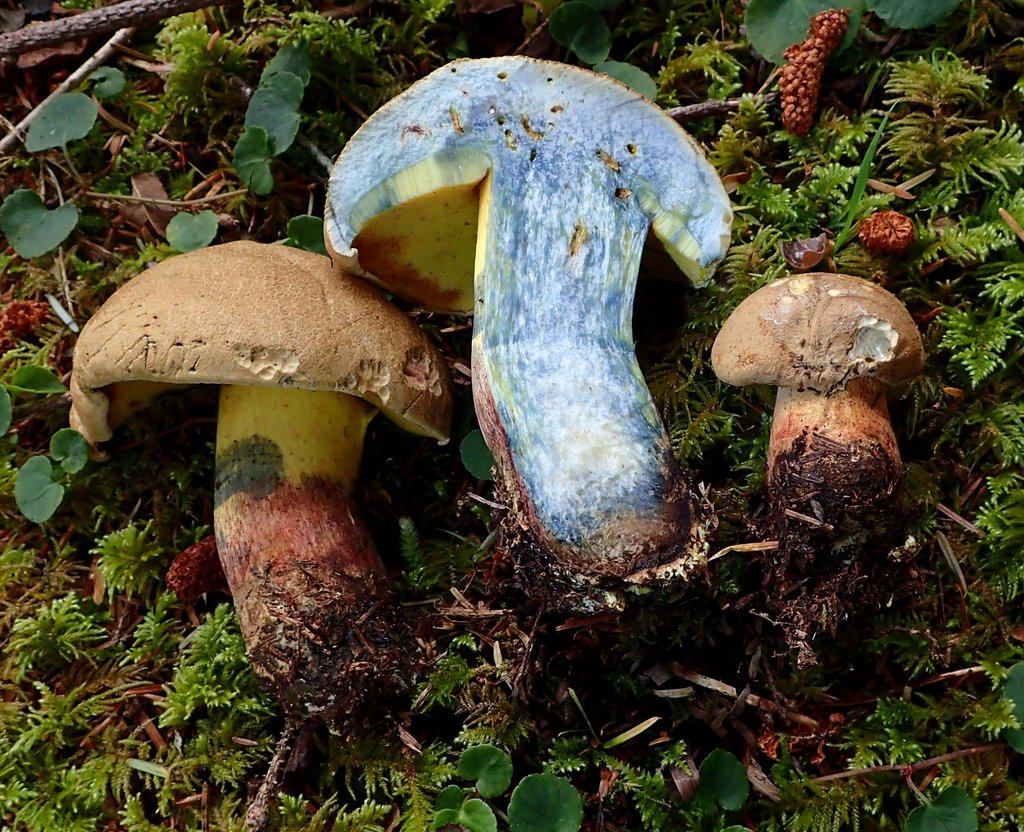
western bitter bolete
Caloboletus rubripes
Caloboletus rubripes, commonly known as the red-stipe bolete or the red-stemmed bitter bolete, is a mushroom in the family Boletaceae. It was known as Boletus rubripes until 2014. Fruit bodies (mushrooms) are robust, with caps up to 18 cm (7.1 in) in diameter, atop thick stipes 5–12 cm (2.0–4.7 in) long. Mushrooms are non-toxic, but is so bitter as to be inedible. The mushroom flesh has a very strong bluing reaction when cut or damaged. and forms mycorrhizal relationships, primarily...
From the article Caloboletus rubripes on Wikipedia (CC BY-SA), quoted section by section
Description
The cap is convex to cushion-shaped, before flattening out in maturity, attaining diameters of 4–20 cm (1+5⁄8–7+7⁄8 in). The cap margin is rolled or curved inward and remains that way until maturity. Its surface is dry, with a velvet-like to slightly hairy texture. It often develops cracks in age. The cap color is variable, ranging from buff to olive-buff to olive-brown; it stains brown when bruised or injured. The flesh is whitish to pale yellow, and will quickly turn blue when cut or exposed to air. The odor of the fruit body ranges from indistinct to unpleasant, and its taste is bitter. The pore surface on the underside of the cap is initially yellow before turning olive-yellow in age; it instantly turns blue when bruised. The angular pores number about 1–3 per millimeter and the tubes comprising the hymenophore are 8–16 mm (3⁄8–5⁄8 in) long. The stem measures 5–15 cm (2–5+7⁄8 in) long by 2–5 cm (3⁄4–2 in) wide, and either nearly equal in width throughout, clavate, or tapered slightly towards either end. The stem is solid (i.e., not hollow), and has a dry surface with slight longitudinal grooves. Its color is pinkish-red to purple-red except for a yellow region near the top and yellow mycelium at the base. The stem lacks reticulation or a ring. Caloboletus rubripes produces an olive-brown spore print. …
Range & habitat
The fruit bodies grow on the ground singly, scattered, or in clusters. They are usually found in coniferous forests, but also in association with oak. Found in North America, the distribution includes the Pacific Northwest region of the US (including Idaho), the southwestern US, and Mexico. They are particularly common in New Mexico and Colorado. Fruit bodies typically appear in the summer and fall. Alexander Smith has noted that they often appear with C. coniferarum and C. calopus.
Wikipedia: “Habitat and distribution”
At the table
The mushrooms are inedible owing to the bitter taste. They are used in mushroom dyeing to produce beige, light brown or light golden brown colors, depending on the mordant used.
Wikipedia: “Uses”
Where it lives
Recorded sightings
—
geo-referenced records in GBIF, from museums, herbaria and field observers.
Drag the globe to turn it. Dots are where records exist, not a range map; darker means more records.
In the stacks
Searching the stacks…
Every page naming Caloboletus rubripes in the Biodiversity Heritage Library →
This page is assembled live from iNaturalist, GBIF, Wikipedia, the Source Library and the Internet Archive. It is not yet part of the hand-edited codex. iNaturalist taxon 417357.