- Plants
- ›Vascular Plants
- ›flowering plants
- ›Dicots
- ›myrtles, evening primroses, and allies
- ›bushwillow family
- ›Terminalia
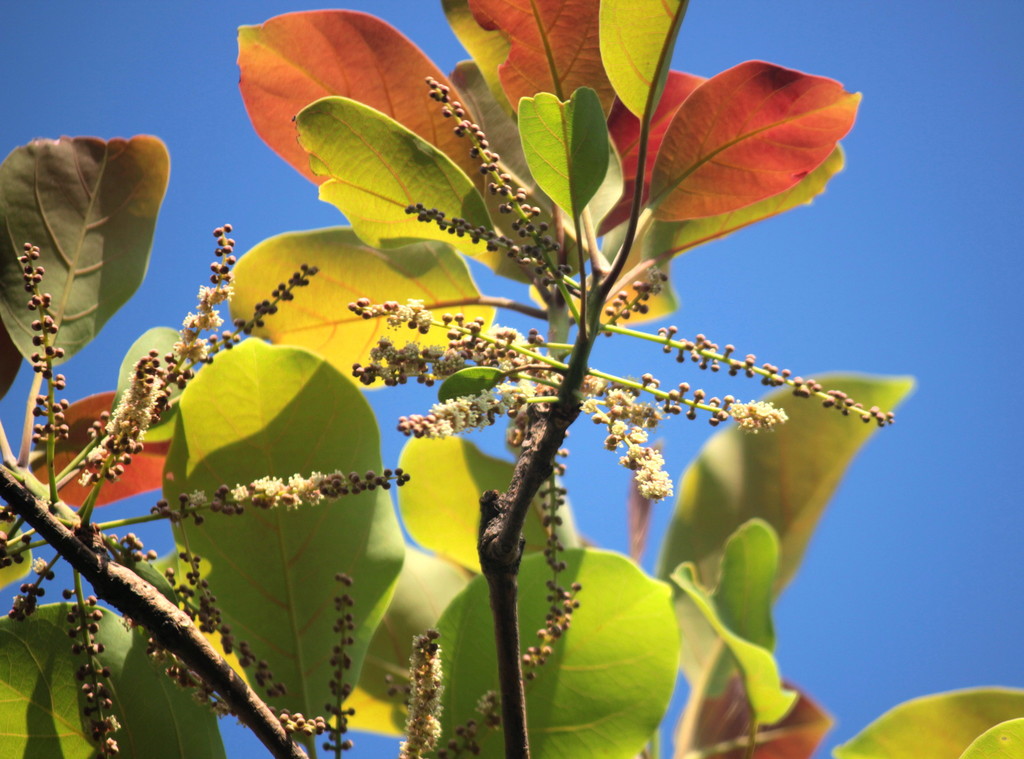
Bibhitaki
Terminalia bellirica
Terminalia bellirica, known as bahera, beleric or bastard myrobalan, is a large deciduous tree in the family Combretaceae. It is common on the plains and lower hills in South and Southeast Asia, where it is also grown as an avenue tree. The basionym is Myrobalanus bellirica Gaertn. (Fruct. Sem. Pl. 2: 90, t. 97. 1791). William Roxburgh transferred M. bellirica to Terminalia as "T. bellerica (Gaertn.) Roxb.". This spelling error is now widely used, causing confusion. The correct name is Terminalia bellirica (Gaertn.) Roxb.
From the article Terminalia bellirica on Wikipedia (CC BY-SA), quoted section by section
In medicine
In traditional Indian Ayurvedic medicine, beleric is known as "bibhitaki" (Marathi: "behada" or "bhenda") (Terminalia bellirica). Its fruit is used in the popular Indian herbal rasayana treatment triphala. In Sanskrit it is called bibhītaka बिभीतक. In India, Neemuch, a town in the Malwa region of Madhya Pradesh is a major trading centre of skinless baheda and entire fruits of T. bellirica. The fruits are widely collected in the wild in the Malwa region of Madhya Pradesh. According to Dymock, Warden, Hooper: Pharmacographia Indica (1890):
This tree, in Sanskrit Bibhita and Bibhitaka (fearless), is avoided by the Hindus of Northern India, who will not sit in its shade, as it is supposed to be inhabited by demons. Two varieties of T. belerica are found in India, one with nearly globular fruit, 1/2 to 3/4 inch in diameter, the other with ovate and much larger fruit. The pulp of the fruit (Beleric myrobalan) is considered by ayurvedic physicians to be astringent and laxative, and is prescribed with salt and long pepper in infections of the throat and chest. As a constituent of the triphala (three fruits), i.e., emblic, beleric and chebulic myrobalans, it is employed in a great number of diseases, and the kernel is sometimes used as an external application to inflamed parts. …
Wikipedia: “Medicinal use”
Where it lives
Recorded sightings
—
geo-referenced records in GBIF, from museums, herbaria and field observers.
Drag the globe to turn it. Dots are where records exist, not a range map; darker means more records.
In the old herbals & bestiaries


In the stacks
Searching the stacks…
Every page naming Terminalia bellirica in the Biodiversity Heritage Library →
This page is assembled live from iNaturalist, GBIF, Wikipedia, the Source Library and the Internet Archive. It is not yet part of the hand-edited codex. iNaturalist taxon 415642.