- Animals
- ›Chordates
- ›Vertebrates
- ›Mammals
- ›Therians
- ›Placental Mammals
- ›Ungulates, Carnivorans, and Allies
- ›Even-toed Ungulates and Cetaceans
- ›Cetaceans and Hippopotamuses
- ›Cetaceans
- ›Toothed Whales
- ›Oceanic Dolphins and Porpoises
- ›Porpoises
- ›Phocoena
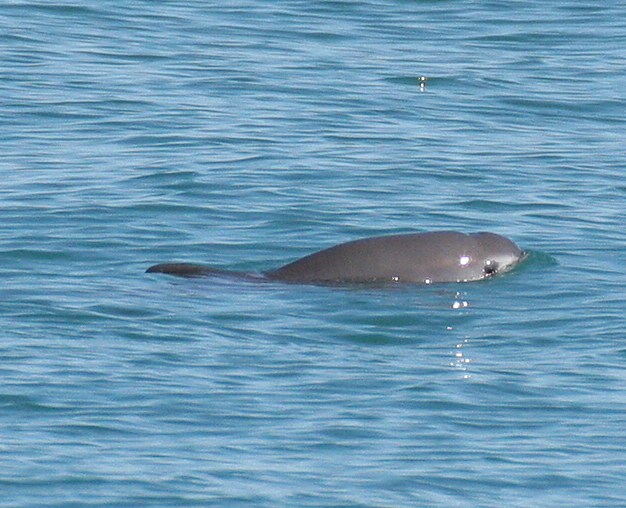
Vaquita
Phocoena sinus
The vaquita ( və-KEE-tə; Phocoena sinus) is a species of porpoise endemic to the northern end of the Gulf of California in Baja California, Mexico. Reaching a maximum body length of 150 cm (4.9 ft) (females) or 140 cm (4.6 ft) (males), it is the smallest of all living cetaceans. The species is currently on the brink of extinction, and is listed as Critically Endangered by the IUCN Red List; the steep decline in abundance is primarily due to bycatch in gillnets from the illegal totoaba fishery.
From the article Vaquita on Wikipedia (CC BY-SA), quoted section by section
Description
The smallest living species of cetacean, the vaquita can be easily distinguished from any other species in its range. It has a small body with an unusually tall triangular dorsal fin, a rounded head, and no distinguished beak. The coloration is mostly grey with a darker back and a white ventral field. Prominent black patches surround its lips and eyes. Sexual dimorphism is apparent in body size, with mature females being longer than males and having larger heads and wider flippers. Females reach a maximum size of about 150 cm (4.9 ft), while males reach about 140 cm (4.6 ft). Dorsal fin height is greater in males than in females. They are also known to weigh around 27 kg (60 lb) to 68 kg (150 lb). This makes them one of the smallest species in the porpoise family.
Range & habitat
Vaquita habitat is restricted to a small portion of the upper Gulf of California (also called the Sea of Cortez), making this the smallest range of any cetacean species. They live in shallow, turbid waters of less than 150 m (490 ft) depth.
Wikipedia: “Distribution and habitat”
What it does
Vaquitas are generalists, foraging on a variety of demersal fish species, crustaceans, and squids, though benthic fish such as grunts and croakers make up most of the diet.
Wikipedia: “Diet”
Listen
Looking for field recordings…
Where it lives
Recorded sightings
—
geo-referenced records in GBIF, from museums, herbaria and field observers.
Drag the globe to turn it. Dots are where records exist, not a range map; darker means more records.
In the stacks
Searching the stacks…
Every page naming Phocoena sinus in the Biodiversity Heritage Library →
This page is assembled live from iNaturalist, GBIF, Wikipedia, the Source Library and the Internet Archive. It is not yet part of the hand-edited codex. iNaturalist taxon 41443.