- Animals
- ›Chordates
- ›Vertebrates
- ›Mammals
- ›Therians
- ›Placental Mammals
- ›Ungulates, Carnivorans, and Allies
- ›Bats
- ›Yinpterochiroptera
- ›Rhinolophoid Bats
- ›Hog-nosed Bats
- ›Craseonycteris
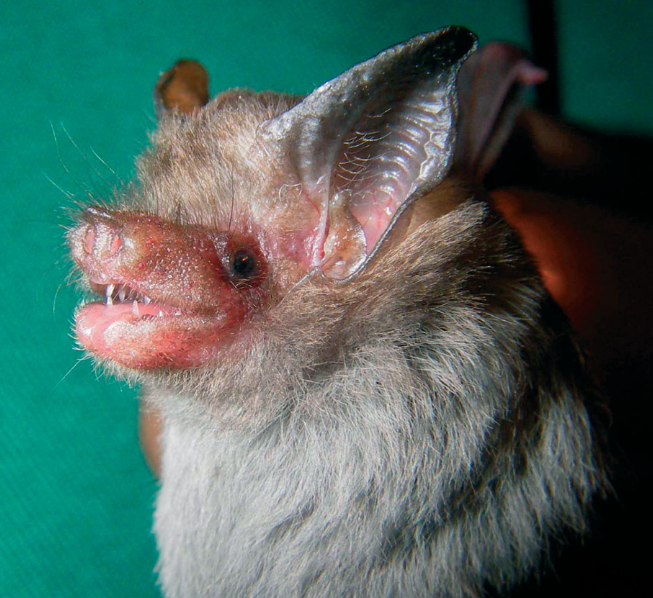
Bumblebee Bat
Craseonycteris thonglongyai
Kitti's hog-nosed bat (Craseonycteris thonglongyai), also known as the bumblebee bat or hog-nosed bat, is a near-threatened species of bat and the only extant member of the family Craseonycteridae. It occurs in western Thailand and southeast Myanmar, where it occupies limestone caves along rivers.
Kitti's hog-nosed bat is the smallest species of bat and arguably the world's smallest mammal by body length (the Etruscan shrew is regarded as the smallest by body mass). It has a reddish-brown or grey coat, with a distinctive pig-like snout. Colonies range greatly in size, with an average of 100 individuals per cave. The bat feeds during short activity periods in the evening and dawn, foraging around nearby forest areas for insects. Females give birth annually to a single offspring.
From the article Kitti's hog-nosed bat on Wikipedia (CC BY-SA), quoted section by section
Description
Kitti's hog-nosed bat measures approximately 29–33 mm (1.1–1.3 in) long and weighs around 2 g (0.071 oz), earning its common name "bumblebee bat". It is the smallest bat species and potentially the world's smallest mammal by body length, though this distinction depends on the measurement criteria used. The main competitors for the title are small shrews; in particular, the Etruscan shrew may be lighter at 1.2 to 2.7 g (0.042 to 0.095 oz) but its body is longer, measuring 36 to 53 mm (1.4 to 2.1 in) from its head to the base of the tail.
The bat has a distinctive swollen, pig-like snout with thin, vertical nostrils. Its ears are relatively large, while its eyes are small and mostly concealed by fur. In the jaw, the premaxillae are not fused with surrounding bones, and the coronoid process is significantly reduced. Its teeth are typical of an insectivorous bat. The dental formula is 1.1.1.32.1.2.3. The upper incisors are notably enlarged. The bat's upperparts are reddish-brown or grey, while the underside is generally paler. The wings are relatively large and darker in colour, with long tips that allow the bat to hover. The second digit of the wing is made of a single short phalanx, and the humerus has an increased number of locking tubercles on its head and beyond. …
Range & habitat
Kitti's hog-nosed bat occupies limestone caves along rivers within dry evergreen or deciduous forests. In Thailand, it is restricted to a small region of the Tenasserim Hills in Sai Yok District, Kanchanaburi Province, within the drainage basin of the Khwae Noi River. While Sai Yok National Park in the Dawna Hills contains much of the bat's range, some Thai populations occur outside the park and are therefore unprotected. Since the 2001 discovery of a single individual in Myanmar, at least nine separate sites have been identified in the limestone outcrops of the Dawna and Karen Hills outside the Thanlwin, Ataran, and Gyaing Rivers of Kayin and Mon States. The Thai and Myanmar populations are morphologically identical, but their echolocation calls are distinct. It is not known whether the two populations are reproductively isolated.
Wikipedia: “Range and habitat”
Listen
Looking for field recordings…
Where it lives
Recorded sightings
—
geo-referenced records in GBIF, from museums, herbaria and field observers.
Drag the globe to turn it. Dots are where records exist, not a range map; darker means more records.
In the stacks
Searching the stacks…
Every page naming Craseonycteris thonglongyai in the Biodiversity Heritage Library →
This page is assembled live from iNaturalist, GBIF, Wikipedia, the Source Library and the Internet Archive. It is not yet part of the hand-edited codex. iNaturalist taxon 41399.