- Animals
- ›Arthropods
- ›Hexapods
- ›Insects
- ›Winged and Once-winged Insects
- ›Butterflies and Moths
- ›Tortricid Leafroller Moths and Allies
- ›Tortricid Leafroller Moths
- ›Tortricine Leafroller Moths
- ›Archipini
- ›Planotortrix
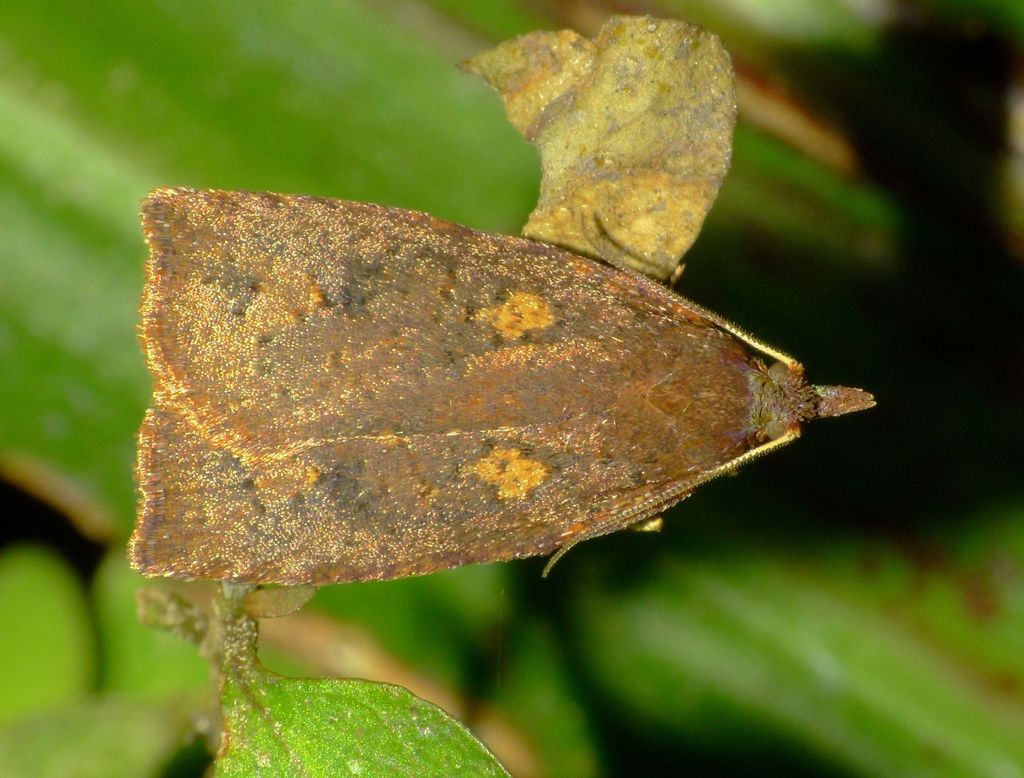
Greenheaded Leafroller
Planotortrix excessana
Planotortrix excessana, the greenheaded leafroller, is a moth of the family Tortricidae. It is native to New Zealand and is an introduced species in Hawaii. It is extremely variable in appearance and feeds on many native and introduced species. It is regarded as a pest of some agricultural and forestry crops.
From the article Planotortrix excessana on Wikipedia (CC BY-SA), quoted section by section
Description
Hudson described the species as follows:
The expansion of the wings varies from 7⁄8 inch to 1+1⁄4 inches. The fore-wings of the male are rather broad, the costa strongly arched and the termen distinctly bowed outward and not oblique; dull reddish - brown to bright reddish - brown generally with very obscure blackish markings; there is a very faintly marked basal patch, an indistinct, irregular central band; an indefinite patch below the apex and an obscure discal spot; the outer portions of the wing are often thickly speckled with blackish grey. The hind-wings are pale grey, sometimes slightly tinged with reddish-brown and faintly dappled with darker grey. The female has the forewings longer and narrower and the general colouring usually brighter than the male. This species is extremely variable in appearance with the males possibly having forewings with a large white or pale yellowish spot, alternatively both the males and females can have forewings being ochreous and marbled with dark brown, or finally again both the males and females may have forewings being a dark purplish brown. The females are even more varied than the male. …
Range & habitat
P. excessana is native to New Zealand. It is distributed throughout the country including on the Chatham Islands and is regarded as being very common. It has also been introduced to Hawaii and is regarded as an invasive species.
Wikipedia: “Distribution”
What it does
P. excessana has several generations per year. The females lay eggs in a flat oval group that contains approximately 50 eggs. The larvae create a silk shelter on the underside of leaves and as they grow construct a structure in which they live by webbing leaves together. When dislodged from their shelter they drop suspended from a silken thread. The larvae pupate in this structure. Adults are attracted to light and have been collected via a mercury vapour light trap.
Wikipedia: “Biology and behaviour”
Listen
Looking for field recordings…
Where it lives
Recorded sightings
—
geo-referenced records in GBIF, from museums, herbaria and field observers.
Drag the globe to turn it. Dots are where records exist, not a range map; darker means more records.
In the stacks
Searching the stacks…
Every page naming Planotortrix excessana in the Biodiversity Heritage Library →
This page is assembled live from iNaturalist, GBIF, Wikipedia, the Source Library and the Internet Archive. It is not yet part of the hand-edited codex. iNaturalist taxon 409268.