- Plants
- ›Vascular Plants
- ›flowering plants
- ›monocots
- ›grasses, sedges, cattails, and allies
- ›grasses
- ›Oatgrasses, Pampasgrasses, and allies
- ›Oatgrasses, Pampasgrasses, and allies
- ›Rytidosperma
Rytidosperma viride
Rytidosperma viride is a flowering plant in the family Poaceae (the grass family). It is endemic to Aotearoa/New Zealand and was described as Notodanthonia viride in 1963.
From the article Rytidosperma viride on Wikipedia (CC BY-SA), quoted section by section
Description
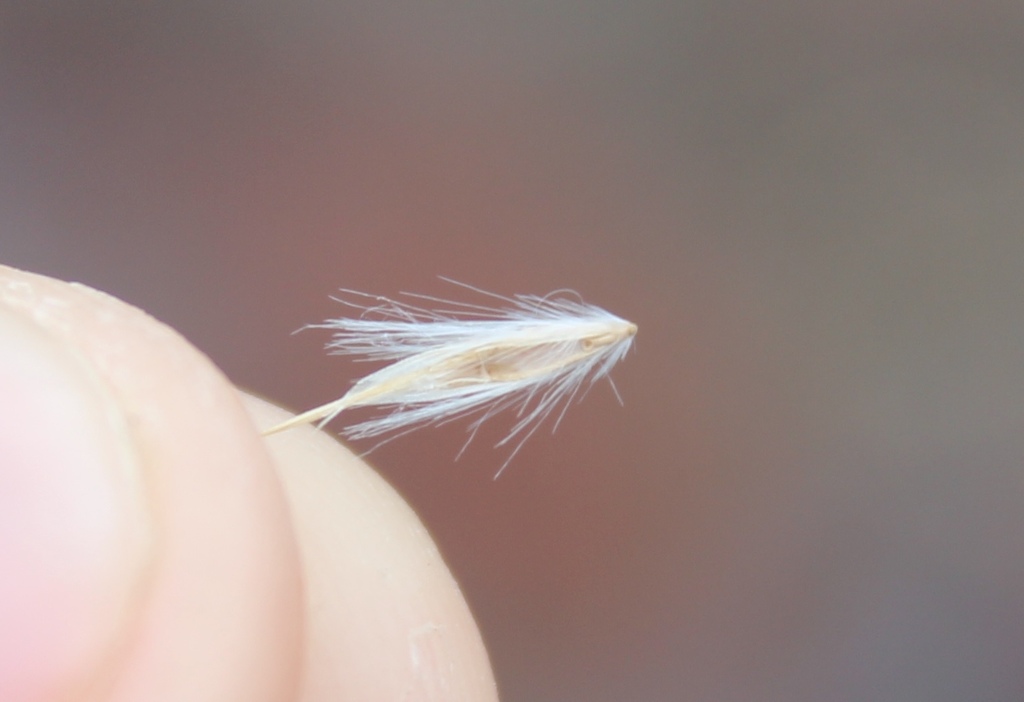
Rytidosperma viride is a grass with tussocks made of short, stiff dark green leaves on branches that are intravaginal (with shoots emerging from within the sheath of the previous node). Like most Rytidosperma, there is a tuft of hairs above the ligule. The leaf-blades are up to 35cm and culms up to 45cm. Spikelets have 3-4 florets, with awned glumes. Florets contain three rows of long hairs, one on the callus (the breaking point with the spikelet), and two on the glumes. The callus hairs are long, reaching the lower lemma hairs, the upper lemma hairs exceed the tip of the palea, and the upper and lower lemma hairs are equally long.
Identification. As a Rytidosperma, the easiest way to identify R. buchananii is to select a single floret (which will contain a single awn, two lateral lobes, and usually three rows of hairs - one on the callus and two on the lemma). The arrangement of the hairs, as well as the relative lengths of the awn, lateral lobes, sometimes the callus can help identify to species, using a key such as that found in the New Zealand Flora.
Similar species. It is most similar to R. gracile, R. nigricans, and R. geniculatum. From the first two, it can be distinguished by its intravaginal branching and long callus hairs that greatly overlap the lower row of lemma hairs. From the R. …
Range & habitat
Rytidosperma viride is endemic to Aotearoa/New Zealand. In the North Island, it is found in the Volcanic Plateau, Taranaki Maunga, Raukumara, and the Coromandel Ranges, with one specimen on Te Mata Peak. In the South Island, it is found scattered in the Kahurangi National Park. The type specimen was collected by Victor Zotov, a Russian-New Zealand botanist specialising in grasses (who also described the species). It was collected in Onetapu Desert (usually called Rangipo Desert), Volcanic Plateau, on the 5th April 1931.
Wikipedia: “Distribution”
What it does
The rust fungus Uromyces danthoniae, a species found that grows parasitically on the leaves of several Rytidosperma species in New Zealand and Australia, infects Rytidosperma viride. It forms dense clusters of orange-brown aecidia on both surfaces of the leaf.
Wikipedia: “Ecology”
In human culture
Rytidosperma - wrinkled seed, from Greek rhytis (wrinkle) and sperma (seed). viride - green, lively, borrowed from Latin viridis.
Wikipedia: “Etymology”
Where it lives
Recorded sightings
—
geo-referenced records in GBIF, from museums, herbaria and field observers.
Drag the globe to turn it. Dots are where records exist, not a range map; darker means more records.
In the stacks
Searching the stacks…
Every page naming Rytidosperma viride in the Biodiversity Heritage Library →
This page is assembled live from iNaturalist, GBIF, Wikipedia, the Source Library and the Internet Archive. It is not yet part of the hand-edited codex. iNaturalist taxon 405791.