- Plants
- ›Vascular Plants
- ›flowering plants
- ›Dicots
- ›pepper plants, birthworts, and allies
- ›pepper plant family
- ›Piper
- ›Macropiper
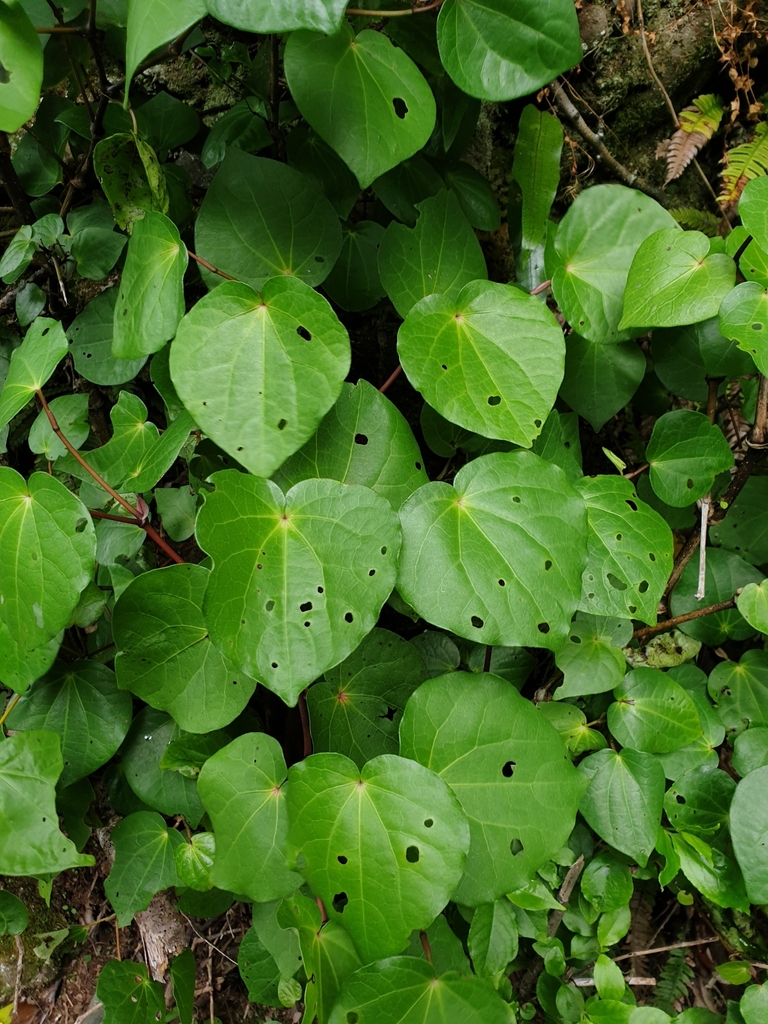
Kawakawa
Piper excelsum
Piper excelsum (formerly known as Macropiper excelsum) of the pepper family (Piperaceae) and commonly known as kawakawa, is a small tree of which the subspecies P. excelsum subsp. excelsum is endemic to New Zealand; the subspecies P. e. subsp. psittacorum is found on Lord Howe Island, Norfolk Island and the Kermadec Islands.
From the article Piper excelsum on Wikipedia (CC BY-SA), quoted section by section
Description
Kawakawa is found throughout the North Island, and as far south as Ōkārito (43.20 °S) on the West Coast, and Banks Peninsula (43.5 °S) on the east coast of the South Island. The tree grows to 6 metres (20 feet). The leaves are often covered with holes caused by the caterpillar of the kawakawa looper moth (Cleora scriptaria). The images depict the variety majus which has larger and more glossy leaves than P. excelsum.
Leaves. Kawakawa leaves are about 5–10 cm long by 6–12 cm wide; they are opposite to each other, broadly rounded with a short drawn-out tip and are heart-shaped at their bases. The leaves are deep green in colour if growing in the forest, but may be yellowish-green in more open situations.
Flowers. The flowers are produced on greenish, erect spikes 2.5–7.5cm long. They can be uni- or bisexual. Kawakawa flowers are quite minute and very closely placed around the spike. After pollination the flowers gradually swell and become fleshy to form small, berry-like fruits that are yellow to bright orange.
Berries. Each berry cluster is the size of a small finger. Ripening period is January and February. These fruits are favoured by kererū or New Zealand pigeon (Hemiphaga novaeseelandiae) and tūī (Prosthemadera novaeseelandiae). They contain very sticky juices.
At the table
Kawakawa was used as a traditional medicinal plant of the Māori. An infusion made from the leaves or roots was used or its leaves were chewed to relieve toothache, and wounds were often bound in kawakawa leaves. The sweet edible yellow berries (most often found in summer on female trees) of the plant were eaten as a diuretic. Traditionally, leaves with holes that had been eaten by caterpillars were considered the best to use. In cultural contexts, host people of a marae wave leaves of kawakawa to welcome guests. Kawakawa are associated with death, and at a tangi, both hosts and guests may wear wreaths of kawakawa on the head as a sign of mourning. Early European settlers to New Zealand used kawakawa in teas, and experimented using it as a flavouring agent in beer. It is commonly grown as an ornamental plant in gardens. Kawakawa essential oil contains myristicin, a deliriant when consumed in high concentrations.
Wikipedia: “Uses”
Where it lives
Recorded sightings
—
geo-referenced records in GBIF, from museums, herbaria and field observers.
Drag the globe to turn it. Dots are where records exist, not a range map; darker means more records.
In the stacks
Searching the stacks…
Every page naming Piper excelsum in the Biodiversity Heritage Library →
This page is assembled live from iNaturalist, GBIF, Wikipedia, the Source Library and the Internet Archive. It is not yet part of the hand-edited codex. iNaturalist taxon 404899.