- Plants
- ›Vascular Plants
- ›flowering plants
- ›Dicots
- ›Sunflowers, Bellflowers, Fanflowers, and Allies
- ›Sunflowers, Daisies, Asters, and Allies
- ›Asteroideae
- ›marigolds and allies
- ›Osteospermum
- ›Homocarpae
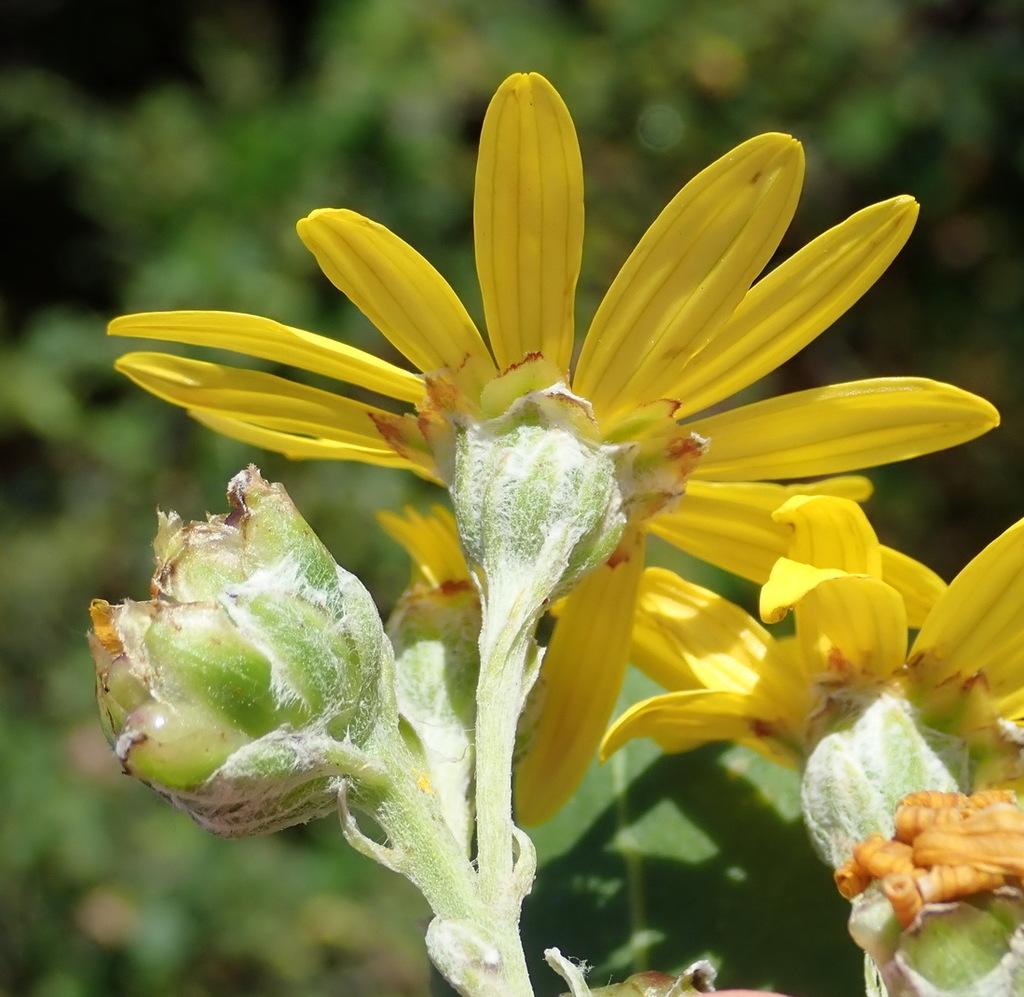
Bietou
Osteospermum moniliferum
Osteospermum moniliferum (synonym Chrysanthemoides monilifera) is an evergreen flowering shrub or small tree in the daisy family, Asteraceae. It is native to southern Africa, ranging through South Africa and Lesotho to Mozambique and Zimbabwe.
Most subspecies have woolly, dull, serrate, oval leaves, but the subspecies rotundatum has glossy round leaves. Subspecies are known as boneseed and bitou bush in Australasia, or bietou, tick berry, bosluisbessie, or weskusbietou in South Africa. The plant has become a major environmental weed and invasive species in Australia and New Zealand.
From the article Osteospermum moniliferum on Wikipedia (CC BY-SA), quoted section by section
Description
Boneseed is a perennial, woody, upright shrub, growing to 3 m (9.8 ft), although occasionally taller. It is a member of the Asteraceae (daisy) family and has showy, bright yellow flowers in swirls of 5–8 'petals' (ray florets) up to 30 mm (1.2 in) in diameter. Fruit are berry-like, spherical at around 8 mm in diameter, and turn dark-brown to black with a bone-coloured seed inside of 6–7 mm diameter. Leaves are 2–6 cm (0.79–2.36 in) long by 1.5–5 cm (0.59–1.97 in) wide, oval tapering to the base with irregularly serrate margins. Bitou bush can be distinguished from boneseed in part due to its more rounded sprawling habit to 1.5–2 m (4.9–6.6 ft), less noticeably toothy leaf margins and seeds that are egg-like rather than spherical. Both boneseed and bitou bush hybridise readily, however, so examples of plants demonstrating a fusion of traits is possible. O. moniliferum has been shown to need pollinators in order to reproduce.
Range & habitat
Osteospermum moniliferum occurs naturally in coastal areas of South Africa, reaching into Lesotho, Zimbabwe, and southern Mozambique. Subspecies rotundatum is concentrated along the eastern coast of South Africa from its southern tip through KwaZulu-Natal to southern Mozambique. Subspecies moniliferum is concentrated around Cape Town and the Cape Peninsula on South Africa's south western coast, where its native habitats include the Cape Flats Dune Strandveld. Subspecies canescens is native to Kwazulu-Natal, the Northern Provinces, and Free State of South Africa and to Lesotho. Subspecies septentrionale is native to Mozambique, Zimbabwe, and the Northern Provinces.
Wikipedia: “Distribution and habitat”
Where it lives
Recorded sightings
—
geo-referenced records in GBIF, from museums, herbaria and field observers.
Drag the globe to turn it. Dots are where records exist, not a range map; darker means more records.
In the stacks
Searching the stacks…
Every page naming Osteospermum moniliferum in the Biodiversity Heritage Library →
This page is assembled live from iNaturalist, GBIF, Wikipedia, the Source Library and the Internet Archive. It is not yet part of the hand-edited codex. iNaturalist taxon 404420.