- Plants
- ›Vascular Plants
- ›flowering plants
- ›monocots
- ›grasses, sedges, cattails, and allies
- ›Sedges
- ›Cyperoideae
- ›Schoeneae
- ›Oreobolus
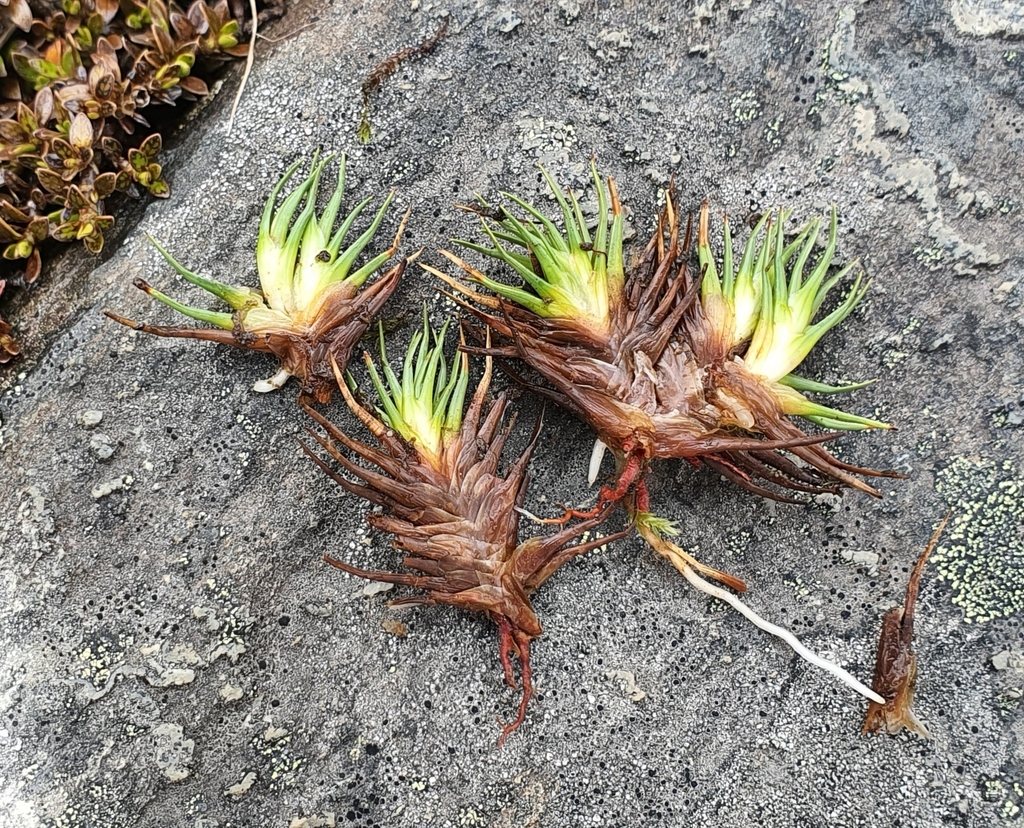
Combsedge
Oreobolus pectinatus
Oreobolus pectinatus, commonly known as Comb sedge, cushion sedge, or flat-leaved comb sedge, is a species of flowering plant in the sedge family that is native to the subantarctic islands, and to the North and South Islands of New Zealand. The specific epithet derives from the Latin, pectin and pectinis, ('comb-shaped or like a comb'), and refers to the leaves.
From the article Oreobolus pectinatus on Wikipedia (CC BY-SA), quoted section by section
Description
Oreobolus pectinatus is a perennial sedge which forms dense cushions growing from 10 to 100 mm high. The stems are densely packed, much branched at base, leafy. Median nerve and two lateral nerves of the leaves are visible at widest part of lamina, while on the adaxial only the median nerve is prominent. Both surfaces of the lamina have abundant stomata. The sheath is not lobed at the apex and has 5 to 7 nerves. The spikelets are usually solitary and the mature peduncle is usually longer than the leaves. There are usually 3 glumes (sometimes 4), with the occasional fourth glume being smaller. The fruit, a nut, is initially colourless, but matures to a red-brown, almost black color. It is greater than 1 mm long and less than 1 mm diameter. It flowers from October to December, and fruits from November to April.
Range & habitat
The plant is found on New Zealand's Antipodean Islands, and the North and South Islands of New Zealand.
Wikipedia: “Distribution”
Where it lives
Recorded sightings
—
geo-referenced records in GBIF, from museums, herbaria and field observers.
Drag the globe to turn it. Dots are where records exist, not a range map; darker means more records.
In the stacks
Searching the stacks…
Every page naming Oreobolus pectinatus in the Biodiversity Heritage Library →
This page is assembled live from iNaturalist, GBIF, Wikipedia, the Source Library and the Internet Archive. It is not yet part of the hand-edited codex. iNaturalist taxon 404329.