- Plants
- ›Vascular Plants
- ›flowering plants
- ›Dicots
- ›borages
- ›borage family
- ›Cynoglossoideae
- ›Myosotideae
- ›Myosotis
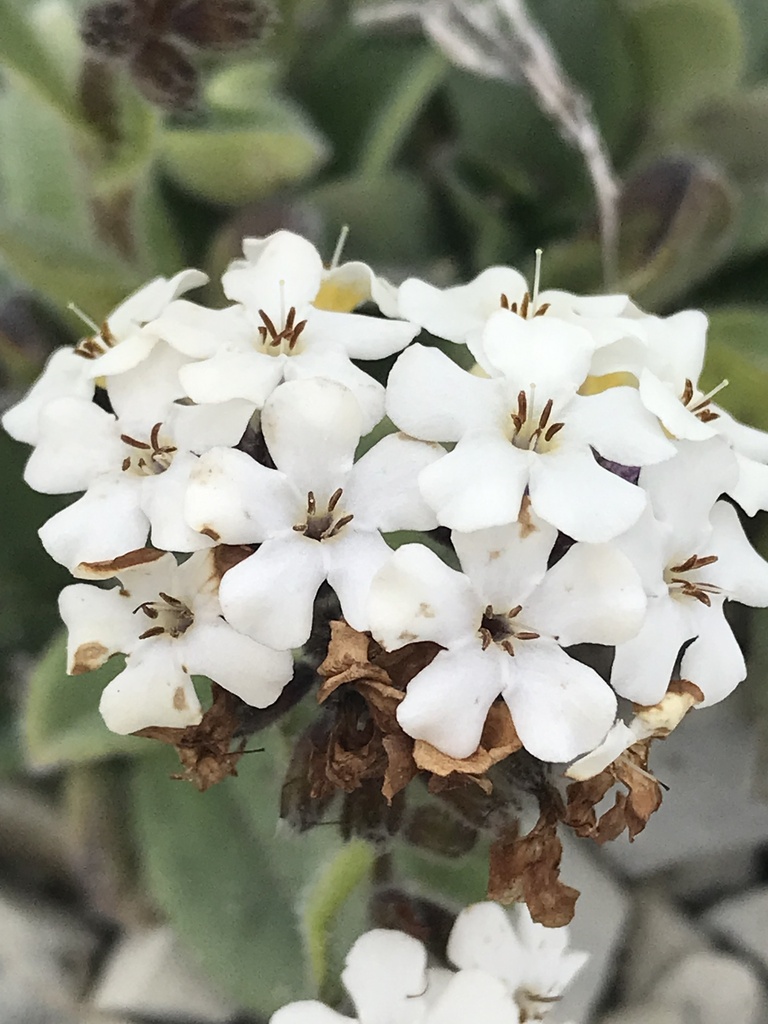
Myosotis traversii
Myosotis traversii is a species of flowering plant in the family Boraginaceae, endemic to the South Island of New Zealand. Joseph Dalton Hooker described this species in 1864. Plants of this species of forget-me-not are perennial rosettes which form tufts or clumps, with ebracteate, erect inflorescences, and white or yellow corollas with partly exserted stamens.
From the article Myosotis traversii on Wikipedia (CC BY-SA), quoted section by section
Description
Myosotis traversii plants are single rosettes often grow together that often cluster together to form clumps or tufts. The rosette leaves have petioles 4–29 mm long. The rosette leaf blades are 5–33 mm long by 3–12 mm wide (length: width ratio 1.5–4.5: 1), usually oblanceolate, narrowly obovate, or obovate, widest at or above the middle, with an obtuse apex. The upper surface and the edges of the leaf are densely covered in mostly flexuous and patent, antrorse (forward-facing) hairs that are oriented mostly oblique to the mid vein. The lower surface of the leaf has similar hairs except they are completely retrorse (backward-facing) or they are mostly retrorse with some antrorse hairs near the apex only. Each rosette has 2–14 erect, usually once-branched ebracteate inflorescences that are up to 230 mm long and are usually bifurcating in an open or condensed forked 'V' shape near the tips. The cauline leaves are up to 18 per inflorescence and are similar to the rosette leaves but smaller with shorter petioles, and decrease in size and become sessile toward the tip. Each inflorescence has up to 75 flowers, each borne on a pedicel up to 2 mm long at fruiting, and each without a bract. …
Range & habitat
Myosotis traversii is a forget-me-not endemic to the South Island, in Marlborough, Western Nelson, Canterbury, Westland and Otago from 690 to 2280 m ASL, on rocks, boulders, shingle, scree, slips and saddles, often on bare, exposed, dry, sunny sites with few other plants.
Wikipedia: “Distribution and habitat”
In human culture
Myosotis traversii Hook.f. is in the plant family Boraginaceae. The species was described by Joseph Dalton Hooker in 1864 in his Handbook of the New Zealand Flora. The lectotype was designated by Lucy Moore, was collected by Leonard Cockayne in the Shingly Range, South Island, and is lodged at the herbarium of the Museum of New Zealand Te Papa Tongarewa (WELT SP002603). There is also an isolectotype at the Allan Herbarium of Manaaki Whenua - Landcare Research (CHR 328277). The specific epithet, traversii, honors William Thomas Locke Travers (1819–1903), who was a lawyer, explorer and naturalist who immigrated to New Zealand and collected plants there. Myosotis traversii is most similar morphologically to M. brockiei, M. capitata, M. rakiura and M. laeta and M. saxatilis. Its hooked trichomes on the calyx and shorter rosette leaves distinguish it from M. brockiei, M. rakiura and M. capitata. Other characters can distinguish it from M. capitata (retrorse hairs on the calyx); from M. brockiei, M. rakiura and M. laeta (partly exserted anthers); and from M. brockiei and M. laeta (short filaments). A mixture of antrorse and retrorse (forward- and backward-facing) hairs on the lower surface of the rosette leaves distinguishes it from M. saxatilis and M. laeta. There are two subspecies recognized in Myosotis traversii: M. traversii subsp. traversii and M. traversii subsp. cantabrica. …
Wikipedia: “Taxonomy and etymology”
Where it lives
Recorded sightings
—
geo-referenced records in GBIF, from museums, herbaria and field observers.
Drag the globe to turn it. Dots are where records exist, not a range map; darker means more records.
In the stacks
Searching the stacks…
Every page naming Myosotis traversii in the Biodiversity Heritage Library →
This page is assembled live from iNaturalist, GBIF, Wikipedia, the Source Library and the Internet Archive. It is not yet part of the hand-edited codex. iNaturalist taxon 404060.