- Plants
- ›Vascular Plants
- ›flowering plants
- ›Dicots
- ›borages
- ›borage family
- ›Cynoglossoideae
- ›Myosotideae
- ›Myosotis
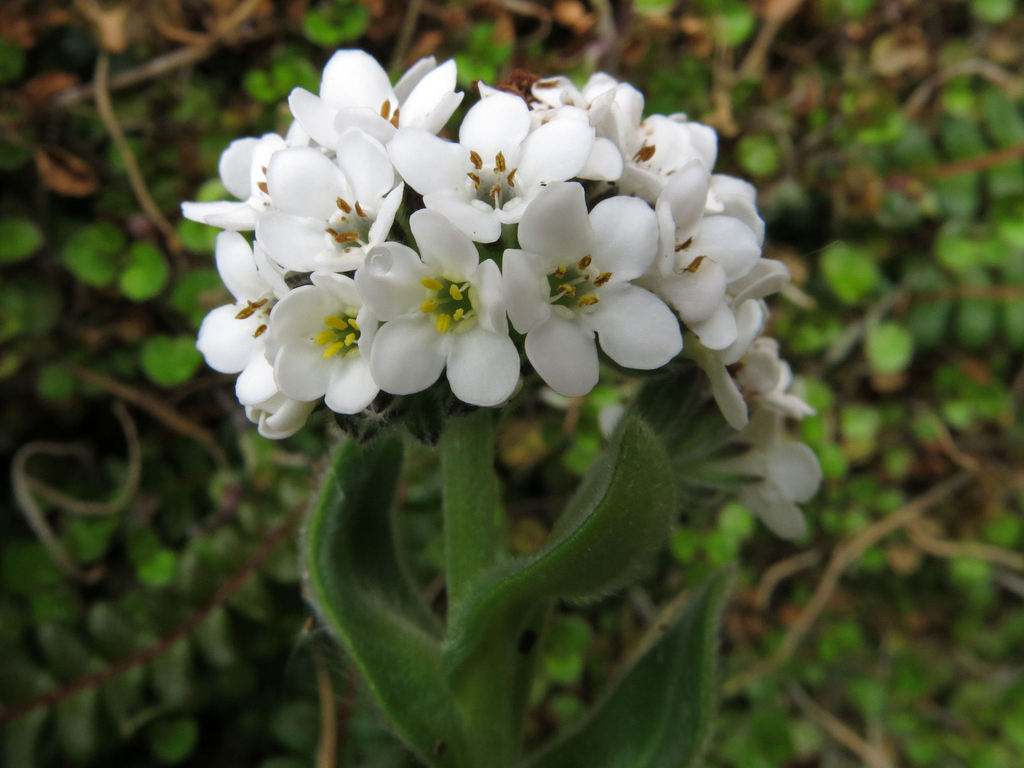
Myosotis rakiura
Myosotis rakiura is a species of flowering plant in the family Boraginaceae, endemic to southern South Island and Stewart Island / Rakiura of New Zealand. Joseph Beattie Armstrong described the species in 1881. Plants of this species of forget-me-not are perennial rosettes which form loose tufts or clumps, with ebracteate, erect inflorescences, and white corollas with exserted stamens.
From the article Myosotis rakiura on Wikipedia (CC BY-SA), quoted section by section
Description
Myosotis rakiura plants are single rosettes that often grow together to form loose tufts or clumps. The rosette leaves have petioles 5–40 mm long. The rosette leaf blades are 19–62 mm long by 7–21 mm wide (length: width ratio 2.0–5.3: 1), oblanceolate or sometimes narrowly ovate, widest at or above the middle (rarely below the middle), with an obtuse apex. The upper surface is densely covered in mostly flexuous, patent to erect, antrorse (forward-facing) hairs that are oriented oblique to the mid vein. The hairs on the edges of the leaf are similar but mostly erect, and the hairs on the underside of the leaf are also similar but mostly retrorse (backward-facing) and appressed to patent. Each rosette has 1–10 erect, once- or twice-branched, ebracteate inflorescences that are up to 300 mm long and are bifurcating in a forked 'V' shape near the tips. The cauline leaves are similar to the rosette leaves but smaller with shorter petioles, and decrease in size toward the tip. Each inflorescence has up to 210 flowers, each borne on a pedicel up to 4 mm long at fruiting, and each without a bract. The calyx is 3–5 mm long at flowering and 3–7 mm long at fruiting, lobed to half to three-quarters of its length, and densely covered in mostly antrorse (some retrorse near the base), patent to erect, mostly flexuous hairs. …
Range & habitat
Myosotis rakiura is a forget-me-not endemic to coastal southern New Zealand, specifically Otago and Southland (South Island), Stewart Island/Rakiura, and Solander Island/Hautere from 0–130 m ASL. It is found on coastal cliffs and rocks, in shrubland, turf or grassland.
Wikipedia: “Distribution and habitat”
In human culture
Myosotis rakiura is in the plant family Boraginaceae and was described as M. capitata var. albiflora in 1881 by Joseph Beattie Armstrong . Lucy Moore gave it a new name, M. rakiura, when she recognized it at the species level, because M. albiflora Banks & Sol. ex Hook.f. was already validly published for a southern South American species. Myosotis rakiura is morphologically similar to other ebracteate-erect species, especially the New Zealand subantarctic island endemic species, M. capitata. Myosotis rakiura can be distinguished from M. capitata by the following characters: white corollas, the presence of retrorse trichomes on many plant parts (e.g. the underside of the rosette leaves), and fully exserted anthers. The lectotype specimen of Myosotis rakiura was collected from Stewart Island/Rakiura by James West Stack and is lodged at Manaaki Whenua - Landcare Research Allan Herbarium (CHR 635645), where there is also an isolectotype (CHR 635646). The specific epithet, rakiura, is derived from the Ngāi Tahu name in te reo Māori for Stewart Island (Rakiura), which can be translated as ‘glowing sky’.
Wikipedia: “Taxonomy and etymology”
Where it lives
Recorded sightings
—
geo-referenced records in GBIF, from museums, herbaria and field observers.
Drag the globe to turn it. Dots are where records exist, not a range map; darker means more records.
In the stacks
Searching the stacks…
Every page naming Myosotis rakiura in the Biodiversity Heritage Library →
This page is assembled live from iNaturalist, GBIF, Wikipedia, the Source Library and the Internet Archive. It is not yet part of the hand-edited codex. iNaturalist taxon 404030.