- Plants
- ›Vascular Plants
- ›flowering plants
- ›Dicots
- ›borages
- ›borage family
- ›Cynoglossoideae
- ›Myosotideae
- ›Myosotis
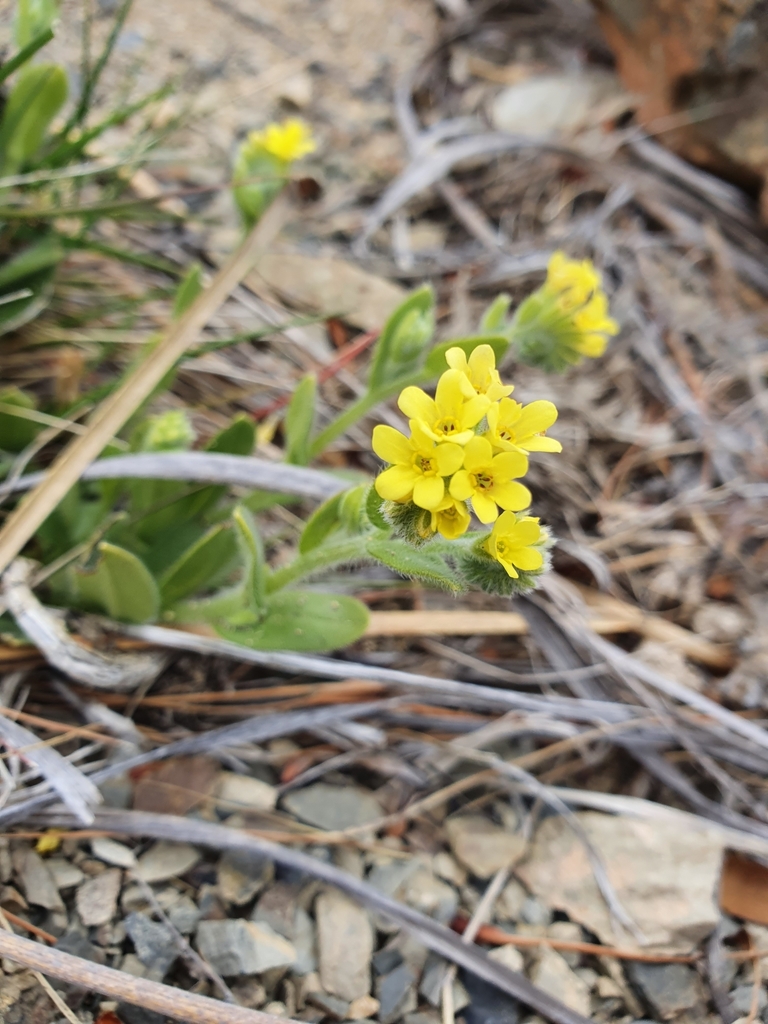
Myosotis australis
Myosotis australis is a species of flowering plant in the family Boraginaceae, native to New Zealand, Australia and New Guinea. Robert Brown described this species in 1810. Plants of this species of forget-me-not are perennial rosettes with ebracteate inflorescences and white or yellow corollas with stamens that are fully included in the corolla tube or sometimes partly protruded.
From the article Myosotis australis on Wikipedia (CC BY-SA), quoted section by section
Description
Myosotis australis plants are rosettes that are sometimes stoloniferous. The rosette leaves have petioles that are 1–68 mm long. The rosette leaf blades are 2–73 mm long by 2–29 mm wide (length: width ratio 1.1–7.7: 1), usually narrowly oblanceolate, oblanceolate, narrowly obovate, obovate, or very broadly obovate, usually widest at or above the middle, an acute or obtuse apex. Both surfaces of the leaf are uniformly and densely covered in flexuous, patent to erect hairs oriented parallel or oblique to the midrib. On the upper surface of the leaf, these hairs are antrorse (forward-facing) whereas on the lower surface, they are a mixture of antrorse and retrorse (backward-facing). Each rosette has 1–17 ascending to erect, sometimes lax or decumbent (rarely prostrate or dwarfed), branched or unbranched, partially bracteate inflorescences that are not bifurcating at the top and are up to 630 mm long. The cauline leaves are similar to the rosette leaves, but become smaller. The flowers are 3–96 per inflorescence (rarely as many as 230), and each is borne on a short pedicel, with or without a bract. …
Range & habitat
Myosotis australis is native to New Zealand, Australia and New Guinea. It can be found from 0–2100 m ASL in New Zealand and Australia, and 1775–4350 m ASL in New Guinea. It is found on rocks, bluffs, outcrops, ledges, scree, or banks. In Australia, it is found in Western Australia, South Australia, New South Wales, Australian Capital Territory, Victoria and Tasmania. In New Zealand it is distributed throughout the South island in Western Nelson, Marlborough, Canterbury, Westland, Otago, and possibly Fiordland, whereas on the North Island it is known only from the Volcanic Plateau and Southern North Island. In New Guinea it is found in both Western New Guinea (in Mimina and Puncak Jaya) as well as Papua New Guinea, in the following districts: Highlands (Chiumbu, Eastern Highlands, Enga, Hela, Southern Highlands, Western Highlands & Jiwaka), Momase (Morobe, West Sepik), and Southern (Central, Milne Bay).
Wikipedia: “Distribution and habitat”
In human culture
Myosotis australis R.Br. is in the plant family Boraginaceae. The species was originally described by Robert Brown in his Prodromus florae Novae-Hollandiae et Insulae Van Diemen 1810. The lectotype was collected by Robert Brown on the "banks of Paterson River" (New South Wales, Australia), is lodged at the herbarium of the Natural History Museum (BM 000939408), and was designated by Carlos Lehnebach. Myosotis australis is morphologically most similar to other ebracteate-erect species from New Zealand, especially Myosotis saxatilis. Several morphological characters can be used to distinguish M. australis from M. saxatilis. The partially bracteate, distally non-bifurcating inflorescence in M. australis can help distinguish it from the obviously bifurcating, ebracteate inflorescence of M. saxatilis. In addition, M. australis has long internodes (>10 mm) between fruits at fruiting, whereas M. saxatilis has short internodes (<12 mm). The species epithet australis is a Latin word that means south or southern, referring to its presence in Australia. According to the latest taxonomic treatment, the following names are all synonyms of M. australis: Myosotis mooreana Lehnebach, M. lytteltonensis (Laing & A.Wall) de Lange (and M. australis var. lytteltonensis Laing & A.Wall;), and M. australis var. …
Wikipedia: “Taxonomy and etymology”
Where it lives
Recorded sightings
—
geo-referenced records in GBIF, from museums, herbaria and field observers.
Drag the globe to turn it. Dots are where records exist, not a range map; darker means more records.
In the stacks
Searching the stacks…
Every page naming Myosotis australis in the Biodiversity Heritage Library →
This page is assembled live from iNaturalist, GBIF, Wikipedia, the Source Library and the Internet Archive. It is not yet part of the hand-edited codex. iNaturalist taxon 404027.