- Plants
- ›Vascular Plants
- ›flowering plants
- ›Dicots
- ›myrtles, evening primroses, and allies
- ›myrtle family
- ›Myrtoideae
- ›Metrosidereae
- ›Metrosideros
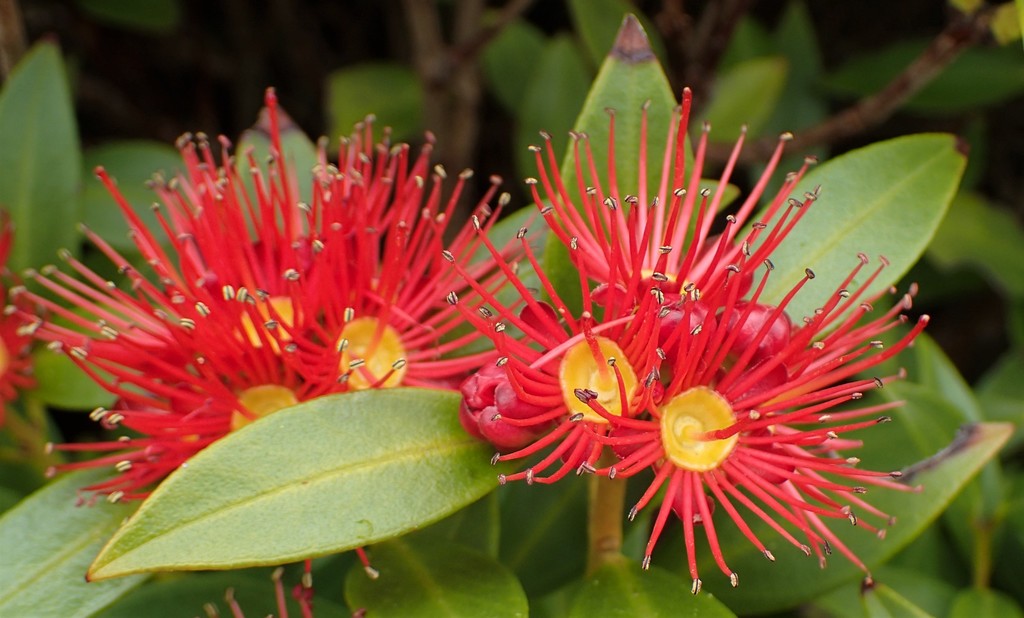
Southern rātā
Metrosideros umbellata
Metrosideros umbellata, commonly known as southern rātā, is an evergreen tree in the family Myrtaceae. It is endemic to New Zealand, where its range mainly covers the South and Stewart Islands, while being largely not present in the North Island. M. umbellata individuals are also found in the subantarctic Auckland Islands. M. umbellata's habitat is unrestricted and can occur in many different natural environments, altitudinal ranges and surfaces.
Metrosideros umbellata was first described by the Spanish botanist Antonio José Cavanilles in 1797. M. umbellata grows to a height of up to 15 metres (50 feet) with a trunk measuring up to 1 m (3 ft 3 in) in diameter. It has an estimated lifespan of 400–500 years. M. umbellata produces masses of typically scarlet-coloured flowers, typically in summer, from November to February. Its bark is thin, and its outer layers peel off as papery flakes. The nectar-producing flowers of M. umbellata are visited by numerous New Zealand birds, such as, bellbirds, kākā, kea, and tūī. M. umbellata's conservation status was assessed by the New Zealand Threat Classification System in 2023 as "Not Threatened".
From the article Metrosideros umbellata on Wikipedia (CC BY-SA), quoted section by section
Description
Metrosideros umbellata (southern rātā) is an evergreen tree endemic to New Zealand in the family Myrtaceae, reaching a height of up to 15 metres (50 feet) with a trunk measuring up to 1 m (3 ft 3 in) in diameter. M. umbellata is estimated to have a maximum 400–500 year lifespan. M. umbellata's bark is 2–3 mm thick, and the outer layers of the bark peel off as papery flakes. The inflorescences (flower clusters) are found on stems, each supporting 1–3 pairs of 1–3 flowered cymules (very small flowers). Its peduncles are up to 10 cm (3.9 in) long. Its receptacles (specialised vegetative tissues) are obconic (inverted cone shape), and gradually become smooth. Its sepals are oblong-triangular, ovate, or campanulate (bell-shaped) in shape and are approximately 3 mm long; its corollas (petals) are red in colour, thick, concave (curved inwards), oval in shape, thin, and are approximately 5 mm long. Metrosideros umbellata's leaves are 2.5–6 cm (1–2 in) long by 1–2 cm (0.4–0.8 in) wide, gradually narrowing to a sharp tip and a short stalk. They are subsessile in character and are lanceolate-shaped and acuminate (tapering to a point) on both sides. The leaves are dark green in colour and are coriaceous (leather-like) and glabrous (smooth) in character, with numerous dotted small oil glands. Beneath the outer layer of the epidermis in the leaves, M. …
Range & habitat
Metrosideros umbellata is endemic to New Zealand. Its range mostly covers the South Island and Stewart Island, but is also locally present in the North Island and the subantarctic Auckland Islands. The northernmost naturally occurring population of M. umbellata is in Te Paki, in the Northland Region, and the species' southernmost naturally occurring population is in the subantarctic Auckland Islands; a group of extinct volcanoes that were once part of the now almost entirely submerged continent of Zealandia. Metrosideros umbellata forms a "coastal barrier" on Stewart Island and some of its offshore islands, as well as the coast of the Southland Region. M. umbellata's population extends inland from Southland to the Hokonui Hills, but is rare or naturally not present from the ranges north of the Hokonui Hills. M. umbellata is to a higher-degree, more common west of the Southern Alps and is common in the West Coast Region, populations occur in essentially every fiord and reach an almost subalpine altitude at the Franz Josef and Fox Glaciers. East of the Southern Alps, M. umbellata populations are infrequent and widely scattered. M. umbellata individuals also form small populations on the beaches of some lakes such as Coleridge, Sumner and Wakatipu, as well as at Aoraki / Mount Cook National Park. It is also found in the Marlborough Sounds and the mouth of the Taieri River. …
Wikipedia: “Distribution”
What it does
The seeds of M. umbellata are tiny, and weigh less than 0.1 mg, hence why they are well-adapted to be dispersed by the wind. M. umbellata's seedlings have been discovered up to 270 m (890 ft) away from the closest trees that are capable of producing seeds, although it is highly likely that they can travel greater distances. The nectar-producing flowers of M. umbellata appear to be pollinated by and visited by numerous New Zealand native birds, these include the tūī (Prosthemadera novaeseelandiae), and bellbirds (Anthornis melanura). In the south-eastern corner of New Zealand, in an area known as The Catlins; M. umbellata is so frequently visited by kākā (Nestor meridionalis) in the area, a locality is now known as Kaka Point, which was a favoured location for kākā birds to visit M. umbellata individuals. In the Southern Alps, the kea (Nestor notabilis), a mountain parrot, is frequently observed to be perching on the flowers of M. umbellata. The flowers are also visited by honeybees (Apis mellifera). M. umbellata individuals are frequently browsed by introduced deer, pigs, cattle, goats, and also to a lesser extent, by wallabies. Metrosideros umbellata plays host to the endemic New Zealand longhorn beetles Blosyropus spinosus, Didymocantha, and Prionoplus reticularis. Several moths use M. …
Wikipedia: “Ecology”
In human culture
Metrosideros umbellata was first described by the Spanish botanist Antonio José Cavanilles in his publication titled "Icones et Descriptiones Plantarum", which was published by him in 1797. Agalmanthus umbellata, is the basionym (original scientific name) of the species, and was first described by the French explorer and author Jules Dumont d'Urville in 1845. M. umbellata has three accepted synonyms, which includes: Melaleuca lucida, Metrosideros lucida, and Nania lucida.
Wikipedia: “History”
Where it lives
Recorded sightings
—
geo-referenced records in GBIF, from museums, herbaria and field observers.
Drag the globe to turn it. Dots are where records exist, not a range map; darker means more records.
In the stacks
Searching the stacks…
Every page naming Metrosideros umbellata in the Biodiversity Heritage Library →
This page is assembled live from iNaturalist, GBIF, Wikipedia, the Source Library and the Internet Archive. It is not yet part of the hand-edited codex. iNaturalist taxon 403879.