- Plants
- ›Vascular Plants
- ›flowering plants
- ›Dicots
- ›myrtles, evening primroses, and allies
- ›myrtle family
- ›Myrtoideae
- ›Leptospermeae
- ›Kunzea
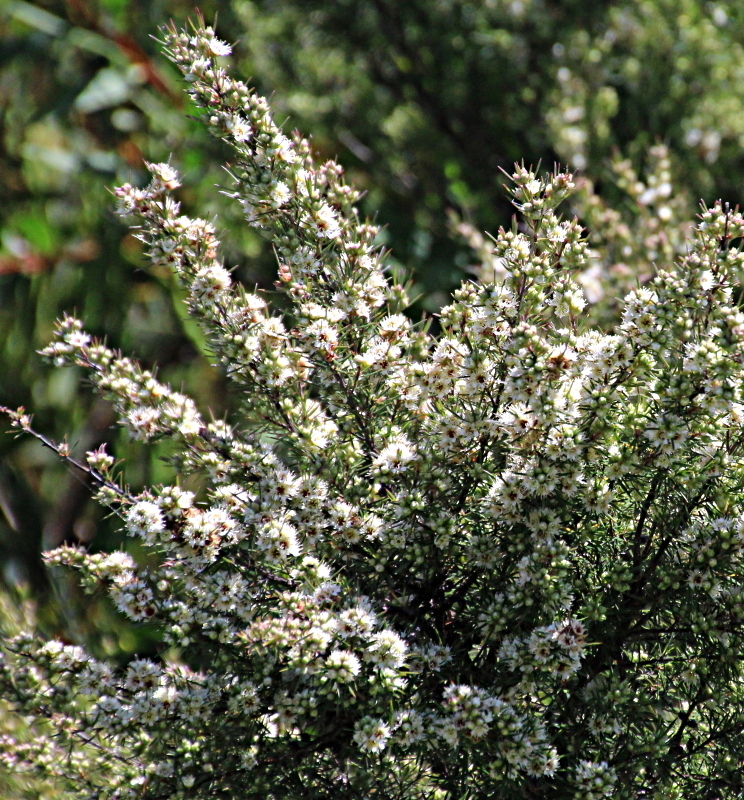
Kunzea linearis
Kunzea linearis, also known by the Māori name rawiri manuka, is a flowering plant in the myrtle family, Myrtaceae and is endemic to New Zealand. It is a densely-foliaged shrub or small tree, characterised by very narrow leaves and clusters of small white flowers with five petals and a large number of stamens, which are longer than the petals. It grows in the north of the North Island and is the most distinctive of the New Zealand kunzeas.
From the article Kunzea linearis on Wikipedia (CC BY-SA), quoted section by section
Description
Kunzea linearis is a densely-branched shrub or tree which usually grows to a height of up to 12 m (40 ft). It is densely branched, usually forming a rounded canopy up to 2 m (7 ft) in diameter. The leaves are densely crowded along the branches, especially near the ends and are hairy, about 9–20 mm (0.4–0.8 in) long, 0.5–1 mm (0.02–0.04 in) wide and lack a petiole. The flowers are arranged in more or less cylindrical groups of between three and forty, and the individual flowers are 2–6 mm (0.08–0.2 in) in diameter. The floral cup is 2–4 mm (0.08–0.2 in) long, 2.5–4 mm (0.1–0.2 in) in diameter, cup-shaped or barrel-shaped and usually has a covering of silvery white hairs. There are five sepal lobes 1–2 mm (0.04–0.08 in) long on the rim of the floral cup. The five or six petals are white, cream-coloured or pale pink, egg-shaped to almost round, about 2–4 mm (0.08–0.2 in) long and wide and there are between 40 and 50 cream coloured stamens which are longer than the petals. Flowering occurs between October and February and is followed by fruit which are woody, barrel-shaped capsules 1.5–3 mm (0.06–0.1 in) long, 2.5–4 mm (0.1–0.2 in) wide with persistent sepal tips.
Range & habitat
Kunzea linearis mostly grows in coastal to lowland shrubland in impoverished soils and peat bogs. It mostly occurs in the northern part of the North Island from North Cape south to Ahipara and the Karikari Peninsula and sporadically south of there. It is the most distinctive of the New Zealand kunzeas.
Wikipedia: “Distribution and habitat”
Where it lives
Recorded sightings
—
geo-referenced records in GBIF, from museums, herbaria and field observers.
Drag the globe to turn it. Dots are where records exist, not a range map; darker means more records.
In the stacks
Searching the stacks…
Every page naming Kunzea linearis in the Biodiversity Heritage Library →
This page is assembled live from iNaturalist, GBIF, Wikipedia, the Source Library and the Internet Archive. It is not yet part of the hand-edited codex. iNaturalist taxon 402945.