- Plants
- ›Vascular Plants
- ›flowering plants
- ›monocots
- ›grasses, sedges, cattails, and allies
- ›Rushes and Allies
- ›Juncus
- ›Juncus
- ›Ozophyllum
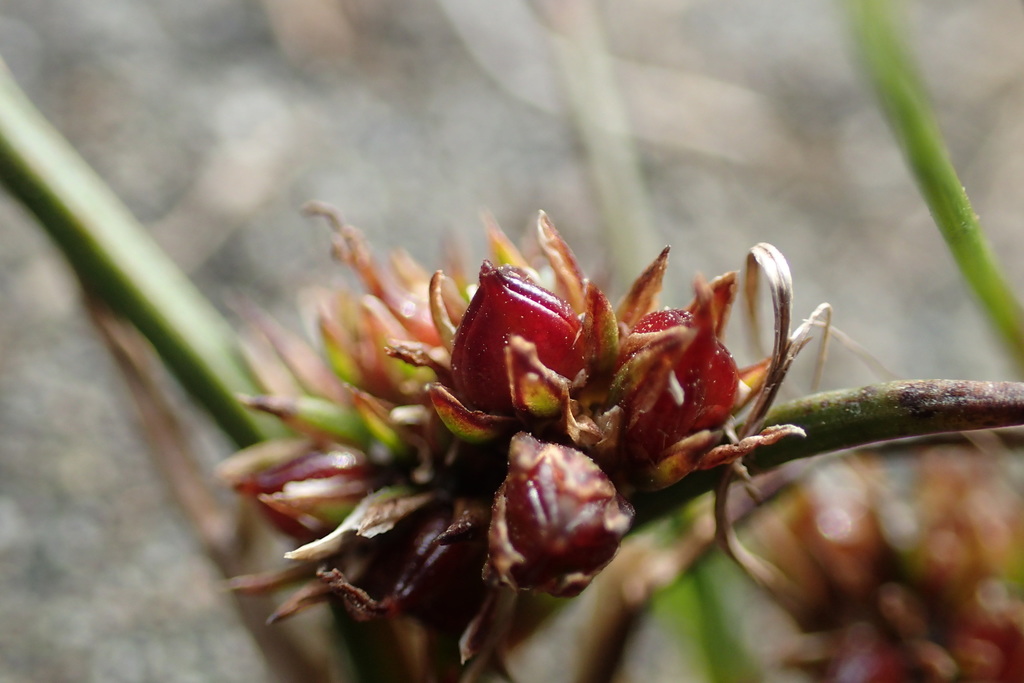
Native rush
Juncus scheuchzerioides
Juncus scheuchzerioides is a species of rush variously called short rush or greater rush. It has an Antarctic circumpolar distribution and is native to many subantarctic islands in, and on the regions bordering, the Southern Ocean.
From the article Juncus scheuchzerioides on Wikipedia (CC BY-SA), quoted section by section
Description
Juncus scheuchzerioides is a densely tufted, erect, perennial rush. It varies in colour from dark green to bright green and reddish-green. It is also variable in size, growing from 20 mm to 300 mm in height. Its stems are 20–200 mm long and 0.2-0.5 mm thick, densely branched from the base, with creeping fibrous roots extending from the basal nodes. The leaves are numerous, basal and cauline. The inflorescence is a compact head of 2-8 flowers, rarely producing a second head; the flowers are 4 mm long. It flowers from December to April, fruiting from February to July.
Range & habitat
The rush is found on the Antipodes, Auckland, and Campbell Islands. It is also native to Macquarie Island, South Georgia and the Falkland, Kerguelen, Crozet and Prince Edward Islands, as well as Chile and Argentina in South America. It usually occupies habitats in or near running water, where it may form large stands, or wet, peaty turf, from sea level to 300 m above sea level.
Wikipedia: “Distribution and habitat”
Where it lives
Recorded sightings
—
geo-referenced records in GBIF, from museums, herbaria and field observers.
Drag the globe to turn it. Dots are where records exist, not a range map; darker means more records.
In the stacks
Searching the stacks…
Every page naming Juncus scheuchzerioides in the Biodiversity Heritage Library →
This page is assembled live from iNaturalist, GBIF, Wikipedia, the Source Library and the Internet Archive. It is not yet part of the hand-edited codex. iNaturalist taxon 402867.